
MalClassifier: Decoding Malware "DNA" Through Network Flow Sequences
MalClassifier: Malware family classification using network flow sequence behaviour
MalClassifier is a privacy-preserving malware family classification system that utilizes network flow sequence mining. By abstracting communication patterns into "n-flows" and applying supervised machine learning (KNN and Random Forest), it achieves a 96% F-measure in identifying specific malware families such as ransomware and botnets.
TL;DR
MalClassifier is a high-performance, privacy-centric framework that identifies malware families by "listening" to the rhythm of network flows rather than reading their content. By treating sequences of network connections (n-flows) as behavioral signatures and applying a novel fuzzy similarity measure, it achieves ~96% classification accuracy across diverse threats like WannaCry and various botnets—all without needing access to the infected host or decrypting the traffic.
The "Blind Spot" in Modern Malware Analysis
Security Operations Centers (SOCs) today face a paradox: they need to identify incoming threats rapidly, but they often lack direct access to infected endpoints due to privacy policies. Traditional methods either require sandboxing (running the malware in a controlled environment, which is slow and environment-sensitive) or Deep Packet Inspection (DPI, which fails against the rising tide of encrypted traffic).
The core insight of MalClassifier is that while malware can hide its payload (what it says), it is much harder to hide its rhythm (how it talks). A Botnet calling home or a Ransomware scanning for victims leaves a distinct "footprint" in the sequence of its network flows.
Methodology: The Art of Fuzzy Flow Mining
MalClassifier transforms raw network logs into a structured sequence of events. The technical innovation lies in how it handles "n-flows"—groups of consecutive network connections.
1. Hybrid Value Similarity
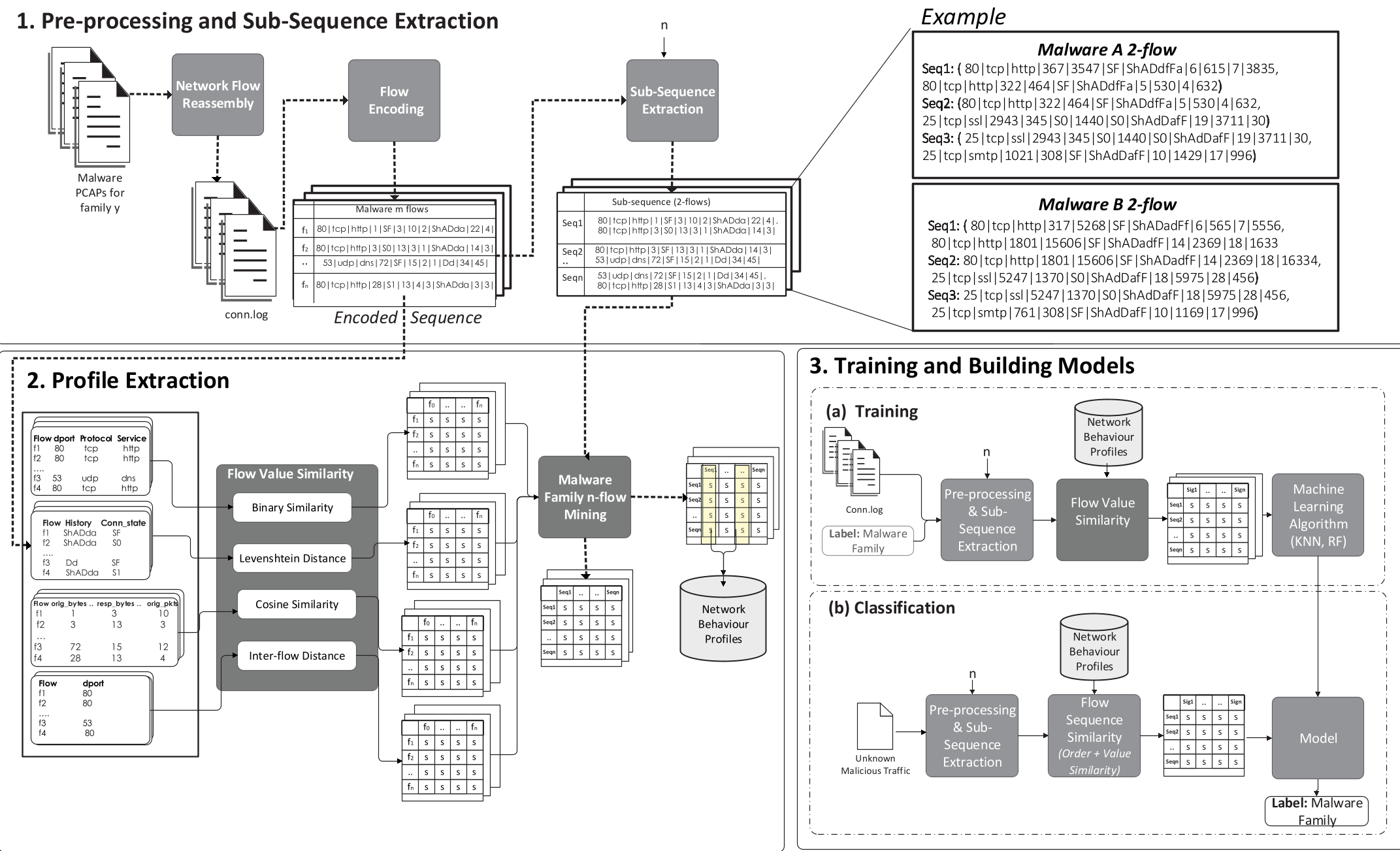
Unlike previous works that used rigid binary matches (is the port 80 or not?), MalClassifier uses a Fuzzy Similarity Measure. It breaks down a network flow into 11 non-identifiable attributes and applies the most appropriate mathematical lens to each:
- Cosine Similarity: Used for numeric vectors (byte counts, packet counts).
- Levenshtein Distance: Used for connection state histories (e.g., "ShADadR").
- Inter-flow Distance: Captures the delta between ports to detect scanning behavior.
2. Architecture Overview
The system workflow spans from raw PCAP ingestion to feature extraction and final classification.
Experiments: Performance and Evasion
The authors tested MalClassifier against 33 samples across 11 families, including notorious names like WannaCry, Sality, and Notpetya.
- Finding the "Sweet Spot" (n): The research found that (bi-flows) works best for KNN models, while maximizes Random Forest performance.
- Resilience: Most sequence-based detectors break if the attacker injects "noise" flows or shuffles the order. MalClassifier’s Order Similarity algorithm mitigates this, maintaining high accuracy even under adversarial manipulation.
Results at a Glance
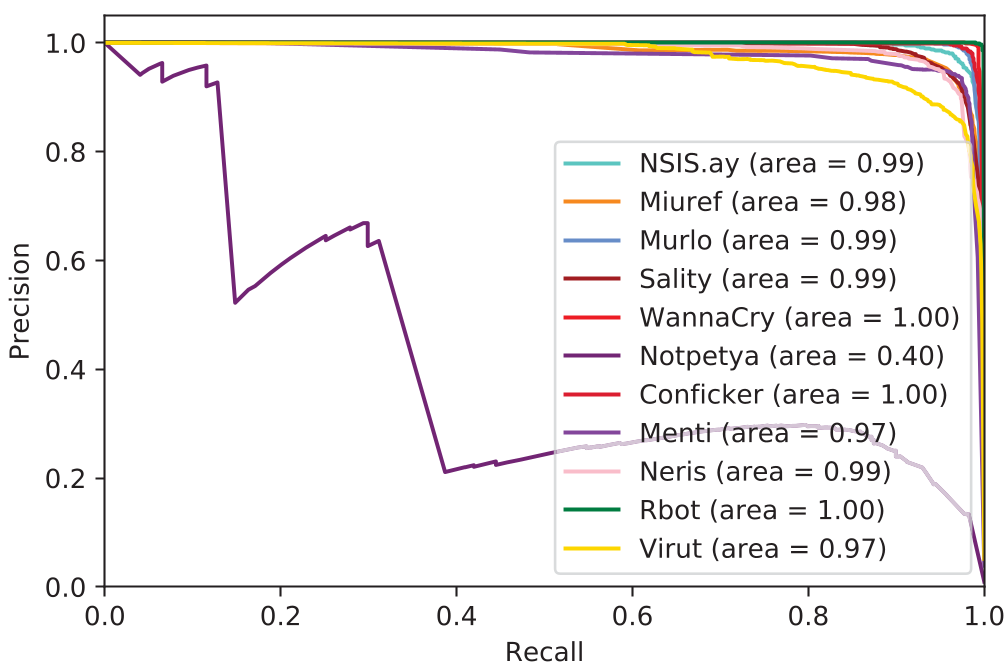
The macro-averaged PR curves demonstrate consistent performance across most families, though some (like Notpetya) proved more elusive due to behavioral overlaps with other families.
Critical Insight: Why This Matters for the Future
The most impactful contribution of MalClassifier is its Privacy-By-Design philosophy. By proving that classification can be done using only "Bro conn.logs" (which exclude IPs and Payloads), it allows organizations to share threat intelligence without leaking internal network topology or sensitive user data.
Limitations & Future Work
The system's primary challenge is "class overlap." In the experiment, 26% of Notpetya flows were misclassified as Miuref because they shared common SMB-like patterns. The authors suggest that future iterations using K-means clustering could help filter out these "generic" flows from the signature-building process.
Conclusion
As encryption becomes the standard for both legitimate and malicious traffic, the "on-the-wire" behavioral approach of MalClassifier represents a vital evolution in defense. It shifts the battleground from what the malware is sending to how it behaves, creating a robust, privacy-aware shield for the modern enterprise.