
Invitation or Bait? Unmasking the Dark Side of Facebook Events
Invitation or Bait? Detecting Malicious URLs in Facebook Events
This paper introduces the first systematic study of malicious URL dissemination within Facebook Events. The authors propose a supervised machine learning framework that leverages 36 event-specific features to detect "bait" events, achieving a peak accuracy of 75% using a Support Vector Machine (SVM).
TL;DR
While most security research focuses on Facebook walls or private messages, this paper uncovers a rising threat: Malicious Facebook Events. By analyzing 36 unique features ranging from "attending" counts to the deceptive use of shortened URLs in descriptions, the researchers built a supervised learning model capable of identifying malicious invitations with 75% accuracy, independent of slow-moving blacklists.
Context: Why Events are the New Frontier for Phishing
With 2.2 billion users, Facebook is a goldmine for cybercriminals. While Facebook Pages and Profiles have been scrutinized heavily, Events offer a unique "social engineering" advantage. They create a sense of urgency and legitimacy through invitations.
The core problem is latency. Services like Web of Trust (WOT) are reactive—they wait for victims to report a link before flagging it. By then, the damage is done. This paper shifts the paradigm to proactive detection by looking at the DNA of the event itself.
The "Anatomy" of a Malicious Event
The authors pinpointed several behavioral "red flags" that distinguish a legitimate invitation from a malicious bait:
- The Temporal Trap: Some malicious events are scheduled 10 years into the future. This allows the malicious link to remain "active" and searchable on the platform for a decade without the event ever "ending."
- The Engagement Gap: Malicious events often have a massive "No Reply" count compared to tiny "Going" or "Interested" counts.
- The Content Clue: In an environment with no character limits, the use of URL shorteners (like bit.ly) is a strong signal of deception, often used to mask-redirect to phishing sites.
Methodology: Feature Engineering & Architecture
The system architecture (shown below) involves a pipeline of data collection via the Facebook Graph API, URL expansion, and classification.
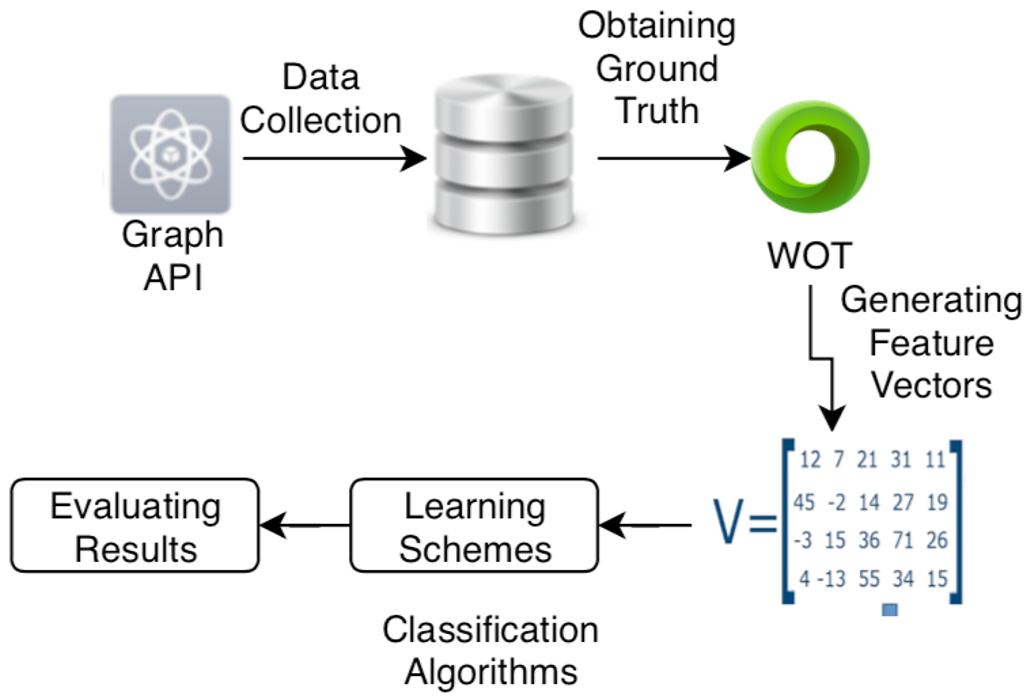
The researchers categorized 36 features into five distinct groups:
- Event-Based: Metadata like guest invitation permissions and "declined" counts.
- Description-Based: Linguistic markers and URL density.
- Post-Based: Interaction levels within the event's discussion wall.
- Link-Based: Structural properties of the URL (path length, hyphen counts).
- Host-Based: The reputation and "fan count" of the Page hosting the event.
Experimental Battleground
The study compared four major machine learning algorithms. Despite the challenges of an imbalanced dataset—which reflects real-world conditions where malicious events are the minority—the SVM (Support Vector Machine) emerged as the most robust classifier.
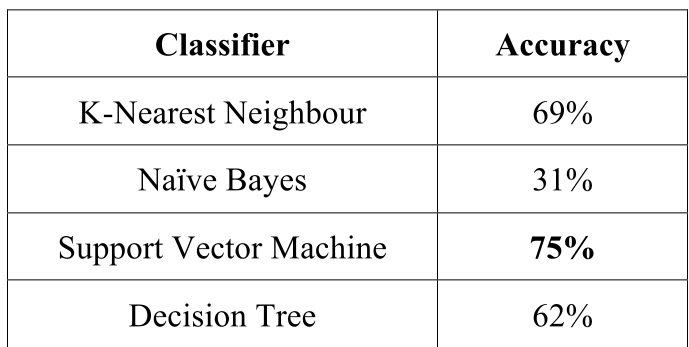
| Classifier | Accuracy |
|---|---|
| Support Vector Machine | 75% |
| K-Nearest Neighbour | 69% |
| Decision Tree | 62% |
| Naïve Bayes | 31% |
The low performance of Naïve Bayes suggests that the features of malicious events are highly interdependent, favoring the high-dimensional mapping capabilities of SVM.
Technical Critical Analysis
Strengths: This is a "first-of-its-kind" study. By focusing on public event metadata, it successfully navigates the privacy hurdles of the modern Facebook Graph API, which has deprecated many user-specific "friend-list" features.
Limitations:
- Sample Size: The dataset of 62 events is small, reflecting the difficulty of bypassing API rate limits.
- Language Barrier: The current model is optimized for English, leaving a gap for non-English phishing campaigns.
- Adversarial Evolution: As attackers realize that "long-duration" events (10 years) are a feature, they may begin to rotate event dates to appear more legitimate.
Conclusion & Future Outlook
This research proves that "Events" are not just for parties—they are structural vulnerabilities. The next step for this technology lies in Natural Language Processing (NLP). By analyzing the "intent" behind the event description (e.g., promising free tickets for a celebrity who isn't touring), future models could achieve even higher precision in detecting "fake" events before a single user clicks a link.