
MALP: Elevating Link Prediction via Semantic Meta-Paths and AUC Optimization
MALP: A More Effective Meta-Paths Based Link Prediction Method in Partially Aligned Heterogeneous Social Networks
The paper introduces MALP (Meta-path and AUC optimization based Link Predictor), a novel method for social link prediction in partially aligned heterogeneous social networks (HSNs). It leverages refined meta-path feature extraction and a semi-supervised AUC optimization technique to predict links across platforms like Foursquare and Twitter simultaneously.
TL;DR
Predicting social links across different platforms (e.g., will a Twitter user follow someone they already know on Foursquare?) is a major challenge due to data sparsity and partial alignment. MALP solves this by refining how we extract semantic "meta-paths" and using a sophisticated mathematical approach to optimize the Area Under the Curve (AUC) directly, bypassing the need to guess "negative" samples.
Problem & Motivation: The "Partial Alignment" Headache
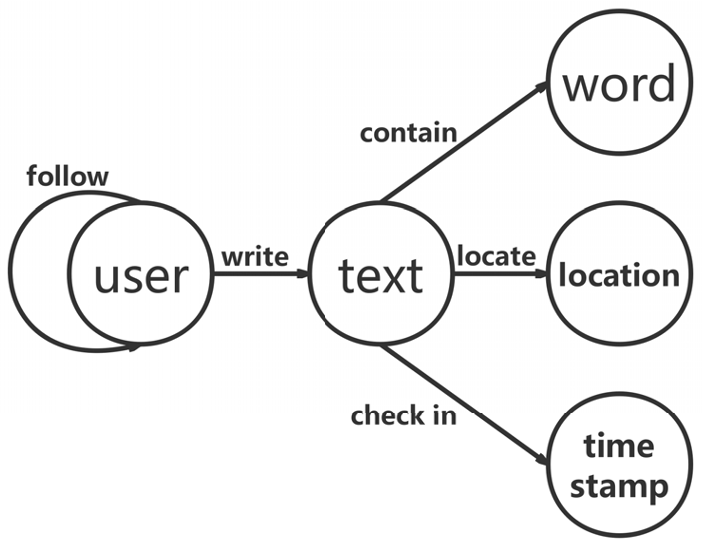
Most real-world social networks are Heterogeneous Information Networks (HINs), containing not just users, but text, locations, and timestamps. While anchor links (the same user having accounts on two platforms) exist, they are usually sparse—meaning networks are only partially aligned.
Previous SOTA methods suffered from two primary flaws:
- Poor Semantic Extraction: They often just count the frequency of paths, ignoring directional intent (e.g., a "Top-K" word choice vs. random noise).
- The PU Learning Bias: Link prediction is a Positive-Unlabeled (PU) problem. You know who is a friend (Positive), but you don't know if "unlinked" users are enemies or just haven't met yet (Unlabeled). Traditional methods try to guess who is a "negative" sample, which introduces massive bias.
Methodology: Refined Meta-Paths and Direct AUC Optimization
1. Refined Feature Extraction
MALP doesn't just look at whether two people use the same word. It uses a Top-K frequency approach. If User A uses a specific niche word frequently and User B follows suit, the link probability is higher than if the word was just a common stop-word used once.
2. Network Schema and Meta-Paths
The authors define meta-paths that cross the "anchor links" between networks. For example, a user on Foursquare checks in at a Location that location is linked to a Tweet on Twitter leading to a potential follow on Twitter.
3. Mathematical Core: AUC Optimization
Instead of building a classifier that might be biased by the distribution of unlabeled samples, MALP uses a risk optimization function: This formula essentially forces the model to rank known links (P) higher than mystery pairs (U) without explicitly labeling the mystery pairs as "negative."
Experiments & Results: Stable Performance under Sparsity
The authors tested MALP against major baselines like MLI and SCAN. The results were consistently superior, especially when the "remaining social link ratio" () was low.
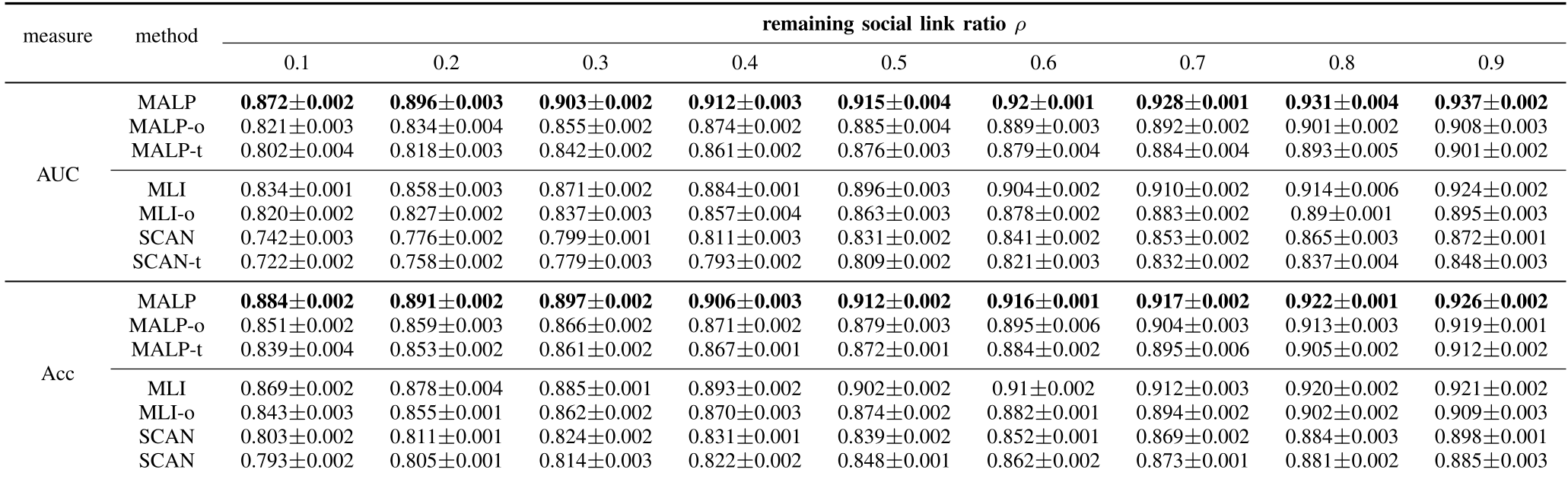
Key Findings:
- Cross-Network Gains: MALP performed significantly better than its "Target-only" version (MALP-t), proving that information does successfully flow across platforms via anchor links.
- Convergence: By using the predicted link probabilities to update the network and iterating (as shown in Algorithm 1), the model "learns" from its own predictions in a virtuous cycle.
Critical Analysis & Conclusion
MALP stands out because it moves away from the "heuristics" of negative sampling and toward a theoretically grounded AUC maximization.
Takeaway: In the era of fragmented social media, the ability to transfer knowledge from one HSN to another using partially aligned meta-paths is crucial.
Limitations: While powerful, the "Analytical Solution" provided in the paper involves matrix inversions , which could become a computational bottleneck as the number of user pairs grows to millions or billions without further optimization (like stochastic approximation).
Future Work: Integrating these meta-path features into Graph Neural Networks (GNNs) or using Transformer-based attention to weight the meta-paths dynamically could be the next frontier for MALP.