
Malware Propagation in OSNs: Why Your Social "Clusters" Might Actually Save You
Malware propagation in online social networks
This paper presents a comparative analysis and simulation of malware propagation in Online Social Networks (OSNs), specifically focusing on XSS (Cross-Site Scripting) worms and Koobface-like malware. The study employs a sample network constructed with power-law degree distribution and high clustering coefficients to model real-world social topographies.
TL;DR
This research investigates the mechanics of malware in Online Social Networks (OSNs), comparing the slow-burning XSS worms (like the infamous Samy) with the viral, social-engineering-driven Koobface. Using complex network simulations, the authors discover a counter-intuitive truth: the highly clustered "small-world" nature of our friendships can actually act as a natural containment zone for certain types of infectious code.
Problem & Motivation
With the rise of Web 2.0, malware moved from attacking IP addresses to attacking relationships. Traditional epidemic models often assume random mixing, but social networks are anything but random. They are defined by Power Law distributions (a few people have many friends) and High Clustering (your friends are also friends with each other).
The authors realized that the way we browse—specifically, whether we stick to our "inner circle" or wander through stranger's profiles—radically changes how quickly a worm can take down a platform like Facebook or MySpace.
Methodology - The Core
The study constructs two types of graphs for comparison:
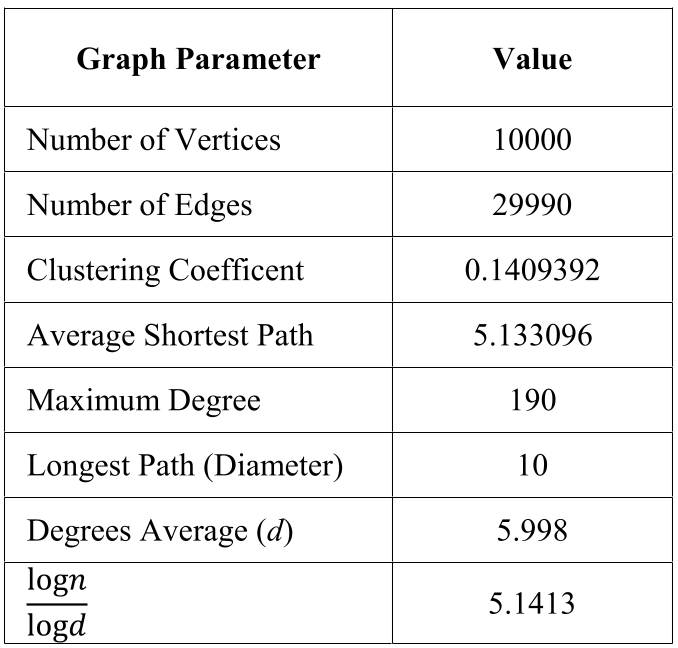
- A Social Network Graph: Features high clustering (CC ≈ 0.14) and small-world properties.
- A Random Equivalent Graph: Features the same degree sequence but near-zero clustering (CC ≈ 0.003).
The core logic separates two distinct propagation "modes":
- XSS Mode: Passive. Infection happens only when a user visits a profile already tainted with malicious scripts.
- Koobface Mode: Active. The malware sends spam to all friends, leveraging social engineering (e.g., "Check out this video!") to trick users into executing a payload.
Experiments & Results: The "Clustering" Paradox
The most striking finding involves the parameter q (the probability of visiting a friend).
- The Containment Effect: In the social network graph, if users primarily visit their friends (high q), the XSS worm spreads slower. Why? Because the infection gets stuck in a "clique." Until an infected member visits a stranger outside their cluster, the virus mimics a localized outbreak rather than a global pandemic.
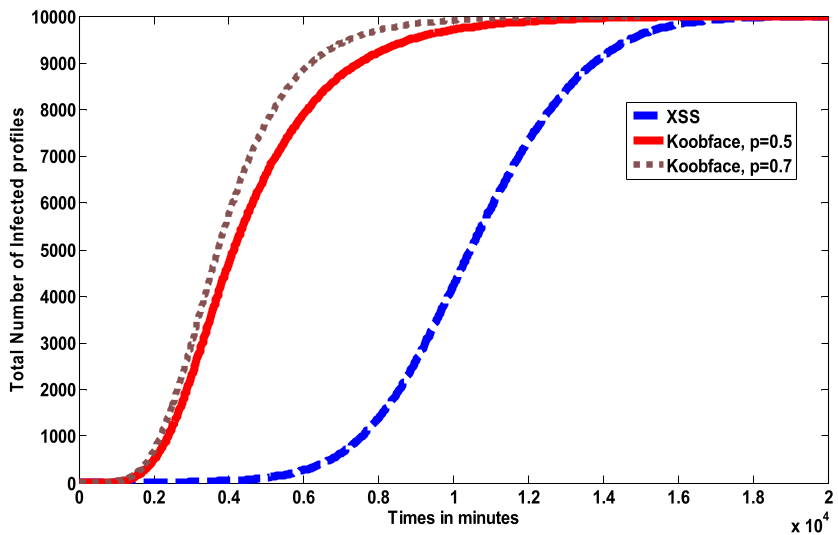
- The Speed of Trust: Koobface-like worms ignore these structural barriers. Because they "push" themselves to the entire friend list via spam, they achieve critical mass almost instantly.
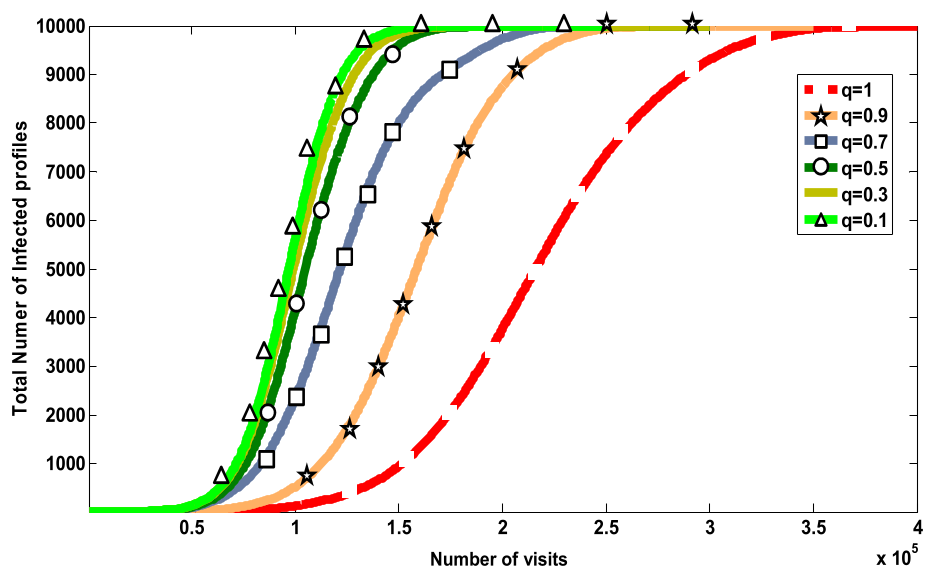
While the graph above shows that high clustering slows down XSS, the data for Koobface (as shown in the trend below) indicates that infection probability p is the only real bottleneck. Once a user clicks that fake "YouTube Update" link, the network structure becomes a super-highway for the virus.
Critical Analysis & Conclusion
Takeaway
Structure matters. The inherent "clumpiness" of human social circles provides a natural inductive bias that resists passive propagation. However, this defense is easily bypassed by active social engineering.
Limitations
- User Churn: The model assumes a static population. In reality, users join and leave OSNs, which could break clusters or create new bridges for infection.
- Static Vulnerability: The simulation assumes all users are equally susceptible. In practice, power users or those with security add-ons (like NoScript) act as "firewalls" within the graph.
Future Prospect
This work highlights the need for Topology-Aware Security. If platform admins know that an infection is currently localized within a specific cluster (using graph analysis), they can quarantine that "neighborhood" without shutting down the entire site—a surgical approach to digital health.