
Unmasking Social Contagion: How XSS and Koobface Worms Hijack Social Networks
Malware propagation in online social networks
This paper presents a comparative analysis and simulation of malware propagation in Online Social Networks (OSNs), specifically focusing on XSS (Cross Site Scripting) and Koobface-like worms. By constructing synthetic networks using power-law degree distributions and tunable clustering, the study identifies that network topology and user interaction patterns are the primary determinants of infection speed.
TL;DR
This study investigates the mechanics of malware spread within Online Social Networks (OSNs). By simulating XSS and Koobface-like worms on realistic network topologies, the authors reveal that while high clustering (close-knit friend groups) actually slows down XSS worms by containing the "outbreak," the active social engineering tactics of Koobface-like worms bypass topological barriers, leading to explosive growth.
Problem & Motivation
The rise of Web 2.0 brought a paradigm shift in cyber threats. Unlike legacy worms that were hindered by firewalls and NAT, Web-based worms like Samy (which hit 1 million MySpace profiles in just 20 hours) hide in plain sight via legitimate HTTP traffic.
The authors identify two distinct propagation vectors:
- XSS Worms: Passive and platform-independent. They spread when a vulnerable user simply views an infected profile.
- Koobface-style Worms: Active and psychological. They use social engineering (e.g., "Check out this video!") to trick users into downloading malicious executables.
The core question is: How do the "small world" and "highly clustered" nature of social networks influence these different threats?
Methodology - The Core
To answer this, the authors generated a synthetic graph of 10,000 nodes using a power-law degree distribution—mirroring how a few "influencers" have many friends while most users have few.
The Structural Comparison
The study compares a Social Network Graph (Highly Clustered) against a Random Equivalent Graph (Low Clustering).
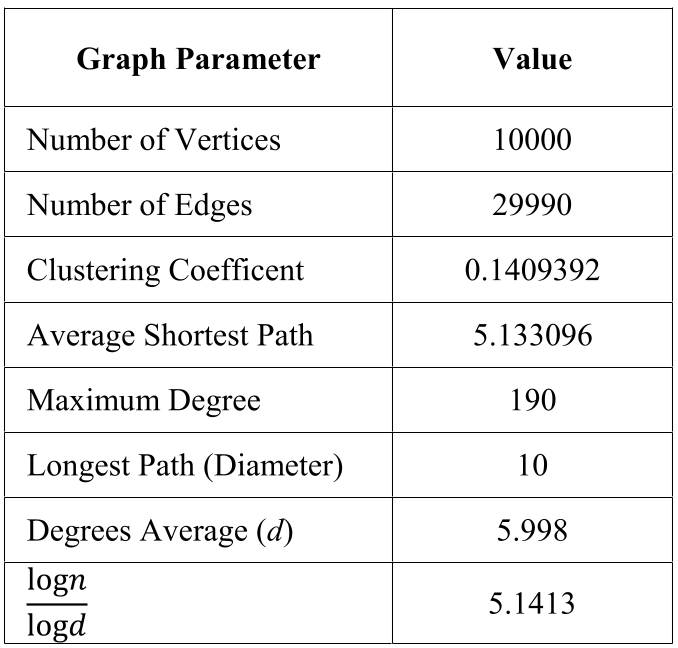
- Clustering Impact: In social networks, if A knows B and B knows C, A likely knows C. This "triangle" structure creates local communities.
- Transmission Logic: For XSS, the authors introduced a parameter —the probability of visiting a friend vs. a stranger. For Koobface, they used —the probability of a user falling for the social engineering trick.
Experiments & Results
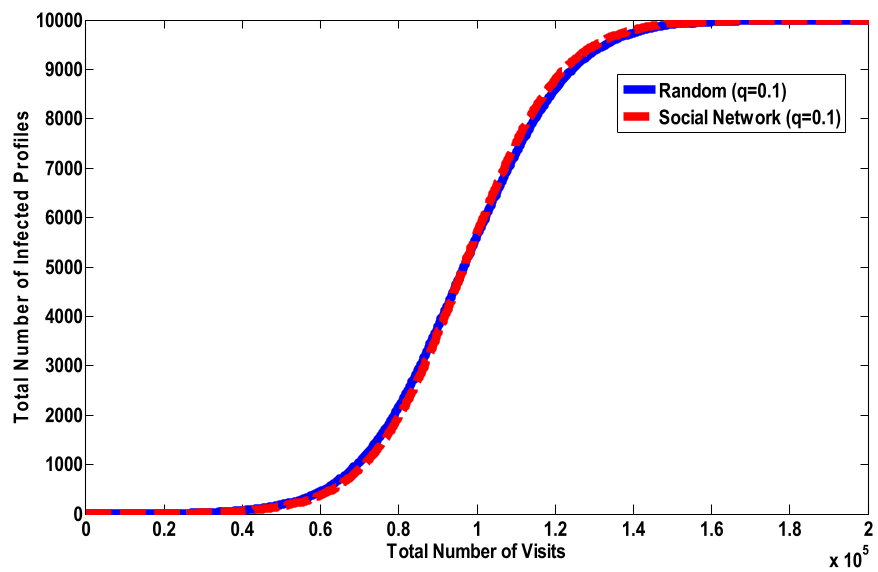
1. The Clustering Paradox (XSS Worms)
Counter-intuitively, high clustering acts as a "containment zone" for XSS worms. As shown in the simulation results, if users primarily visit their friends (high ), the worm lingers within the local cluster, delaying its jump to the rest of the network.
2. Koobface: The Speed Demon
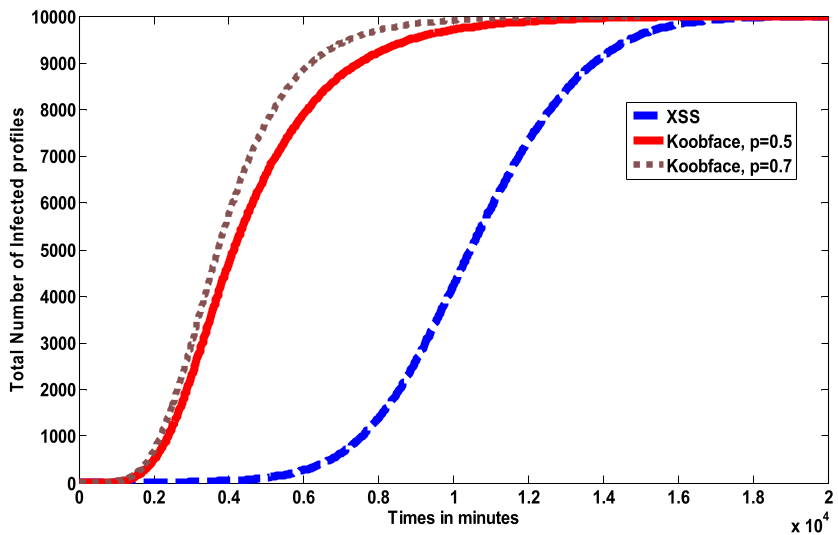
The speed of Koobface-like worms dwarfs XSS. Because an infected user sends spam to all friends simultaneously, the branching factor is much higher than the single-visit-single-infection model of XSS.
3. The Power of "Initial Infected Profiles" (IIP)
For XSS worms, starting with 100 infected users instead of 1 makes a massive difference in "take-off" time. However, for Koobface, the propagation is so inherently aggressive that the number of initial infections (once past a certain threshold) has a diminishing return on the total time to reach 90% saturation.
Critical Analysis & Conclusion
Takeaways
- XSS Defense: Since XSS worms have a "slow start" period, OSN providers have a window of opportunity to use honeypots (fake profiles) to detect anomalous script injections before they hit the tipping point.
- Koobface Defense: Topological defenses are useless here. The bottleneck is human psychology. Rapid warning systems and automated filtering of suspicious outbound messages from "zombie" accounts are critical.
Limitations & Future Work
The current model assumes a static network. In reality, OSN links are dynamic, and user behavior (churn, leaving groups) changes. Future research should integrate Heterogeneous Mean Field (HMF) theories to understand how the "hubs" (users with thousands of friends) influence the critical threshold of these outbreaks.
Final Thought
The study proves that in the digital world, "trust" is the most vulnerable protocol. Whether it's a script in your browser or a link from a "friend," the architecture of our social connections determines our collective immunity.