
MamaBot: Bridging the Maternal Health Gap with NLP and Machine Learning
MamaBot: a System based on ML and NLP for supporting Women and Families during Pregnancy
MamaBot is an AI-driven chatbot system leveraging Machine Learning (ML) and Natural Language Processing (NLP) to provide 24/7 support for pregnant women and families. Built on the Microsoft Bot Framework and integrated with Telegram, it offers specialized health guidance, emergency localization, and symptom assessment to bridge the communication gap between physicians and patients.
TL;DR
MamaBot is an intelligent conversational agent designed to support women from early pregnancy through the pediatric years. By moving health support into familiar messaging interfaces like Telegram and utilizing Microsoft's LUIS for Natural Language Understanding, it provides a "human-like" first-level medical support system that addresses symptoms, emergencies, and lifestyle guidance.
Background & Motivation: The Digital Frustration of Motherhood
The "mHealth" revolution has historically been hampered by a paradox: while health apps are among the most downloaded, they are also the most quickly abandoned. For pregnant women, the stakes are higher. The time-constrained nature of clinical visits often leaves mothers-to-be searching the web, encountering contradictory or unverified advice.
The authors identify a core psychological barrier: the "patient's trust problem." Traditional digital forms feel dehumanized, causing frustration when patients cannot fully express their worries. MamaBot aims to solve this by providing a conversational interface that feels like a dialogue rather than a data-entry task.
Methodology: Architecture for Long-term Context
One of the primary technical challenges in maternal health is the time span. Unlike a travel bot used for a single booking, a pregnancy bot must support a user for 1 to 4 years. During this time, the "context" shifts from embryonic development to pediatric nutrition.
The Three-Layer Architecture
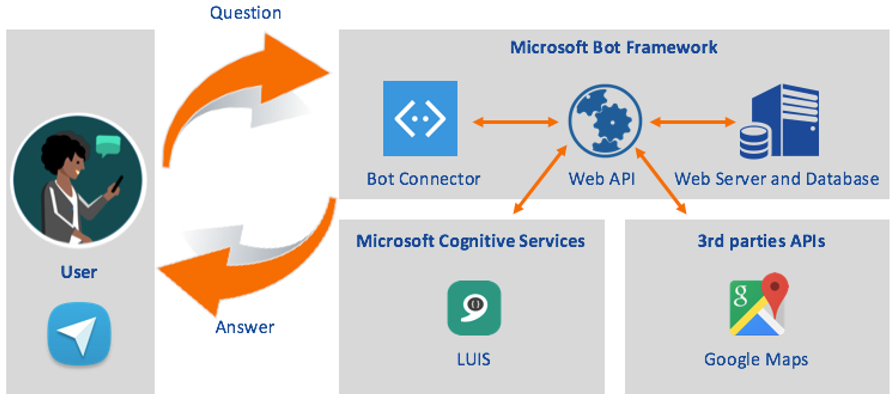
The system is built on a robust, scalable stack:
- Front-End: Telegram was chosen for its encryption and multi-platform support, requiring no additional app installation for the user.
- Back-End: A Microsoft IIS Web Server manages the logic and interfaces with 3rd-party APIs (Google Maps/Bing).
- Cognitive Layer (LUIS): The Language Understanding Intelligent Service (LUIS) performs the heavy lifting of extracting Intents (what the user wants) and Entities (the subject of the query).
Solving the "Topic-Switch" Challenge
As the number of intents grows, accuracy typically drops. MamaBot introduces a contextualization layer. By pre-processing requests with keywords related to child age or specific pathologies, the bot can accurately distinguish between a mother asking about "nausea" in her first trimester versus a symptom related to her toddler.
Real-World Application & Use Cases
MamaBot is not just a FAQ bot; it is a service-oriented agent. The paper highlights five key use cases:
- Emergency Localization: Using GPS to find the nearest hospital or 24-hour pharmacy.
- Symptom Assessment: Recognizing 117 pathologies across 10 body areas to advise on the severity of a condition.
- Certified Guidance: Sourcing data exclusively from institutional bodies like the Italian National Institute of Health to ensure safety and authority.

Critical Insight & Future Outlook
While MamaBot represents a significant step forward in mHealth UI/UX, the authors acknowledge the inherent limitations of 2018-era NLP, such as difficulty with complex linguistic nuances like hypernyms and hyponyms.
From a modern perspective, this work laid the groundwork for the "AI-first" healthcare shift. The decision to use messaging platforms instead of bespoke apps was prophetic, as current trends move toward "Invisible UI" where the service lives where the user already resides. Future iterations integrating LLMs could potentially solve the remaining "semantic accuracy" issues mentioned in the study, allowing for even more complex medical reasoning.
Takeaway: The success of medical AI hinges not just on the "intelligence" of the model, but on the accessibility of the interface. MamaBot proves that meeting patients in their chat apps can transform health monitoring from a chore into a supportive companion.