
Establishing a Manageable Small World: Optimized Social Networks for Enterprise Collaboration
A Manageable Small World for Collaborative Enterprises Social Network
This paper proposes a "Manageable Small World" networking strategy for collaborative enterprise social networks. By utilizing a "randomly exchanging neighbors" algorithm on an initially regular graph, it constructs a decentralized community that achieves high clustering and short diameters, facilitating efficient service broadcasting and searching.
TL;DR
To address the scalability limits of enterprise collaboration, this paper introduces a Manageable Small World social network. By starting with a regular graph and applying a constrained "neighbor exchange" algorithm, the authors create a decentralized topology that combines the high cliquishness of lattices with the short paths of random graphs—slashing network diameter while ensuring zero-cost degree stability.
Background: The Limits of Centralization
In modern Virtual Organizations (VOs), relying on a centralized business process engine is a recipe for disaster. Such "hub-and-spoke" models create bottlenecks and are vulnerable to single-point failures. While Peer-to-Peer (P2P) systems offer an alternative, purely random networks (Erdős-Rényi) or Scale-free networks (Barabási-Albert) often exhibit high diameters or undesirable "hotspots" where specific nodes are overwhelmed.
The authors' insight is to leverage the Small World Phenomenon—the idea that any two nodes in a massive network can be connected via a very short path—to optimize service discovery (searching) and information dissemination (broadcasting) between enterprises.
Methodology: The "Neighbor Exchange" Strategy
Unlike standard Small World models that randomly rewire edges (which can change node degrees), the authors propose a Degree-Preserving Neighbor Exchange.
1. The Core Graph Evolution
The process begins with a 2r-regular graph where each node is connected to predecessors and successors. To introduce the "Small World" property, the algorithm selects two edges and swaps their endpoints.
2. Algorithmic Foundation
The ExchangeNeighbor(a, i, b, j, c, k, d, l) operation is the heart of the system. It ensures that:
- Connectivity is maintained by cross-connecting endpoints.
- Node degrees remain constant, preventing the formation of unmanageable hotspots.
- High Clustering is preserved, ensuring that local "communities" of enterprises can still collaborate efficiently.
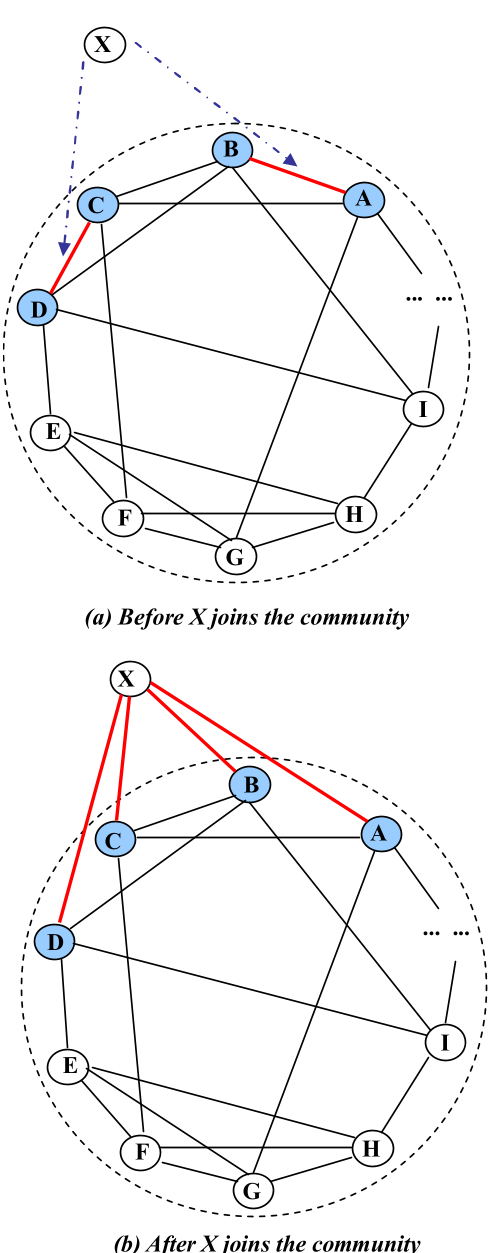 Figure 1: Illustration of a new node X being introduced into the small world by existing members.
Experiments and Results: Efficiency at Scale
The authors conducted extensive simulations to validate the "Small World" characteristics of their manageable community.
1. Rapid Diameter Reduction
The experiments show a dramatic "elbow" in the performance curve. With an exchange probability as low as 0.05, the Mean Shortest Path (MSP) drops precipitously. This means messages that once took over 100 hops can now reach their destination in fewer than 15.
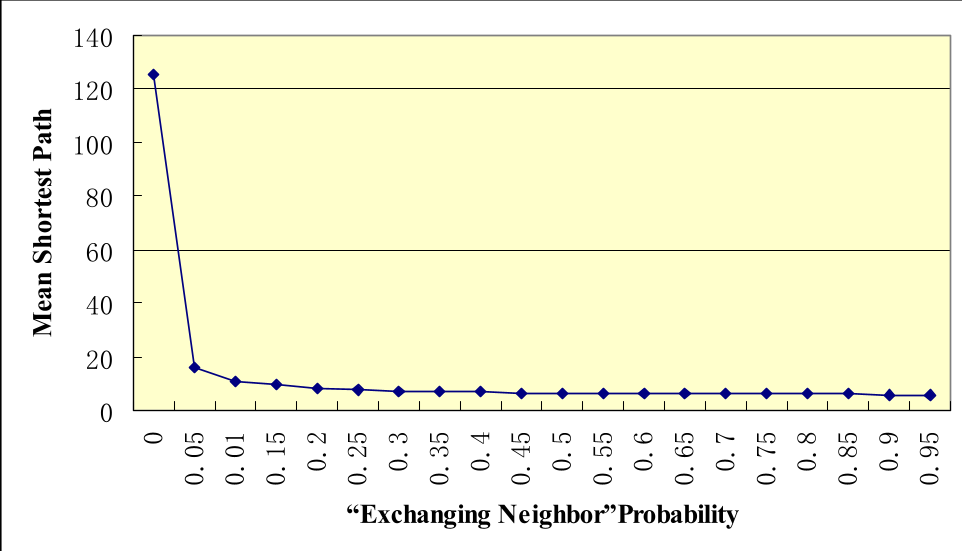 Figure 2: The effect of neighbor exchange probability on the Mean Shortest Path.
2. Maintenance Complexity
The proposed algorithms for Join and Leave (Proactive/Passive) are optimized for high-churn environments:
- Join Complexity: time.
- Leave Complexity: time—essentially instantaneous local re-linking.
- Self-Healing: The
PassiveLeavemethod allows the network to automatically repair itself if a node goes offline unexpectedly.
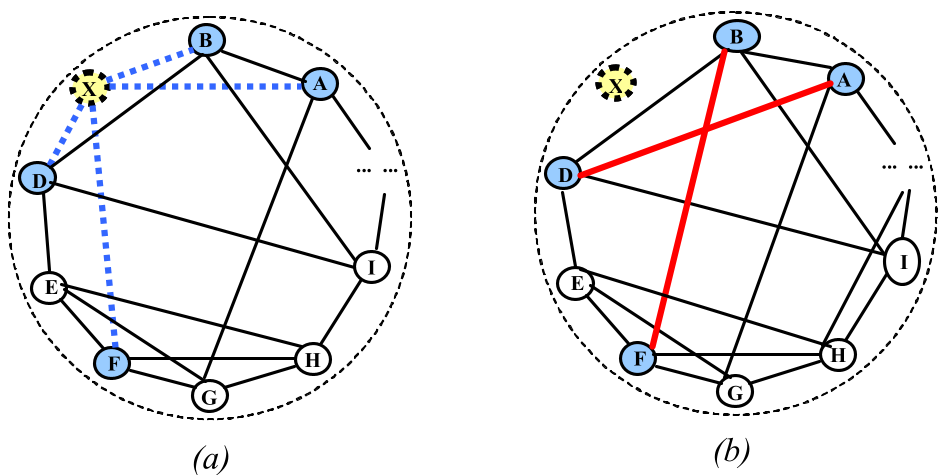 Figure 3: Topology transition during node departure and subsequent self-healing.
Critical Insight & Conclusion
The true value of this paper lies in its deterministic approach to randomness. By enforcing a "regular" constraint on a "small world" architecture, the authors provide a network that is as predictable as a structured lattice but as fast as a random web.
Takeaways for Industry:
- Scalability: This architecture is being deployed in Mobile IPTV systems across Europe and China, proving its real-world viability for Data Centers and CDNs.
- Load Balancing: By keeping the degree unchanged, the system ensures no single enterprise node becomes a communication bottleneck.
Limitations: While the O(log N) diameter is excellent, the paper assumes a relatively uniform trust model between enterprises. In competitive environments, additional security layers (like sybil attack protection) would be required to complement this physical topology.