
Social Broker Networks: Balancing Information Sharing and Privacy in the IoT Era
Managing Privacy in a Social Broker Internet of Thing
This paper introduces a privacy-preserving framework for the Broker-to-Broker Social Internet of Things (BBS-IoT) based on the Social Broker paradigm. It leverages a self-organizing social network of brokers and integrates k-anonymity techniques with multi-level diffusion policies to manage sensitive information sharing.
TL;DR
The paper addresses the privacy-utility tradeoff in the Social Internet of Things (SIoT). By treating IoT brokers as social entities that form friendships (FSL) and acquaintances (AL), the authors introduce a system where data is shared based on its "sensitiveness." Using k-anonymity and social-based diffusion policies, it allows for smart city/mall environments to calculate aggregate data without exposing the specific status of individual private nodes.
Problem & Motivation: The Silo vs. Privacy Dilemma
In the standard Internet of Things (IoT), devices often operate in isolated "islands" or ecosystems. Inter-ecosystem communication is typically static and hard to scale. The Social IoT (SIoT) paradigm solves this by allowing brokers—the mediators between publishers and subscribers—to form social relationships, much like humans do.
However, this openness is a double-edged sword. If a broker in a shopping mall shares temperature or humidity data with a neighboring shop's broker, it might inadvertently leak business-sensitive or private location data. The core challenge is: How can we foster a collaborative "social" network of devices without compromising the privacy of the participants?
Methodology: Social Logic and Anonymization
The authors propose a two-tiered approach to solve this.
1. The Social Link Hierarchy
Brokers categorize their connections into three types of links, mimicking human social circles:
- Full Semantic Link (FSL): Trusted "true" friends.
- Temporary Semantic Link (TSL): Weak friendships or frequent acquaintances.
- Acquaintance Link (AL): Temporary or random connections to avoid isolation.
2. Multi-Level Diffusion Policies
Information is not just binary (public/private). The authors define four levels:
- Public: Shared freely using standard algorithms.
- Slightly Reserved: Full info to FSLs; anonymized info to ALs.
- Moderately Reserved: Shared only with FSL/TSL, always anonymized.
- Secretive: Local only; no sharing.
3. k-Anonymity and TBGs (The Core Architecture)
To hide the source of data, the system uses k-anonymity via suppression (removing data) and generalization (making data less specific).
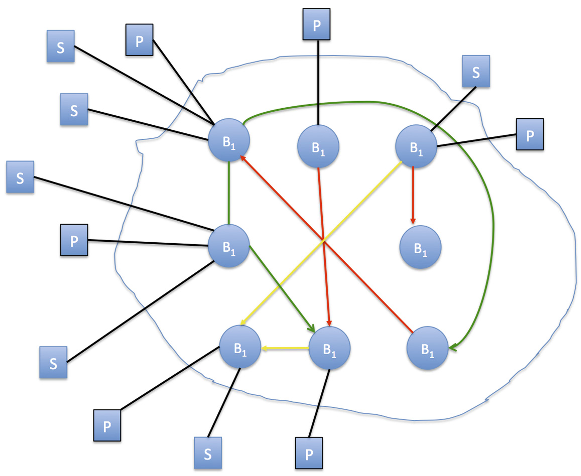
The most innovative part is the Global Anonymization through Temporary Broker Groups (TBGs). When a broker wants to share sensitive data (like "humidity"), it forms a TBG with its FSL (trusted) neighbors. They exchange data among themselves, shuffle/generalize the values and locations, and then publish the anonymized aggregate to the wider network. The "social" trust of the FSLs acts as the security boundary.
Experimental Context: The Smart Shopping Center
The paper illustrates the mechanism using a large shopping mall scenario. Brokers managing individual shops (e.g., a shoe store) need environmental data from the main entrance.
- Without Privacy: The shoe store knows exactly which store provided the humidity data.
- With the Proposed Method: The shoe store receives an accurate average humidity for the "Main Door Area," but cannot pin the data back to a specific individual shop's sensor, protecting the shop's operational privacy.
Critical Analysis & Conclusion
Takeaway
The genius of this work lies in applying human social intuition to machine-to-machine (M2M) protocols. By allowing brokers to "promote" or "downgrade" their neighbors based on the quality and trust of interactions, the network evolves naturally.
Limitations
- Trust Bootstrap: The paper assumes a trust network exists to manage the upgrade from TSL to FSL, but the specific mechanics of avoiding "malicious" brokers during the bootstrap phase are left for future work.
- Overhead: Performing k-anonymity and forming TBGs across a distributed network adds computational and latency overhead which might affect real-time IoT applications.
Future Outlook
The authors are currently testing this on Smart Office and Smart Health solutions. Given the sensitivity of health data, the integration of Social-based reputation approaches (like PROSA variants) will be critical to see if these "social" brokers can truly safeguard human-centric data.