
BMC: Navigating the Latent Geometry of LLMs for Better Reinforcement Learning
Manifold Bandits: Bayesian Curriculum Learning over the Latent Geometry of Large Language Models
This paper introduces Bayesian Manifold Curriculum (BMC), a structure-aware framework for sampling training problems in LLM reinforcement learning. By organizing prompts into a hierarchical "Latent Task Tree" based on model embeddings and applying Bayesian learning, BMC achieves SOTA training efficiency and broad task coverage, significantly improving over uniform and unstructured bandit sampling.
TL;DR
Reinforcement Learning (RL) has become the backbone of modern reasoning models (like DeepSeek-R1), but the "dark secret" of RL is how much compute is wasted on "dead" prompts—questions the model already knows or can't possibly solve. Bayesian Manifold Curriculum (BMC) solves this by mapping the model’s internal perception of tasks into a tree structure, using Bayesian logic to hunt for the most "productive" problems without losing the "diversity" needed for general intelligence.
The "Why": Beyond the Difficulty Trap
Most modern RL pipelines use Dynamic Sampling: they keep throwing prompts at a model until they find one where the model's answers vary (non-zero reward variance). While this finds the "frontier of learnability," it is incredibly slow.
More importantly, the authors argue that the industry has a blind spot: we confuse Difficulty with Type. A model might find a Geometry problem and a Calculus problem equally hard, but learning from one doesn't help with the other. By treating every prompt as an independent "arm" in a bandit problem, we miss the structure of the task space.
Methodology: The Latent Task Tree
The core innovation is building a map of the model's mind. The authors don't use human labels (like "Algebra"); they use the model's own hidden embeddings to cluster problems.
- Manifold Approximation: Using PCA and UMAP on intermediate layer activations, the method identifies local "charts" or patches of similar logic.
- Latent Task Tree: Through recursive clustering (HDBSCAN), they build a hierarchy. A root node (all math) branches into Geometry, then into 3D Geometry, and so on.
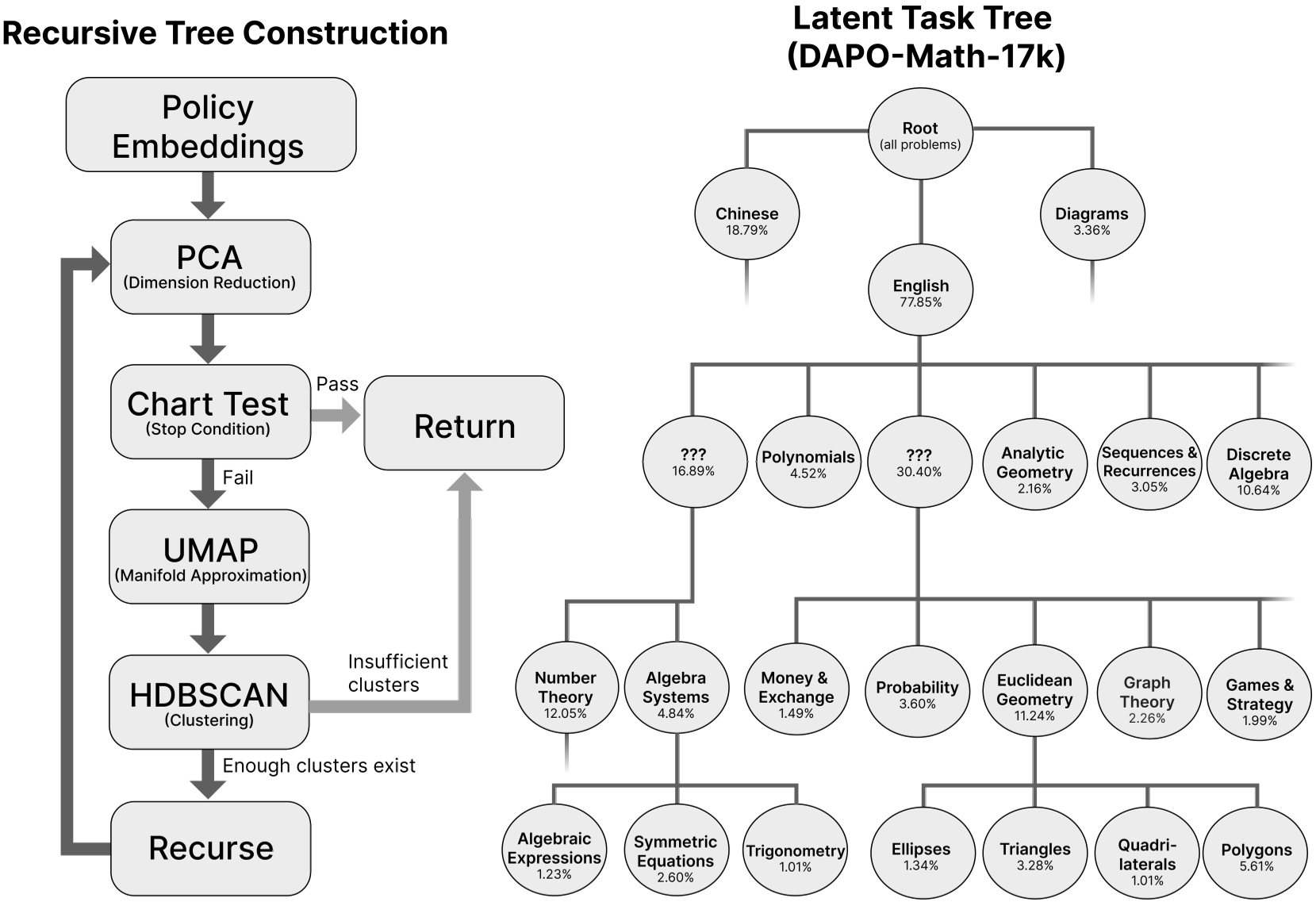 Figure 1: The recursive construction of the Latent Task Tree from LLM embeddings.
The Bayesian Engine: BMC and BMC-T
Once the tree is built, BMC acts as an "agent" that explores the tree.
- Top-Down Sampling: It uses Hierarchical Thompson Sampling to pick types of problems it thinks will be productive.
- Bottom-Up Updates: When the model succeeds or fails, BMC calculates a "surprise" score. If a result is unexpected, it propagates that uncertainty up the tree, signaling that "maybe our whole understanding of this sub-topic has changed."
- BMC-T (Utility-Aware): This variant lets researchers say, "I want my model to be good at the AIME competition." It biases the sampler toward training regions that are geometrically similar to the target benchmark.
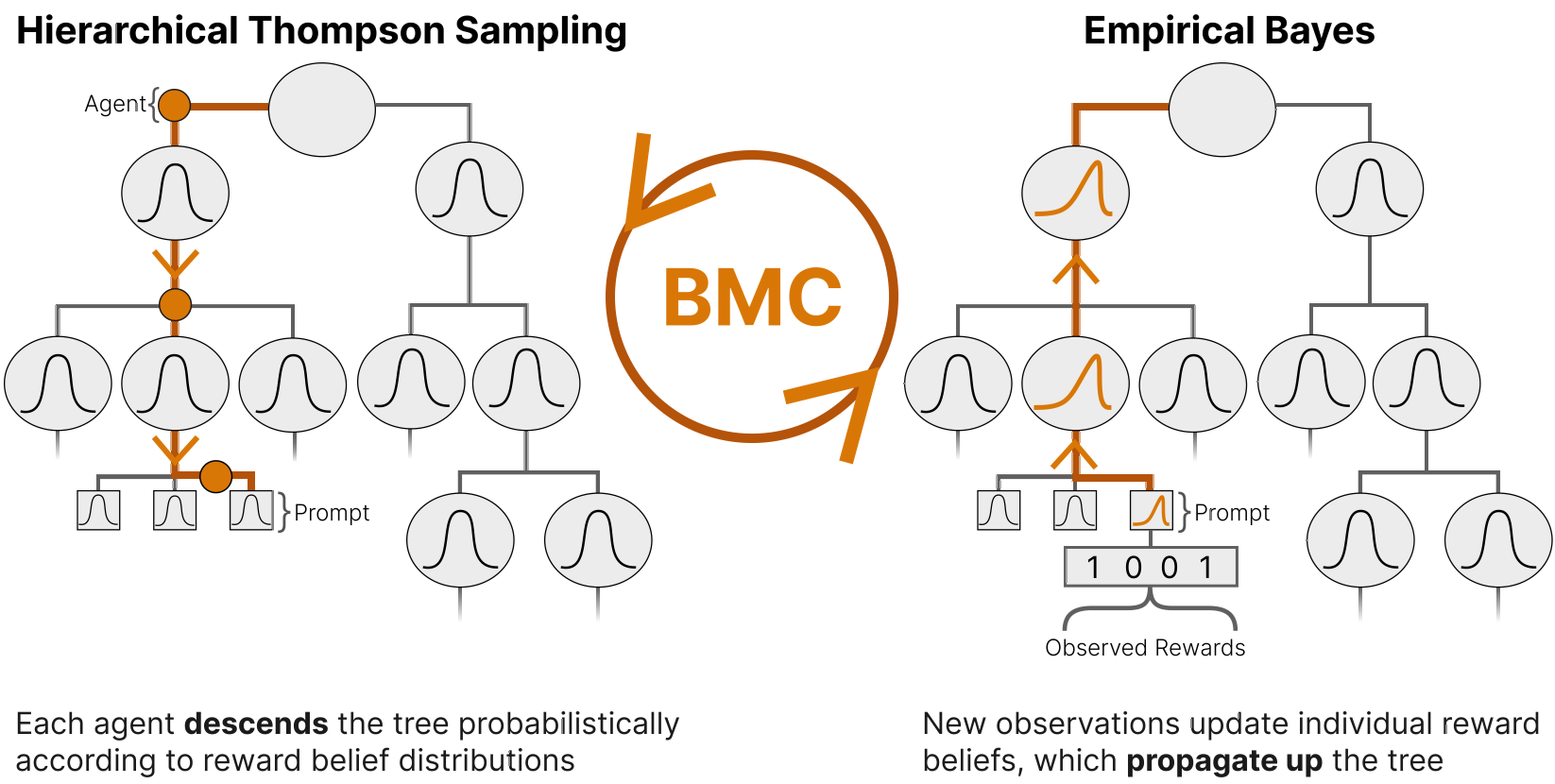 Figure 2: The feedback loop between hierarchical sampling and Bayesian belief propagation.
Experimental Results: Faster, Leaner, Smarter
The results across Qwen3 models (4B and 8B) prove that structure matters:
- Efficiency: BMC matches the learning speed of Dynamic Sampling but without the massive time penalty of regenerating batches.
- The "Evaluation Deadzone": The paper reveals that sometimes models "learn" on productive data (high variance) that simply isn't relevant to benchmarks. BMC-T fixes this by aligning a diverse curriculum with specific evaluation "utility."
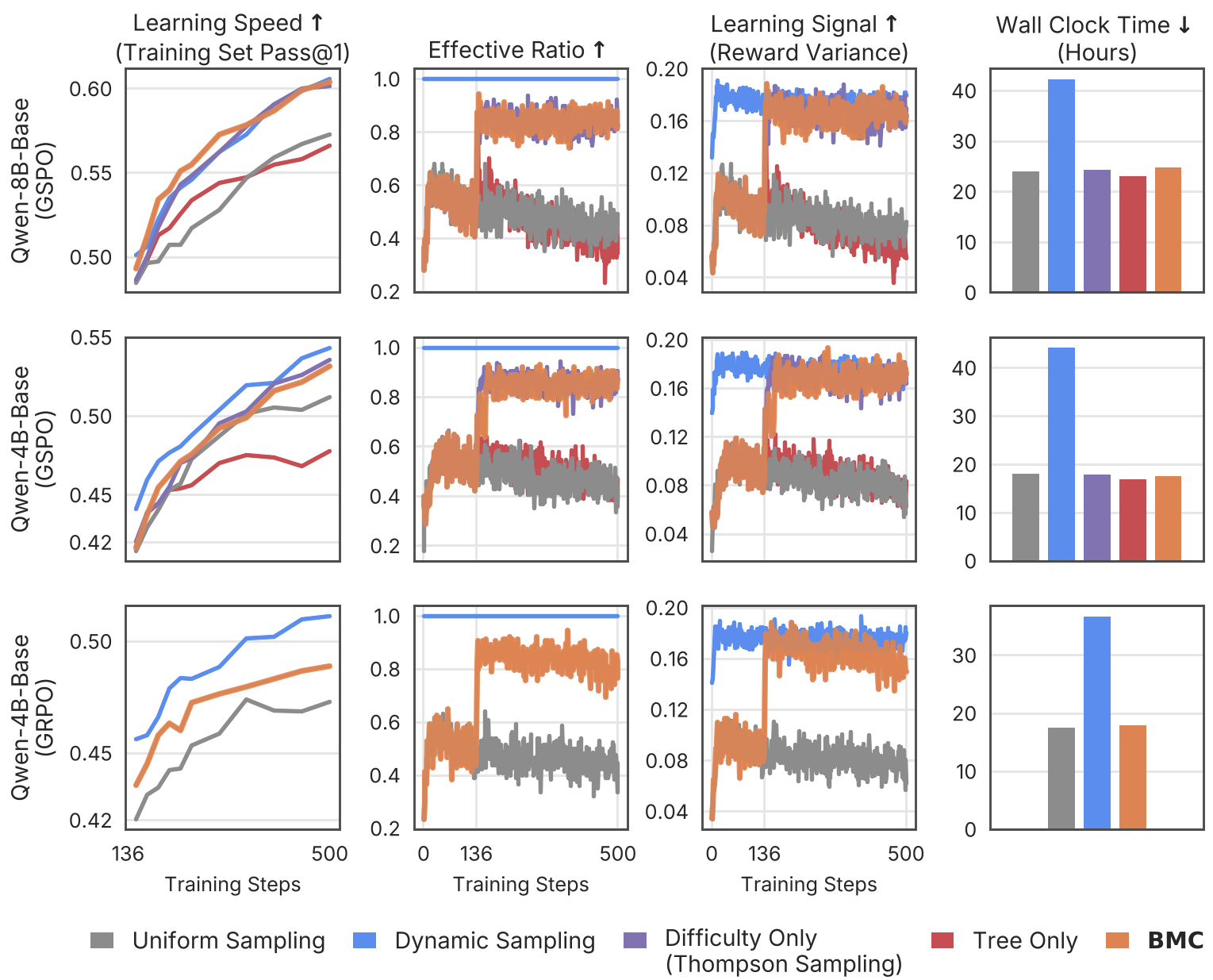 Figure 3: BMC recovers the learning speed of Dynamic Sampling while maintaining the low wall-clock time of Uniform sampling.
Deep Insight: The Bitter Lesson vs. Latent Geometry
This work feels like a modern update to Rich Sutton’s "The Bitter Lesson." Instead of imposing human categories on models, BMC extracts the model’s own categories. It acknowledges that the "Manifold Hypothesis" isn't just a theoretical curiosity—it is a practical tool for orchestrating the training of the world’s most complex reasoning machines.
Limitations & Future Work
The tree is currently static; if a model's "mind" changes too much during RL, the map might become outdated. While the authors found this effect to be minor over standard training horizons, future "Live BMC" versions that rebuild the tree dynamically could push the frontier even further.
Conclusion (Takeaway)
The days of uniform data sampling are over. To build the next generation of O1-style reasoners, we need to treat curricula as a manifold-structured bandit problem. BMC proves that by listening to the model’s latent representations, we can train models that are not just more accurate, but more diverse and balanced across the entire landscape of human knowledge.