
Beyond Isolated Frames: Manifold Learning for Video-Based Gender Classification
Manifold Learning for Gender Classification from Face Sequences
The paper introduces a manifold learning framework for gender classification specifically designed for face sequences in video data. By extending the Locally Linear Embedding (LLE) algorithm and introducing a manifold-to-manifold distance measure, the system achieves a SOTA classification rate of 97.2% on diverse datasets.
TL;DR
This research shifts the paradigm of gender recognition from "frame-by-frame" analysis to "manifold-to-manifold" matching. By extending the Locally Linear Embedding (LLE) algorithm to handle face sequences, the authors achieve a 97.2% accuracy rate that is remarkably robust against facial misalignment and low resolution.
Background Positioning: This work represents a significant leap in Non-linear Dimensionality Reduction applied to biometrics, moving away from simple SVM classifiers toward understanding the intrinsic geometry of facial data.
The Problem: The "Isolated Pattern" Fallacy
Most previous gender classification systems treat a video as a bag of images. They classify each image independently and then use voting or averaging to guess the gender. This approach is fundamentally flawed because:
- It ignores the correlation between consecutive frames.
- It struggles with non-linear variations caused by head movement, expressions, and lighting.
- It often requires near-perfect face alignment, which is unrealistic in surveillance or real-world HCI scenarios.
Methodology: Discovering the Male and Female Manifolds
The core insight is that face images of a specific gender do not move randomly in high-dimensional space; they lie on a smooth, low-dimensional manifold.
1. Modified LLE for Sequences
The authors modify the standard LLE find the -nearest neighbors. Critically, to learn what makes a "male" or "female" face rather than just identifying individuals, they constrain the neighbor search to come from different sequences in the training set. This forces the algorithm to discover features shared across the entire gender class.
2. Manifold Distance Measure
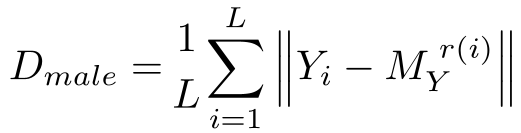
Once the Male () and Female () manifolds are built, a new sequence is classified by projecting it into both. The decision is made using a simple yet effective distance formula: where is sequence length and represents the closest point on the training manifold.
Experiments & Results
The authors tested their method on three major databases: CRIM, VidTIMIT, and Cohn-Kanade, featuring diverse lighting and expressions.
Performance vs. The State-of-the-Art
The results were conclusive. The Manifold Learning approach consistently crushed traditional methods across all resolutions:
| Method | 20x20 Pixels | 40x40 Pixels | 60x60 Pixels |
|---|---|---|---|
| Pixels + SVM + Fusion | 88.0% | 89.2% | 88.5% |
| LBP + SVM + Fusion | 90.5% | 91.0% | 92.1% |
| Manifold Learning (Proposed) | 96.8% | 97.1% | 97.2% |
Key Insights from Results:
- Invariance to Resolution: Accuracy only dropped by 0.4% when downscaling from 60x60 to 20x20, proving the manifold captures structural features rather than just raw pixel intensity.
- No Alignment Needed: Unlike SVM-based methods that fail without precise centering, the LLE-based approach is inherently more flexible to shifts and rotations.
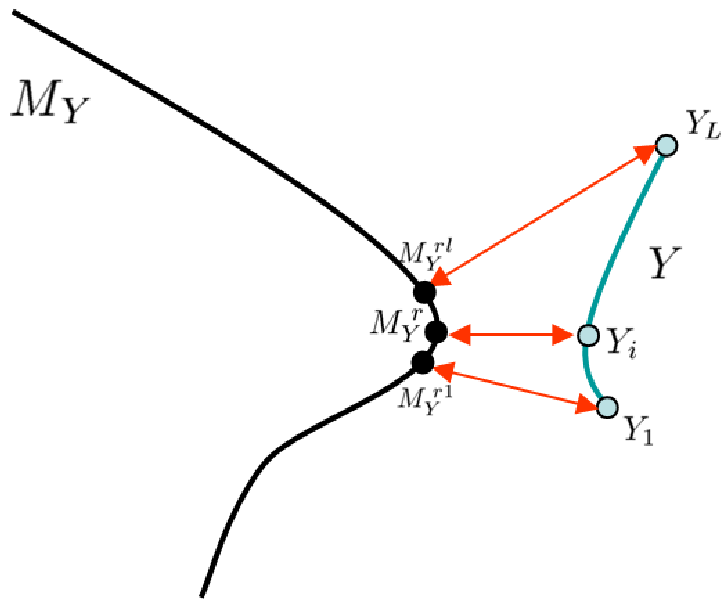 Note: Performance peaked at neighbors and embedding dimensions .
Critical Analysis & Conclusion
Takeaway
The success of this method proves that the "temporal correlation" in video is not just noise—it's a roadmap to the intrinsic structure of the data. By treating a video as a single manifold entity rather than a series of points, we gain massive robustness.
Limitations
- Computational Complexity: Finding nearest neighbors across large manifolds can be expensive as the training set grows.
- Temporal Dynamics: While it handles sequences, it doesn't explicitly model the order of frames (temporal flow), only their collective geometry.
Future Directions
The authors suggest this framework can be extended to Age Classification and Facial Expression Recognition, where the underlying data manifolds are likely even more complex and non-linear.