
Wikipedia’s Hidden Arbiters: Decoding the Mechanics of Editorial Manipulation
Manipulation Among the Arbiters of Collective Intelligence: How Wikipedia Administrators Mold Public Opinion
This research investigates potential manipulation within Wikipedia's governance by analyzing the behavior of administrators. It introduces the Clustered Controversy (CC) Score to quantify how editors focus on specific contentious topics and proposes a voter-weighted model to identify suspicious candidates during the Request for Adminship (RfA) process.
TL;DR
Even the most robust systems of collective intelligence have a "bottleneck" of power. This paper explores how a subset of Wikipedia administrators may be "infiltrating" the ranks to mold public opinion on controversial topics. By introducing the Clustered Controversy (CC) Score, the researchers demonstrate that while some admins appear neutral before election, they "unmask" themselves post-promotion—a behavior that can be predicted by weighting the votes of the "wise" over the "many."
The "Trojan Horse" Problem in Digital Governance
Wikipedia’s "Neutral Point of View" (NPOV) is its most sacred tenet. However, the system relies on administrators—voted in via the Request for Adminship (RfA) process—to settle disputes and protect pages.
The core problem? A dedicated advocate for a specific cause (e.g., the Israel-Palestine conflict) can "play the game," performing mundane janitorial tasks and appearing neutral just long enough to get elected. Once they have the "mop" (admin tools), they can effectively suppress opposing views. This is not just a theory; leaked emails from groups like CAMERA have explicitly outlined plans to infiltrate Wikipedia’s admin ranks.
Methodology: Measuring the "Clustered Controversy"
The authors move beyond simple edit counts. They argue that manipulation isn't just about editing controversial pages; it’s about a hyper-focus on a specific cluster of controversial topics.
1. Defining Controversy
The researchers used a regression model to predict an article's controversy level based on features like revert rates, anonymous edits, and talk page activity.
2. Topical Clustering via LDA
To see if an editor is focused on a specific "agenda," they used Latent Dirichlet Allocation (LDA) to categorize Wikipedia into 1,000 topics. If an editor's work is both highly controversial and tightly clustered in one of these topics, their CC-Score spikes.
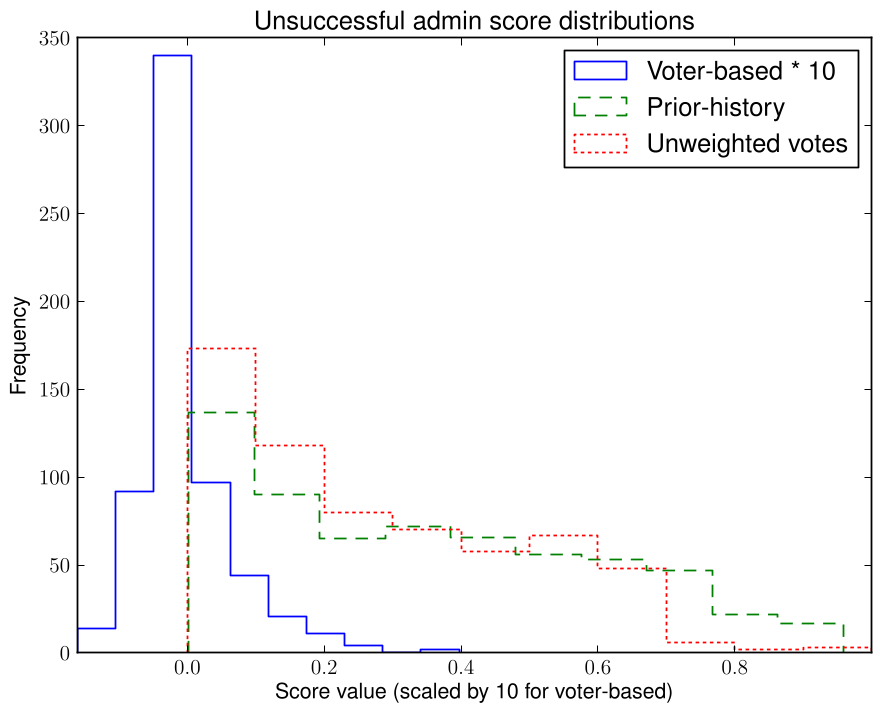 Figure 1: Comparison of RfA scores for successful vs. unsuccessful candidates.
The "Smoking Gun": Behavior Change Post-Election
The most striking finding of the paper is the behavioral shift.
- Normal Editors: Generally broaden their interests over time, leading to a decrease in CC-Scores.
- The "Infiltrators": A significant cohort of successful admins showed a "fat tail" increase in CC-Scores immediately after receiving their powers.
Surprisingly, these "just-above-threshold" admins—those who barely passed the vote—were the ones most likely to pivot toward concentrated controversy.
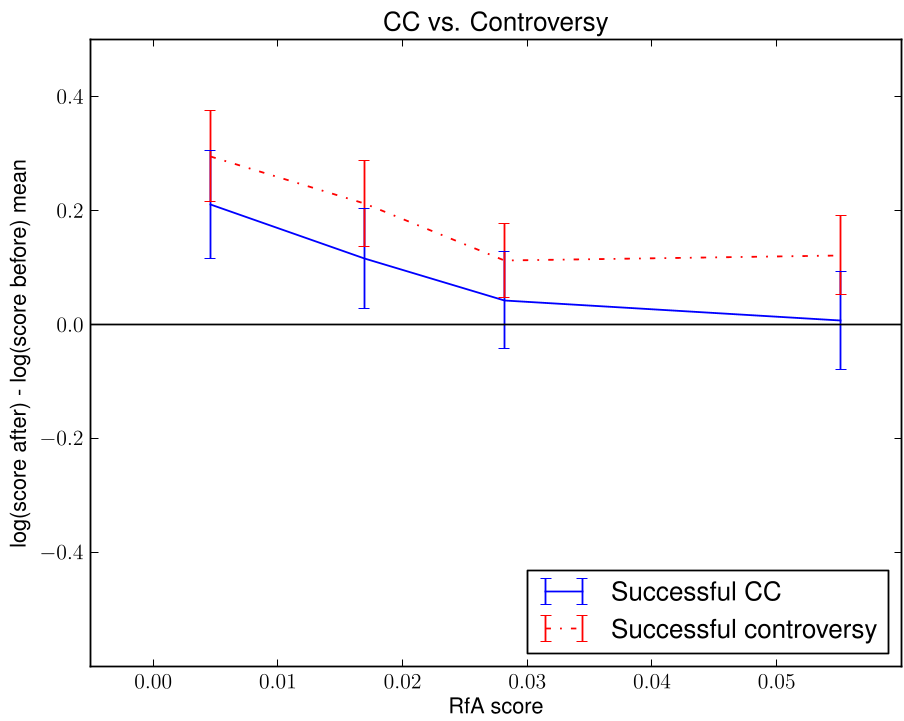 Figure 2: Changes in CC-Score and Controversy Score before and after RfA.
Why the "Wisdom of the Crowds" Fails (and How to Fix It)
Common metrics used to judge RfA candidates were found to be useless for identifying potential manipulators:
- Raw Vote Percentage: Higher vote counts did not correlate with better future behavior.
- Prior History Models: Quantitative metrics of "admin-like" behavior actually favored the manipulators, as they are often the ones most carefully mimicking the "ideal" editor.
The Solution: Expert Voter Weighting
The researchers applied a "voter-based score" (based on Ghosh et al.) that gives more weight to voters who have a history of making "correct" (consensus-aligned) judgments. This weighted model was far more effective at identifying the "just-above-threshold" candidates who would later abuse their power.
Critical Insight & Conclusion
This paper serves as a warning for all decentralized governance systems (DAOs, open-source projects, and social media). The signal of wisdom is often drowned out by the noise of the masses.
Takeaways:
- Manipulation is sophisticated: Bad actors don't just vandalize; they simulate "good citizenship" to gain systemic power.
- Expertise matters: Purely democratic "one-person-one-vote" systems are highly susceptible to "POV-pushing" groups. Weighting the opinions of established, reliable participants is a necessary defense mechanism.
Limitations: The study relies on historical data from 2012-2013; modern Wikipedia has introduced more automated bots, though the fundamental human "social engineering" aspect of becoming an admin remains remarkably similar today.