
The paper proposes a "many-body branch-selection" mechanism to achieve a strong Josephson Diode Effect (JDE) in an interacting nanoscale SQUID. By utilizing a double-quantum-dot interferometer, the researchers demonstrate that nonreciprocity is significantly enhanced when positive and negative critical currents are optimized on different many-body branches (0 and π states) across a quantum phase boundary.
TL;DR
Researchers have uncovered a powerful mechanism for the Josephson Diode Effect (JDE) that leverages many-body physics rather than simple geometry. By using an interacting double-quantum-dot SQUID, they demonstrated that one can "select" different quantum ground states for positive and negative currents. This branch-selection—bolstered by nonlocal Cooper-pair tunneling—transforms the diode effect from a fragile numerical curiosity into a robust, gate-tunable "diode band."
The Motivation: Moving Beyond "Skewed" CPRs
In the race to build dissipationless superconducting electronics, the Josephson Diode Effect (JDE) is the holy grail. Traditionally, JDE is achieved by breaking inversion and time-reversal symmetry to "distort" or "skew" the Current-Phase Relation (CPR).
However, there is a limit to how much you can warp a single ground state. The authors of this paper asked a deeper question: What if the forward and backward currents belonged to entirely different many-body states?
By operating near the 0-π transition—a quantum phase transition where the ground state parity changes due to strong electron correlations (Coulomb repulsion $U$)—the system reaches a non-analytic point. At this boundary, the physics isn't just distorted; it's redefined.
Methodology: The Power of Parallel Dots and Nonlocal Pairing
The researchers modeled a SQUID consisting of two parallel quantum dots. The "secret sauce" here is the nonlocal pairing channel ($\zeta$).
- Local Pairing: A Cooper pair tunnels through a single dot.
- Nonlocal Pairing: A Cooper pair is split, with one electron traversing each arm.
Why Nonlocal Pairing Matters
While many models treat SQUID arms as independent, this paper proves that the nonlocal channel is the "control knob" for stability. It reduces the energy splitting between competing states and reshapes the phase boundary. Without it, the diode effect only exists in high-precision "hotspots." With it, we get a wide, experimental-friendly "diode band."
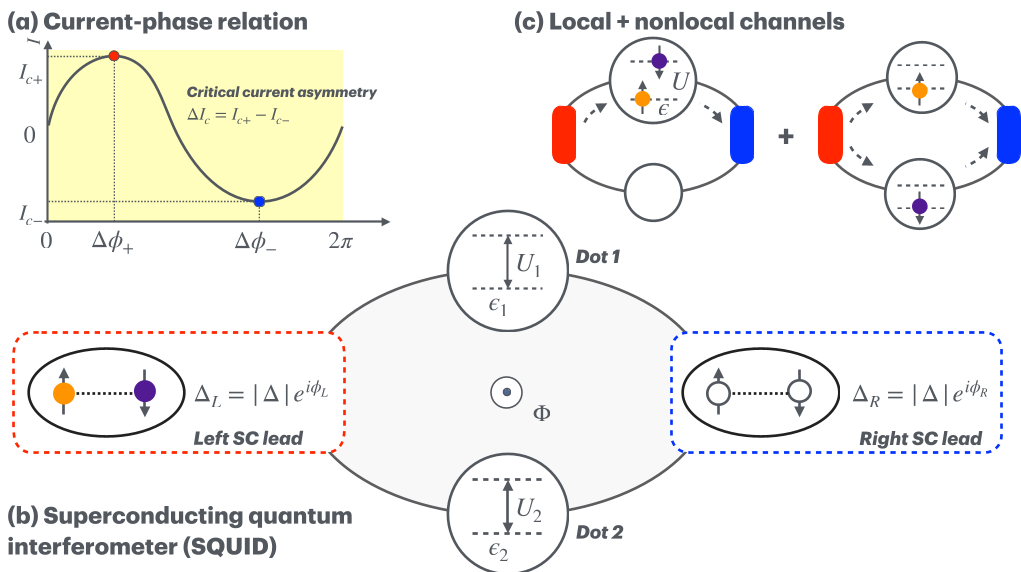 Fig 1: (b) The SQUID architecture with two quantum dots. (c) Visualization of local vs. nonlocal (pair-splitting) transport.
The Core Insight: Branch-Selection Mechanism
The beauty of this method lies in the Energy-Phase relationship. As the phase difference $\Delta\phi$ changes, the system's ground state can hop between a "Singlet" (0-phase) and a "Doublet" ($\pi$-phase).
In the "Branch-Selected" regime:
- The Positive Critical Current ($I_{c+}$) is reached while the system is in the Singlet branch.
- The Negative Critical Current ($I_{c-}$) is reached while the system is in the Doublet branch.
Because these two branches have fundamentally different slopes (currents), the resulting asymmetry $\Delta I_c$ is massive compared to standard single-branch diodes.
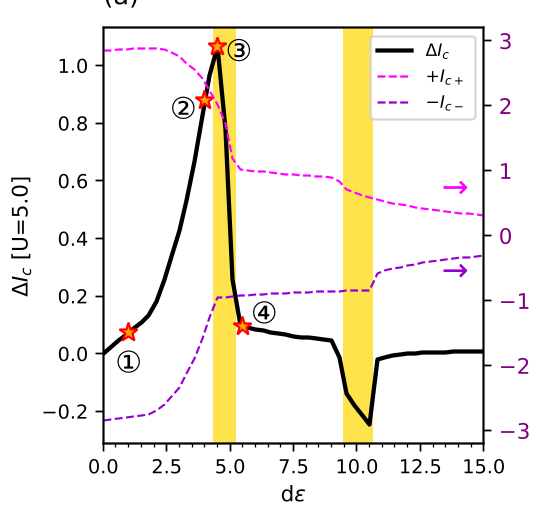 Fig 2: The orange region highlights where $I_{c+}$ and $I_{c-}$ are plucked from different many-body branches, maximizing the diode effect.
Experimental Evidence & Robustness
A common critique of "Atomic Limit" models (where the superconducting gap $\Delta o \infty$) is that they ignore the quasiparticle continuum. The authors addressed this using the Generalized Atomic Limit (GAL).
They found that even with a finite gap, the many-body mechanism holds. The nonlocal 0-π transition remains far more effective at generating a diode response than the local one. By tuning the gate voltage (detuning $d\epsilon$) and magnetic flux $\Phi$, the direction of the diode can be reversed, offering a "programmable" rectifier.
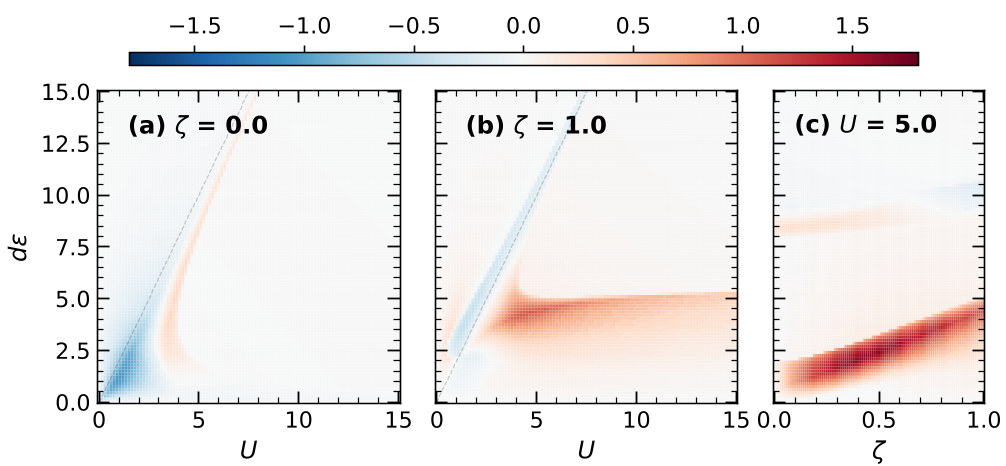 Fig 3: Contrast between $\zeta=0$ (local only, fragile hotspots) and $\zeta=1.0$ (nonlocal included, robust diode bands).
Deep Insight & Future Outlook
The "Branch-Selection" principle provides a new design rule: To maximize nonreciprocity, place your operating point where the CPR extrema straddle a quantum phase boundary.
This is not just for quantum dots. This logic could potentially be extended to:
- Topological Josephson Junctions involving Majorana bound states.
- Spin-Orbit Coupled Systems where magnetic textures drive transition boundaries.
The study proves that in the quantum world, the most efficient way to go "one way" is to change who you are (the many-body state) before you turn around.
Senior Editor's Note: This work elegantly bridges the gap between many-body theory and device engineering. The transition from point-like "hotspots" to "diode bands" via nonlocal pairing is a significant step toward making Josephson diodes a practical reality in quantum circuits.