
Mapping Search Relevance to Social Networks: Deciphering the "Who" in the "How"
Mapping search relevance to social networks
The paper introduces a social-distance-aware search mechanism designed for social networking sites, utilizing a modified Recursive Neighborhood Mean (RNM) algorithm to cluster users into cohesive subgroups. By mapping LinkedIn's social graph structure for 21M members, the study demonstrates that incorporating community-based social proximity significantly raises search relevance. The method achieves a 54% higher likelihood of search result clicks within the same subgroup compared to traditional keyword-only baselines.
TL;DR
This seminal work from KDD 2009 addresses a fundamental flaw in traditional search: it treats all searchers as identical entities. By leveraging the LinkedIn social graph (21M members), the authors prove that "Social Distance"—defined through community clusters rather than just degrees of separation—is one of the strongest predictors of search intent. They introduced a modified Recursive Neighborhood Mean (RNM) clustering algorithm to group users, leading to a 54% improvement in search result click-through rates (CTR).
The "Small World" Search Paradox
In web search, we look for information; in social search, we look for people. Traditional algorithms like PageRank assume that "quality" is a global property. However, in a social network, relevance is relative.
The authors point out two critical limitations of prior work:
- Keyword Ambiguity: A search for "Manager at P&G" might return hundreds of profiles. Keyword relevance cannot distinguish which one the searcher actually knows or identifies with.
- The Geodesic Failure: While we live in a "Small World" (where most people are 6 steps away), being "3 degrees away" isn't specific enough. Millions of people fall into that bucket, creating a "flat" relevance gradient that fails to rank results effectively.
Methodology: Clustering at Scale
To solve this, the researchers focused on Social Structure as a proxy for identity. They used a modified version of James Moody’s RNM algorithm.
The Intuition behind Modified RNM
Instead of just counting hops, the algorithm works like a "diffusion" process:
- Random Initialization: Every user is assigned random values on dimensions.
- Recursive Averaging: In each iteration, a user's value becomes the mean of their neighbors' values.
- Meta-stable Equilibria: Densely connected groups (communities) quickly reach a common value, while sparse connections between groups prevent these values from equalizing globally.
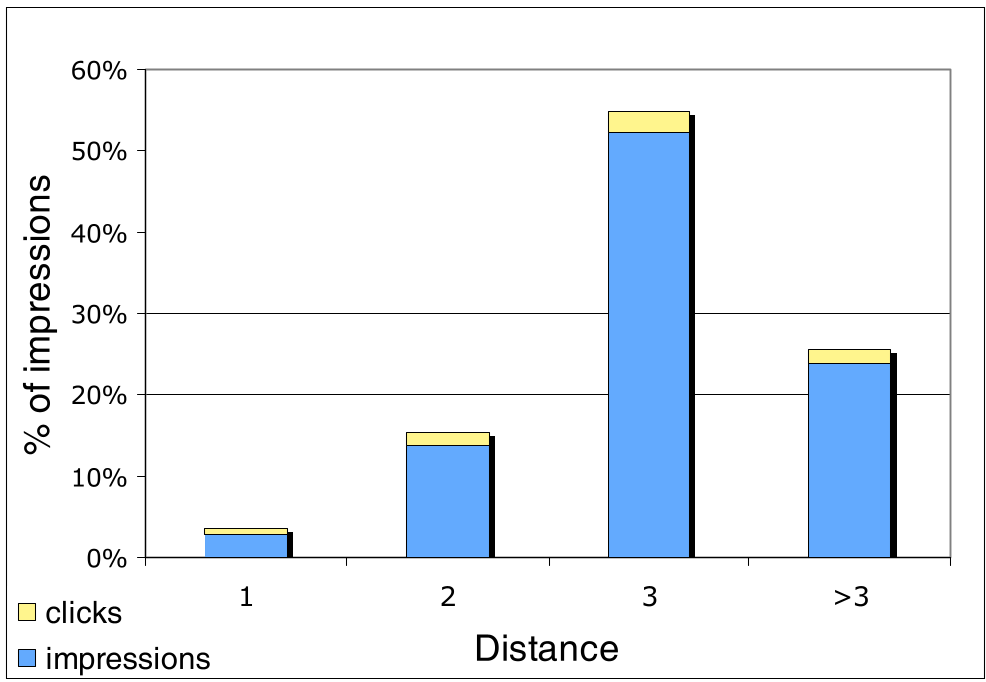 Figure 1: Most search impressions occur at a distance of 3 degrees or more, where keyword differentiation becomes hardest.
This approach is computationally efficient (), making it feasible for the 21M nodes and hundreds of millions of edges present in the 2008 LinkedIn graph.
Experimental Results: The Power of Subgroups
The researchers divided the graph into 100 subgroups. The findings were stark: the conditional probability of a user clicking a result in their own subgroup was double the baseline.
Logistic Regression Insights
To prove this wasn't just a side effect of people searching for their direct friends (1st-degree connections), the authors ran a logistic regression.
| Variables | Odds Ratio | Importance |
|---|---|---|
| Same Subgroup | 1.542 | High Impact |
| Degree = 1 (Friends) | 3.651 | Expected |
| Degree > 3 | 0.898 | Negative Correlation |
Even when excluding direct connections and accounting for the result's position (rank), Same Subgroup membership provided a 54% lift in click probability.
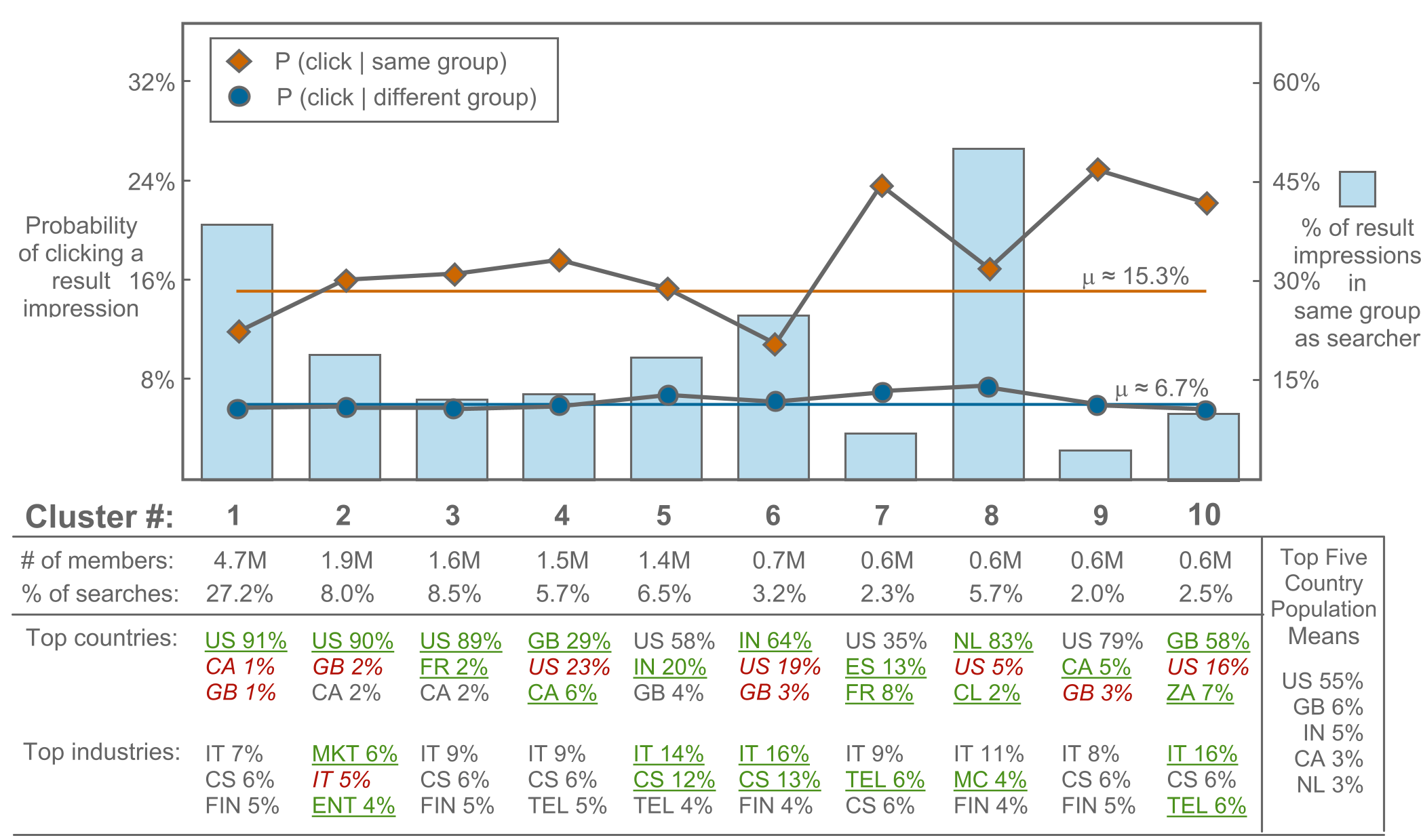 Figure 2: Consistent doubling of CTR when the searcher and the result belong to the same community cluster.
Beyond Geography
An interesting finding was that these subgroups were not just geographic clusters. While geography is a factor, Figure 4 in the paper shows that clusters often span continents based on shared professional industries or educational backgrounds, proving that structural social distance captures nuances that simple attribute-matching (like "Current City") misses.
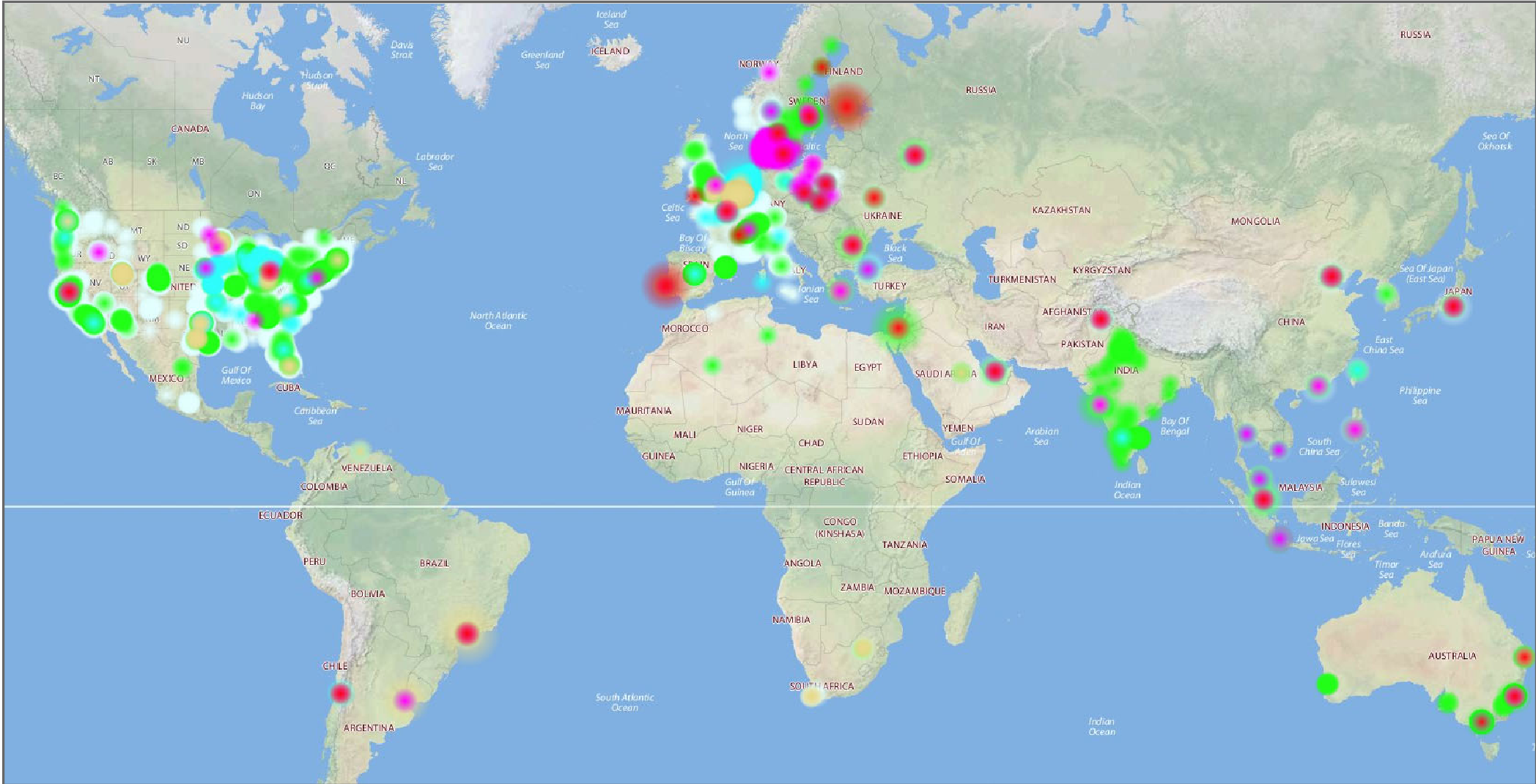 Figure 3: Social subgroups are geographically diverse, reflecting the complexity of professional networks.
Critical Insight & Conclusion
This paper was one of the first to bridge the gap between Sociological Theory (Homophily and Diffusion) and Large-scale Industrial Search.
Key Takeaway: Relevance isn't just about what you Type; it's about who you Are within the network. By mapping the macro-structure of social networks into "hard clusters," we can dramatically reduce search noise.
Limitations: The study used "hard" clustering (one user = one group). In reality, users belong to multiple overlapping circles (work, school, hobbies). Future iterations of this logic now use Graph Neural Networks (GNNs) and Node Embeddings to capture these overlapping identities in high-dimensional latent space.