
BigUISN: Decoding Popularity in the Fog of Uncertain Social Big Data
MapReduce-Based Complex Big Data Analytics over Uncertain and Imprecise Social Networks
This paper introduces BigUISN, a MapReduce-based analytical solution designed to mine "interesting popular patterns" from uncertain and imprecise social networks. By leveraging a distributed divide-and-conquer approach, it identifies groups of social entities frequently followed by users even when relationship data is incomplete or probabilistically defined.
TL;DR
In the era of Big Data, social connections aren't always "black and white" (followed vs. not followed). Due to privacy masks and data noise, connections are often probabilistic. This paper presents BigUISN, a MapReduce-driven framework that efficiently unearths popular groups of users in these "uncertain" networks. It achieves high scalability and an 8x speedup over traditional serial methods by combining probabilistic theory with a distributed pruning strategy.
Problem & Motivation: The Uncertainty of Connection
Most social mining algorithms treat a "Follow" relationship as a binary state. But what if we only have a 70% certainty that User A follows User B? This uncertainty stems from:
- Privacy Settings: Data might be partially obscured to protect user identity.
- Naming Ambiguity: Is "Johnny" the same as "Jean"? The system might assign a probability to this link.
The challenge is that processing these "Existential Probabilities" at scale causes a combinatorial explosion. Identifying groups of followees that are "likely" popular requires more than simple counting; it requires a deep integration of probability into the mining logic.
Methodology: Pruning the Uncertain Search Space
BigUISN utilizes the MapReduce model to decompose the social graph into manageable partitions. The framework operates through an iterative process:
1. Expected Count Mechanism
Instead of counting raw followers, BigUISN calculates the Expected Count (expCnt). If a group of followees is followed by a set of followers with probabilities , the popularity is the sum of these probabilities.
2. Multi-Stage MapReduce Workflow
- Phase 1 (Individual Popularity): Identifies single social entities that meet the minimum threshold .
- Phase 2+ (Group Popularity): Iteratively builds pairs, triplets, and -tuplets.
The Core Insight (Pruning): The algorithm applies a "Downwards Closure" property. If followee is not popular enough individually, any pair is mathematically guaranteed to be unpopular. This allows the system to drop thousands of potential combinations early.
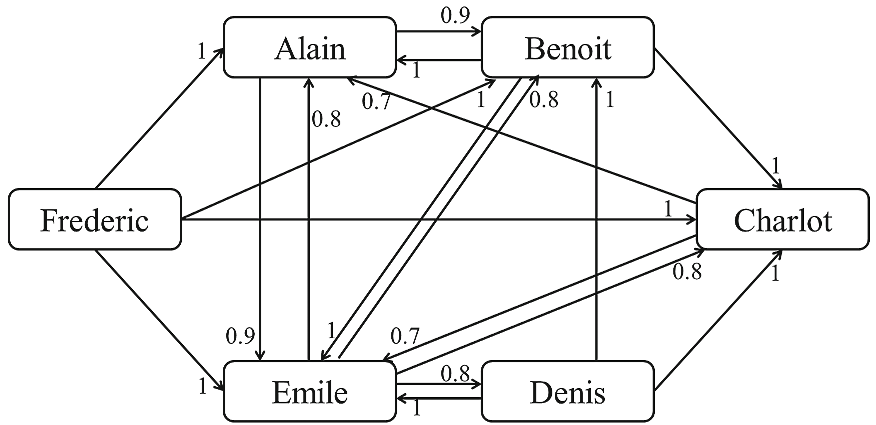 Figure 1: Conceptual representation of followership linkages in complex networks.
Experiments & Results: Performance at Scale
The authors tested BigUISN on real-world data from SNAP (Facebook and Twitter).
- Speedup: On the Facebook dataset (88k connections), BigUISN outperformed the serial FoP-miner by 800%.
- Stability: The runtime is remarkably stable. Even when the "uncertainty" (the probability values) varies, the MapReduce overhead remains constant, proving it can handle "noisy" data without a performance penalty.
- Scalability: By using Amazon EC2 clusters, the authors showed that as the dataset size grows (Twitter dataset with 1.7M connections), the distributed nature of BigUISN keeps the computation time within practical limits compared to non-distributed peers.
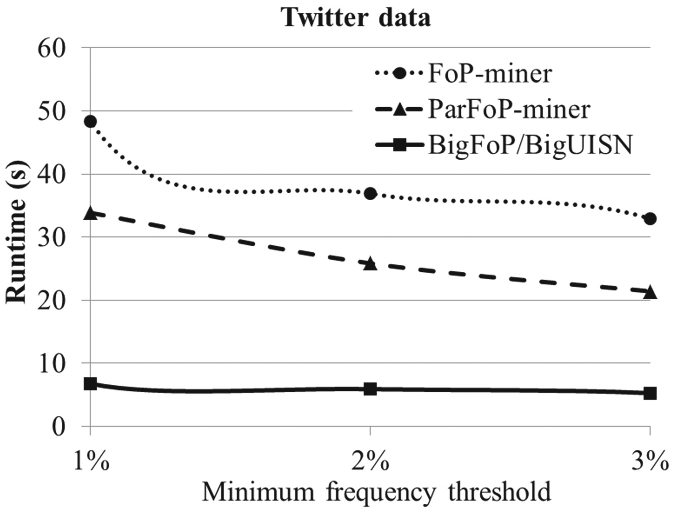 Figure 2: Runtime performance vs. Threshold on Facebook and Twitter datasets.
Critical Analysis & Conclusion
BigUISN effectively bridges the gap between theoretical probabilistic mining and industrial-scale big data.
Takeaway: The value of this work lies in its "Uncertainty-Awareness." Businesses can now perform targeted advertising by identifying popular user clusters even when the underlying data is fuzzy or anonymized.
Limitations: While MapReduce is robust, it involves significant disk I/O between stages. Future iterations could leverage Apache Spark to keep intermediate results in memory, likely cutting latency even further. Additionally, the existential probability is currently treated as an input; an automated way to calculate these probabilities from behavioral patterns would be a powerful extension.
Conclusion: As data privacy regulations (like GDPR) make social data more "imprecise," algorithms like BigUISN that embrace uncertainty rather than avoiding it will become the standard for social analytics.