
Scaling Centrality: MapReduce Design Patterns for Large-Scale Social Graphs
MapReduce Design Patterns for Social Networking Analysis
This paper presents a scalable MapReduce-based framework for social network analysis, specifically targeting the calculation of Betweenness Centrality. By leveraging chained MapReduce jobs and Breadth-First Search (BFS) on sparse-adjacency matrices, the method decomposes complex graph metrics into distributed tasks suitable for Big Data environments like Hadoop.
Executive Summary
TL;DR: This paper tackles the "scalability wall" in social network analysis by re-engineering the Betweenness Centrality metric for the MapReduce paradigm. By utilizing sparse-adjacency matrices and a specific two-stage chained job structure, the author provides a blueprint for calculating graph metrics on massive datasets that otherwise crash conventional sequential architectures.
Context: Positioned within the field of Big Data Engineering, this work acts as a bridge between classical graph theory and modern distributed systems (Hadoop), specifically focusing on design patterns that mitigate the I/O and communication bottlenecks of iterative graph processing.
The Scalability Bottleneck
In the world of Social Media Analytics, nodes and edges represent actors and their relationships. As these networks scale to billions of connections, two major issues arise:
- Memory Constraints: Loading a full "bridge" or shortest-path calculation into RAM is impossible for massive graphs.
- Communication Overhead: MapReduce is notoriously inefficient for iterative graph algorithms because it often shuffles the immutable graph topology repeatedly across the network.
The author's core insight is to separate the graph topology from the analysis result, ensuring that only the necessary fragments of the graph are processed at any given time.
Methodology: The Chained MapReduce Pattern
The implementation decomposes the Betweenness Centrality formula into a distributed pipeline.
1. Shortest Path Estimation (BFS)
Instead of using Dijkstra’s algorithm (which requires complex state management), the author opts for an inductive Breadth-First Search (BFS). The "frontier" of the graph is pushed incrementally. Each iteration determines the shortest current path to a node without backtracking.

2. The Two-Stage Pipeline
The system relies on a Job Controller to handle the execution of two distinct MapReduce classes:
- The Path-Finder Job: A Mapper emits updated paths while a Reducer compares lengths to determine the "Best" (shortest) paths.
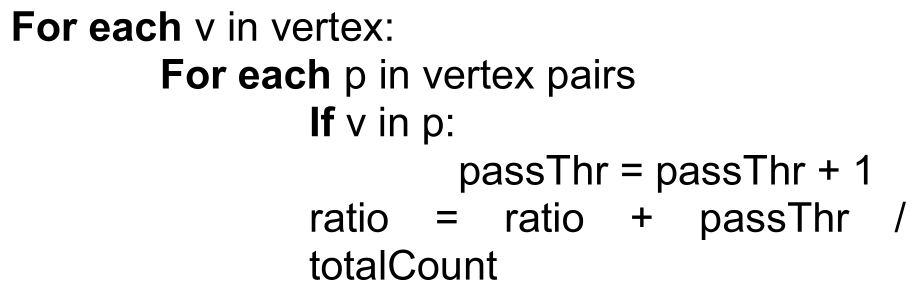
- The Statistical Job: A second chain takes these paths and calculates the ratio of how many shortest paths pass through a specific node of interest.
Deep Dive into the Algorithm
The pseudo-code reveals a strict adherence to the Functional Programming constraints of MapReduce:
- Mapper: Takes a starting node and an adjacency list, then "emits" the next step in the path.
- Reducer: Aggregates these paths, filters for the target node, and maintains only the minimal length sequences.
This "stateless" approach allows the task to be spread across a cluster of commodity hardware without the need for global shared memory, which is the primary limitation of non-distributed graph libraries.
Experimental Context & Results
By citing established benchmarks—such as Lin and Schatz’s work where PageRank runtime was reduced by 69% using similar patterns—the author demonstrates the viability of this decomposition. The use of sparse-adjacency matrices significantly reduces the boolean footprint of the graph, allowing the Hadoop framework to handle fragments of the structure without triggering "Out of Memory" errors.
Critical Insight & Conclusion
Takeaway
The real value of this paper isn't just in calculating "Betweenness Centrality," but in providing a reusable template for any iterative graph metric. By treating the graph as a series of message-passing events rather than a static entity, we can scale social analysis to the petabyte level.
Limitations & Future Work
The author acknowledges two main hurdles:
- Latency: Chained jobs in Hadoop have high overhead as they must write intermediate results to the Distributed File System (DFS).
- Efficiency: Future iterations could benefit from more advanced representations of current paths to reduce the data volume during the "Shuffle" phase.
For practitioners, this paper serves as a reminder that the key to Big Data is not just more hardware, but the algorithmic decomposition of legacy formulas into distributed-friendly patterns.