
Market-Based Incentive Design: Solving the Crowdsourcing Coverage Hole
Market-Based Incentive Mechanism Design for Crowdsourcing
This paper introduces a Market-Based Incentive Mechanism for crowdsourcing to resolve the "coverage hole" problem. It utilizes a novel reverse auction framework with dynamic reserve prices to motivate participants to move from over-saturated popular areas to underserved locations, achieving SOTA task completion rates.
TL;DR
The effectiveness of mobile crowdsensing (e.g., noise mapping, traffic monitoring) depends on spatial coverage. However, participants naturally cluster in popular urban centers, leaving "coverage holes" elsewhere. This paper proposes a Market-Based Incentive Mechanism that uses a reverse auction with dynamic reserve prices to nudge participants toward unpopular areas, boosting task completion by nearly 300% over traditional methods.
Deep Dive into the Motivation: The Distribution Paradox
In most crowdsourcing scenarios, participants are not uniformly distributed. They follow regular mobility patterns, resulting in Supply Surplus in popular areas and Demand Surplus in remote ones.
Previous SOTA methods like MSensing focused on social welfare but treated participant locations as static or ignored the coverage gap. This leads to a lose-lose situation:
- Platform: Tasks in unpopular areas remain unfinished.
- Participants: Those in crowded areas face fierce competition and often lose auctions, wasting their potential utility.
Methodology: Soft Control via Reverse Auctions
Instead of "hard control" (commanding users where to go), the authors implement "soft control" through profit incentives.
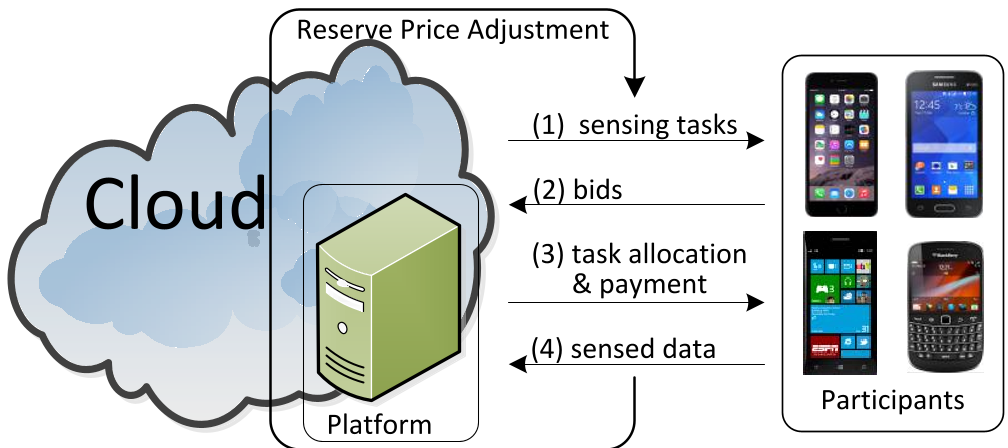
1. The Reverse Auction Framework
The platform acts as a buyer of data, and participants act as sellers.
- Reserve Price (): The maximum the platform is willing to pay for task .
- Bid (): Participants submit their cost, including sensing and movement costs ().
2. Dynamic Price Adjustment
The "secret sauce" is the round-by-round adjustment. If a task is in supply surplus (), the platform reduces its reserve price by .
3. Algorithm Design
- Winner Selection: Proven to be NP-hard via reduction from the Set Cover problem. The authors propose a Greedy Algorithm that selects participants based on their marginal social welfare.
- Truthfulness: A Critical Payment Determination algorithm ensures that the dominant strategy for participants is to report their true costs, preventing market manipulation.
Experimental Validation
The mechanism was tested in a simulated 200m x 200m area with 100 tasks and 500 participants clustered at the center (Gaussian distribution).
Key Findings:
- Task Completion: When participants are highly concentrated (), the proposed mechanism outperforms MSensing by 294.9%.
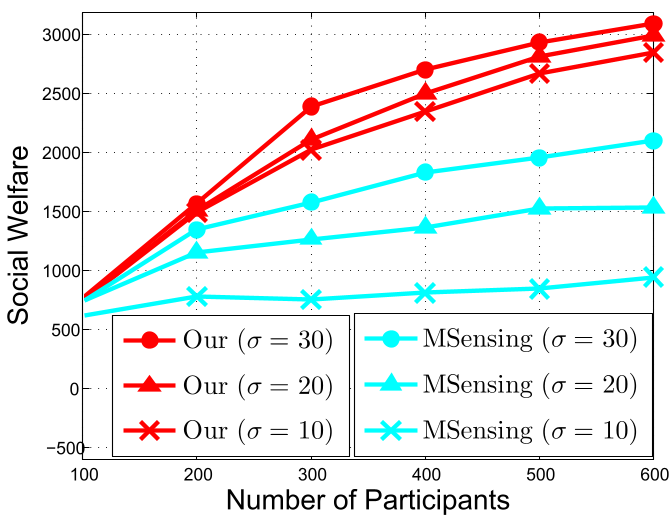
- Social Welfare: There is a massive gain in total system value because participants are distributed efficiently rather than redundant sensing in the same spots.
 (a) Task Completion Ratio: Note the widening gap as participant density increases.
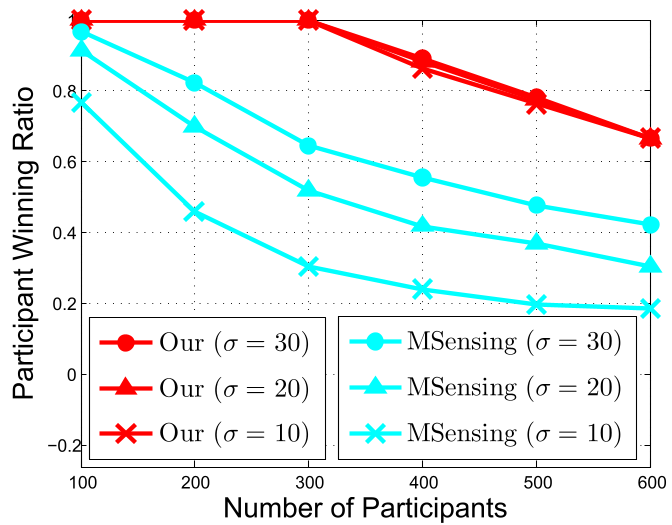
 (b) Participant Winning Ratio: More users find profitable tasks compared to baseline models.
Critical Insight: Why it Works
The brilliance of this approach lies in its Inductive Bias toward movement. By lowering the payout in popular areas, the "opportunity cost" of staying put becomes too high. Self-interested users naturally move toward the "coverage holes" to find higher reserve prices, effectively balancing the market without requiring centralized, mandatory movement commands.
Summary & Future Outlook
This paper serves as a vital bridge between Auction Theory and Mobility Control.
Limitations: The current model assumes participants have absolute freedom to move, which may not account for real-world constraints like road networks or predefined destinations. Future Work: Integrating more complex movement cost functions and exploring long-term participant retention strategies would be the logical next steps for this research line.