
Physics of the Market: Quantifying SNS Spikes as Stock Price "Acceleration"
Marketing Awareness by Social Network: A Case Study of HeatTech Products
This paper proposes a detection model to quantify the correlation between Social Network Service (SNS) volume spikes and stock price fluctuations. Using Latent Dirichlet Allocation (LDA) for topic extraction and a second-order differential equation for modeling, the authors demonstrate that product-related SNS bursts can act as constant "accelerations" on stock market performance, as evidenced by a case study on UNIQLO’s HeatTech.
TL;DR
Can a viral product on social media be modeled like a physical force acting on a stock? This paper moves beyond simple sentiment analysis by proposing a "Marketing Awareness" model. It treats SNS volume spikes as a constant acceleration (k) applied to stock prices, using differential equations to prove that social buzz directly drives the momentum of market valuations.
Background: Beyond Positive and Negative Sentiment
In the world of Awareness Computing (AC), identifying consumer reputation is crucial. However, traditional sentiment analysis is often binary and fails to capture the magnitude of market impact. The authors argue that stock prices are the ultimate "measurement index" because they aggregate all available information about a product's success. The challenge lies in determining if an SNS spike is merely noise or a signal that will move the needle on Wall Street.
Methodology: The "Force" of Social Media
The core innovation is the application of Newtonian logic to financial data. The authors propose that when an SNS spike occurs, it exerts a step-shaped "acceleration" on the stock price.
1. Topic Extraction (Cleaning the Signal)
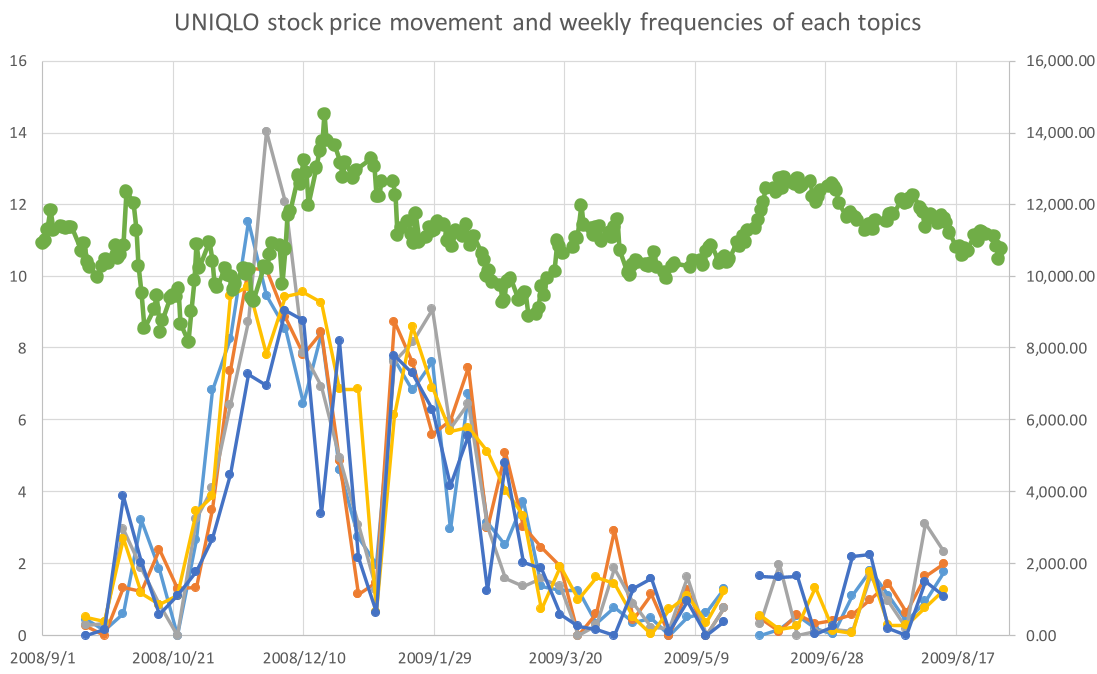
To remove noise, the authors used Latent Dirichlet Allocation (LDA) with Gibbs sampling on Yahoo Answers data. By focusing on bi-gram nouns, they identified five distinct topics related to UNIQLO's HeatTech, such as "Popular expansion" and "Comparison with competitors."
2. The Differential Equation
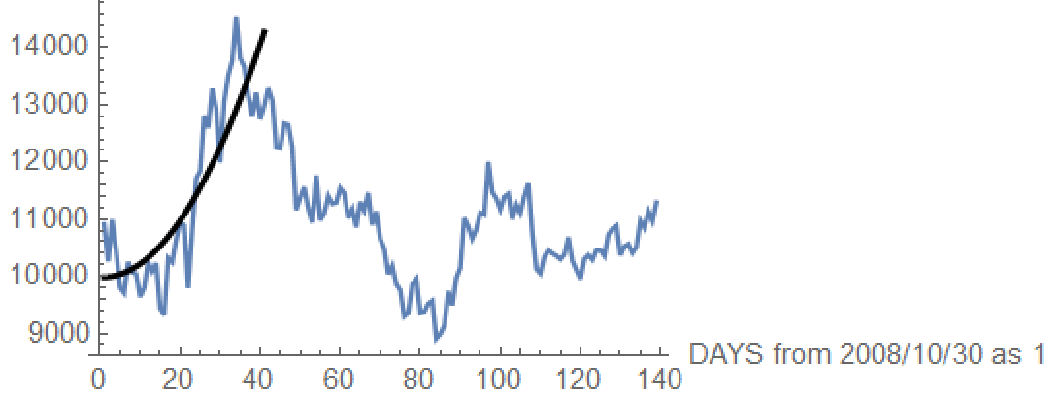
The fundamental assumption is: Where is the stock price, and is the constant acceleration triggered by the SNS burst. Solving this gives a quadratic position-time formula: By using the method of least squares, the authors fit this curve to the actual stock data to determine the sensitivity of the stock to social media pressure.
Experimental Results: The HeatTech Case Study
Analyzing UNIQLO (Fast Retailing Co.) during the 2008 peak of HeatTech products, the authors found a remarkable fit.
- Fitting Function:
- Correlation: A Pearson’s coefficient of 0.866.
- Sensitivity (k): 5.24 JPY/day².
The high correlation confirms that the stock price movement was not random but followed the "acceleration" curve dictated by the SNS awareness spike.
Critical Analysis & Conclusion
Market Insight
The paper introduces the concept of Stock Price Sensitivity. Not all products are created equal; some (like HeatTech) have high sensitivity (k=5.24), where a burst of interest leads to a massive valuation surge. Others, such as products facing a potential boycott, might show a negative but much smaller acceleration (k=0.35 in their secondary case study).
Limitations
- Directional Identification: The model still requires human intervention or prior analysis to decide if should be positive or negative.
- Spike Period Definition: The reliability of the fit is highly dependent on accurately defining the start and end of the SNS burst.
Final Takeaway
This research provides a bridge between qualitative text mining and quantitative financial modeling. By treating social media as a physical "impulse," marketers and investors can move toward an automated system that doesn't just ask "What are people saying?" but rather "How fast will this move the stock?"