
Bridge Extraction: Rethinking Influencer Marketing via Link Prediction
Marketing campaign targeting using bridge extraction
This paper introduces a novel marketing campaign targeting methodology based on "Bridge Extraction" within social networks. By combining topological metrics, sentiment analysis, and Klout-based influence scores, the authors predict future links (bridges) between influential communities to identify key nodes that act as intermediaries for effective information diffusion.
TL;DR
To maximize marketing ROI under limited budgets, this paper moves beyond simple "high-follower" metrics. It proposes a framework to identify bridge nodes—users who are predicted to form links between influential communities. By targeting these strategic intermediaries, marketers can ensure information flows across community boundaries, achieving superior diffusion.
The "Eco-Chamber" Problem in Modern Marketing
Most social marketing strategies suffer from a "local peak" problem: a brand finds an influential user, but that user’s influence is often contained within a single, highly-connected cluster. These "echo chambers" lead to redundant messaging within one group while leaving other potential markets untouched. The authors suggest that the true value lies in Bridges—the thin lines that connect these silos. Predict where a bridge will form, and you capture the future of information flow.
Methodology: From Crawling to Conversion
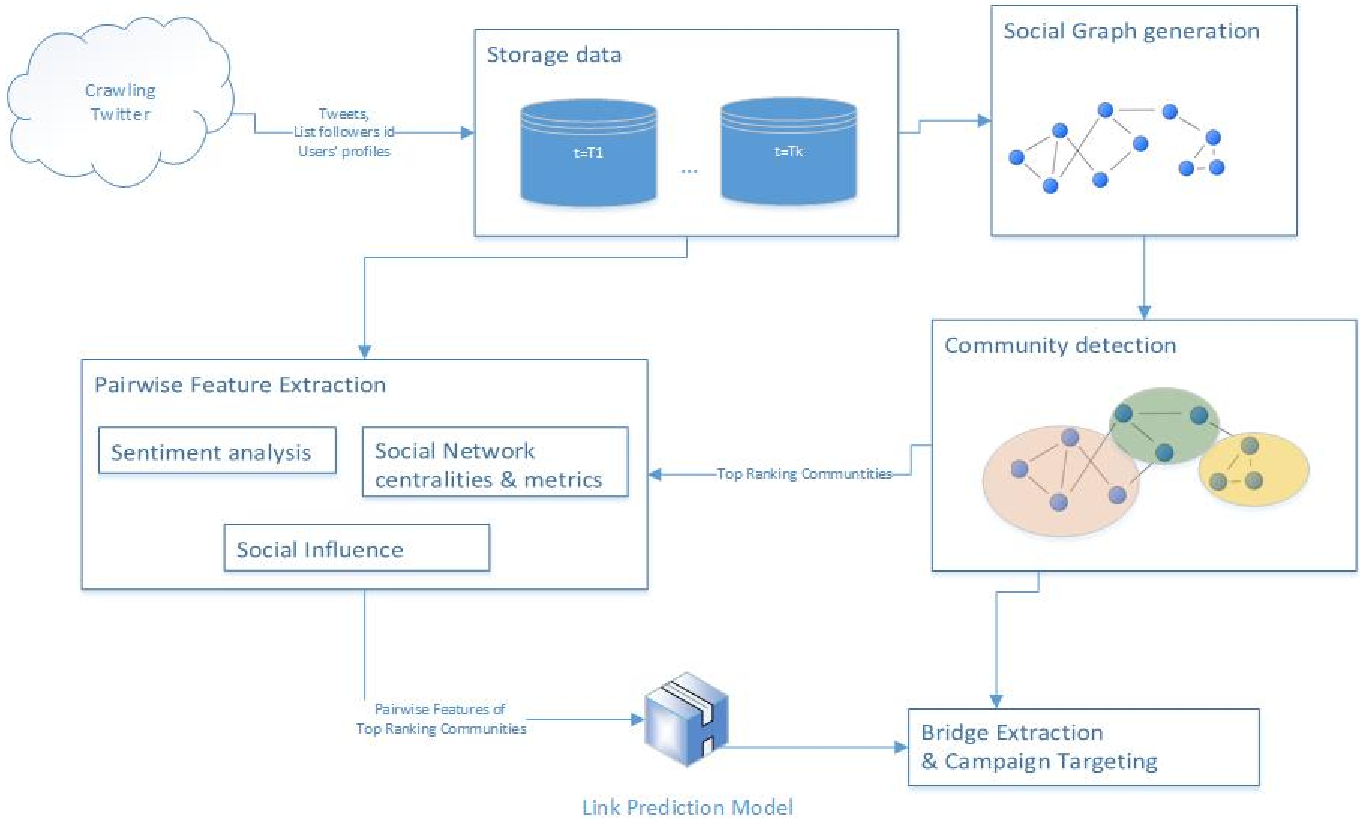
The proposed system architecture is a sophisticated pipeline designed to transform raw Twitter data into a ranked targeting list.
1. Hybrid Feature Engineering
The model doesn't just look at who follows whom. It integrates:
- Topological Features: Adamic-Adar, Jaccard Coefficient, and Preferential Attachment to measure "structural proximity."
- Sentiment & Linguistics: Using LIWC (Linguistic Inquiry and Word Count) to analyze psychological traits and TextBlob for sentiment alignment.
- External Influence: Integrating Klout scores to validate the social weight of individuals.
2. Community Influence Ranking
Using the Louvain algorithm, the network is decomposed into communities. These communities are then ranked not just by size, but by the aggregate influence (Klout) of their members. The goal is to find bridges primarily between "Top-Tier" communities.
Experimental Results: The Power of Predicted Bridges
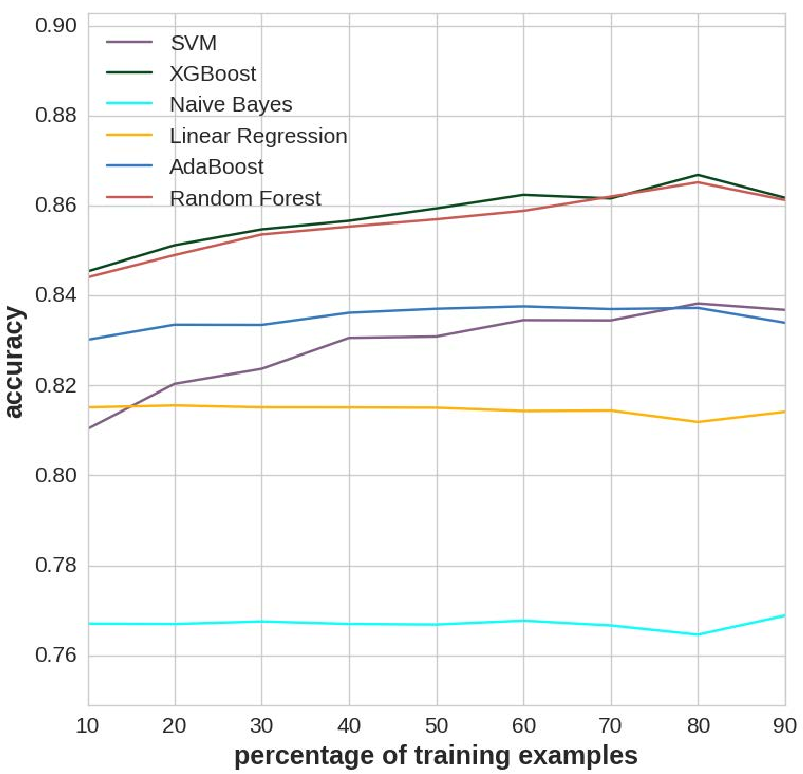
The authors tested several classifiers (SVM, Naive Bayes, Random Forest, etc.) across two types of graphs: the "Relation Graph" (general followers) and the "Mutual-Follow Graph" (stronger ties).
Key findings include:
- XGBoost Success: XGBoost emerged as a winner for the Mutual-Follow graph with an F1 score of 0.909, proving that ensemble gradient boosting is highly effective at capturing the non-linear relationship of link formation.
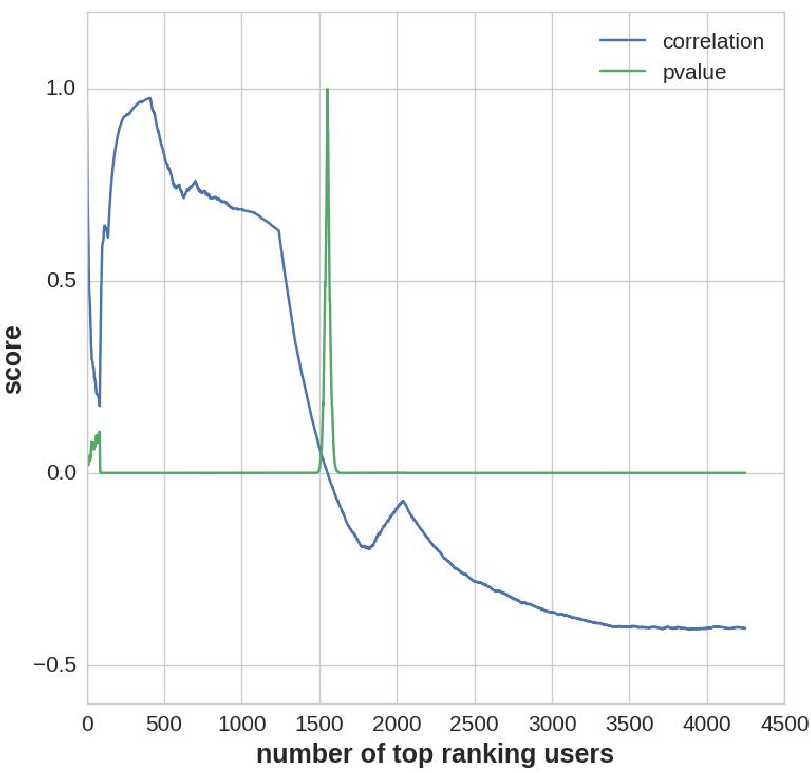
- Correlation with Influence: As shown in the Spearman Correlation analysis, there is a massive positive correlation (~0.9) between a user's participation in bridges and their overall Klout score for the top 500 users.
Critical Insight: Why Bridge Extraction Matters
A "Bridge" node is essentially a bottleneck for information. In the study, the bridge detection rate between top communities was 0.8%, compared to only 0.3% in lower-ranked ones. This suggests that influential people are naturally more likely to form cross-community alliances. For a marketer, paying a premium for a "bridge node" is more efficient than paying for multiple redundant "community-internal" influencers.
Conclusion & Future Outlook
This work shifts the focus of Social Network Analysis (SNA) in marketing from Node Centrality to Link Potentiality.
Limitations: The study assumes the network is relatively static over short windows (3-4 days) and relies on third-party metrics like Klout. Future Direction: The authors aim to scale this using Spark/Hadoop and incorporate location-based features to further refine the "Bridge" prediction accuracy.