
E-Service Harmonization: Navigating the Intersection of Digital and Physical Commerce
18659_Marketing challenges of e-services.
This paper explores the strategic integration of e-services within traditional marketing frameworks, identifying them as both substitutes and complements to existing product portfolios. It emphasizes the shift from supply chains to value networks and highlights the necessity of multi-channel coordination in the digital age.
TL;DR
As the Internet shifts from a niche tool to a fundamental infrastructure, organizations face the daunting task of "harmonizing" marketing activities across disparate channels. This paper argues that e-services are more than just websites—they are strategic components that act as both substitutes and complements to physical goods, requiring a radical shift from managing supply chains to orchestrating value networks.
The "Harmonization" Gap: Why E-Commerce is Still Hard
Despite the ubiquity of the Internet, many organizations still struggle with a fragmented customer experience. The author, Ruth N. Bolton, identifies a critical pain point: Information Asymmetry has shifted from the seller to the buyer. In computer-mediated environments, customers have more power, more data, and less geographical loyalty.
The motivation for this research is clear: traditional "siloed" marketing (where the online team doesn't talk to the retail team) is failing. The challenge lies in creating a consistent brand equity when a customer might discover a product on social media, research it via a Web-based support portal, and finally purchase it through a physical kiosk or dealership.
Methodology: Categorizing the E-Service Portfolio
Bolton provides a framework for understanding how e-services fit into a modern business. By mapping channels against offerings, she demonstrates that e-services are not merely "online versions" of old products, but entirely new drivers of value.
The Marketing Activity Matrix
The paper categorizes market expansion into four quadrants:
- Digitized Products: Turning music or text into bits.
- Web Services: Support sites that enhance physical goods.
- New Digital Offerings: Standalone services like email or stock alerts.
- Embedded E-Services: The most forward-looking category, where microprocessors in consumer durables (refrigerators, cars) enable transactions without direct buyer involvement.

Figure 1: The intersection of traditional and digital channels according to the offering type.
Critical Implementation Challenges
The core of the paper focuses on "How" to extract value. Bolton identifies three technical and psychological levers:
- Usability & Navigation: The digital interface is the new storefront. Quality is measured by how easily a user can navigate the latent space of the website.
- Customization: Leveraging customer information to provide a unique, data-driven experience.
- The Trust Paradox: As interactivity increases, so does the risk to privacy. Creating trust through security is a prerequisite for any usage-based pricing strategy.
Experimental Insight: Multi-Channel Synergies
The paper cites real-world examples to validate its framework. Specifically, it notes Dell’s strategic use of in-store kiosks to capture the 25% of the market that remains retail-only. This illustrates the "Complementary" nature of e-services; they shouldn't just replace traditional channels but fill the gaps between them.
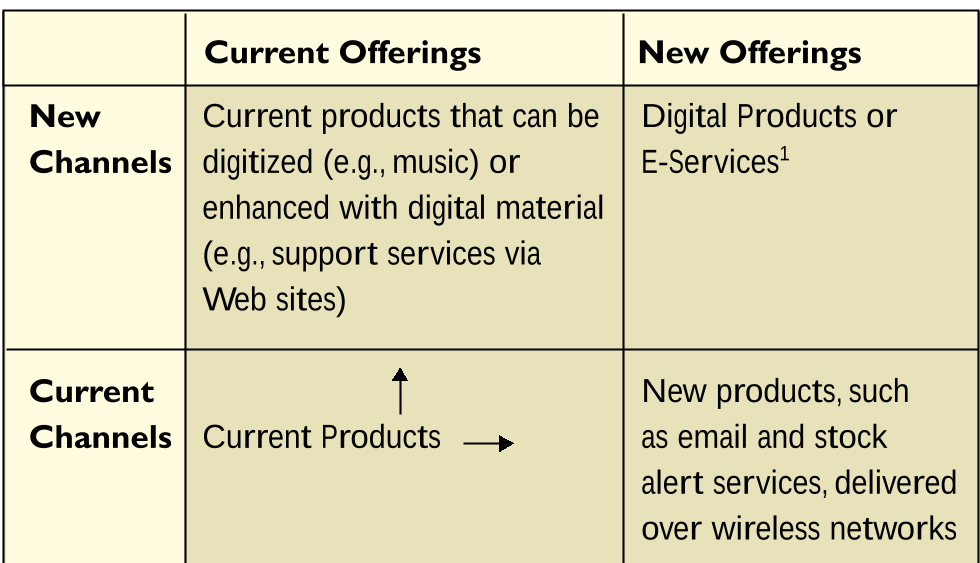
Table 1: Strategic placement of offerings across new and current channels.
Summary and Future Outlook
The ultimate takeaway is that e-services have transformed marketing from a linear process into a multidimensional "Value Network."
Key Takeaways:
- Consistency is King: Marketing activities must be consistent across personal selling, mass media, and computer-mediated interactions.
- From Chains to Networks: Organizations must learn to leverage customer-to-customer communication as a form of brand equity.
- Performance Metrics: Traditional metrics are insufficient; we need new ways to measure the effectiveness of interactive media.
Limitations: While the paper provides a robust theoretical framework, it acknowledges that the long-run ramifications of e-commerce on organizational behavior remain partially unclear, particularly regarding how geographically-based competition will evolve into purely digital rivalry.