
Marketing the Unmarketable: A Logic-Based Approach to Social Diffusion
Marketing impact on diffusion in social networks
The paper introduces a formal mathematical and logical framework for integrating marketing impact into the standard threshold model of social networks. It proposes two axiomatic systems—one for promotional marketing and one for preventive marketing—and proves their soundness and completeness as extensions of Armstrong's axioms from database theory.
TL;DR
This paper bridges the gap between social network diffusion models and database theory. The authors introduce "marketing pressure" into the classic threshold model, allowing for formal reasoning about how a budget can be used to either promote a product or prevent the spread of a social norm (like smoking). They provide a sound and complete set of axioms—extensions of Armstrong's famous axioms—to define these influence relations precisely.
Background: Beyond Peer Pressure
Historically, models like the Threshold Model (Granovetter, 1978) focused on peer influence: an agent adopts a behavior once enough neighbors do. But in the real world, adoption is also driven by external factors—ads, coupons, or public health campaigns. The core challenge is: how do we formally model the trade-off between social influence and a limited marketing budget?
The Core Mechanism: Marketing Receptivity
The authors redefine the adoption condition for an agent as follows:
- : The actual money spent on agent .
- : The "receptivity" of the agent. If is positive, it's promotional; if negative, the spending acts as a preventive barrier.
- : The intrinsic threshold (resistance) of the agent.
The model considers a set influencing a set under budget (). This means that with spending , if adopts the product, will eventually follow.
Methodology & Architecture
The researchers split the logic into two systems based on the intent of the marketing:
- Promotional Marketing: Uses an "additive" transitivity—if influences with budget , and influences with budget , then influences with budget .
- Preventive Marketing: Focuses on the "stability" of the influence under any possible counter-campaign within a budget.
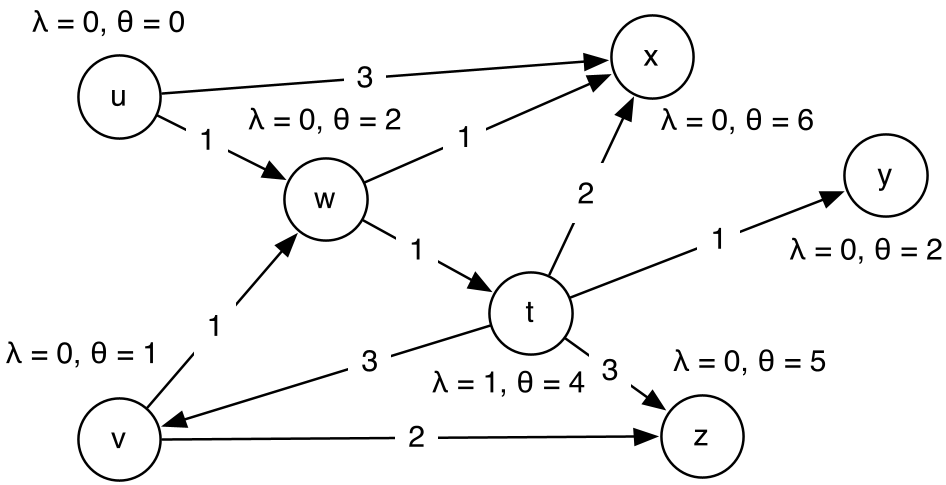 In the figure above, the diffusion process demonstrates how marketing pressure on a specific node (like 't') can trigger a chain reaction across the network.
Axiomatizing Social Influence
The beauty of this work lies in its "Completeness Proofs." The authors show that the logic of marketing influence is virtually identical to the logic of functional dependencies in databases.
Promotional Logic Axioms:
- Reflexivity: Any set influences itself with any budget.
- Augmentation: If influences , then adding agents to both sets preserves the relation.
- Transitivity: .
Preventive Logic Axioms:
Interestingly, the preventive model includes a Monotonicity rule: if you can influence someone despite a large preventive budget , you can definitely do it against a smaller budget .
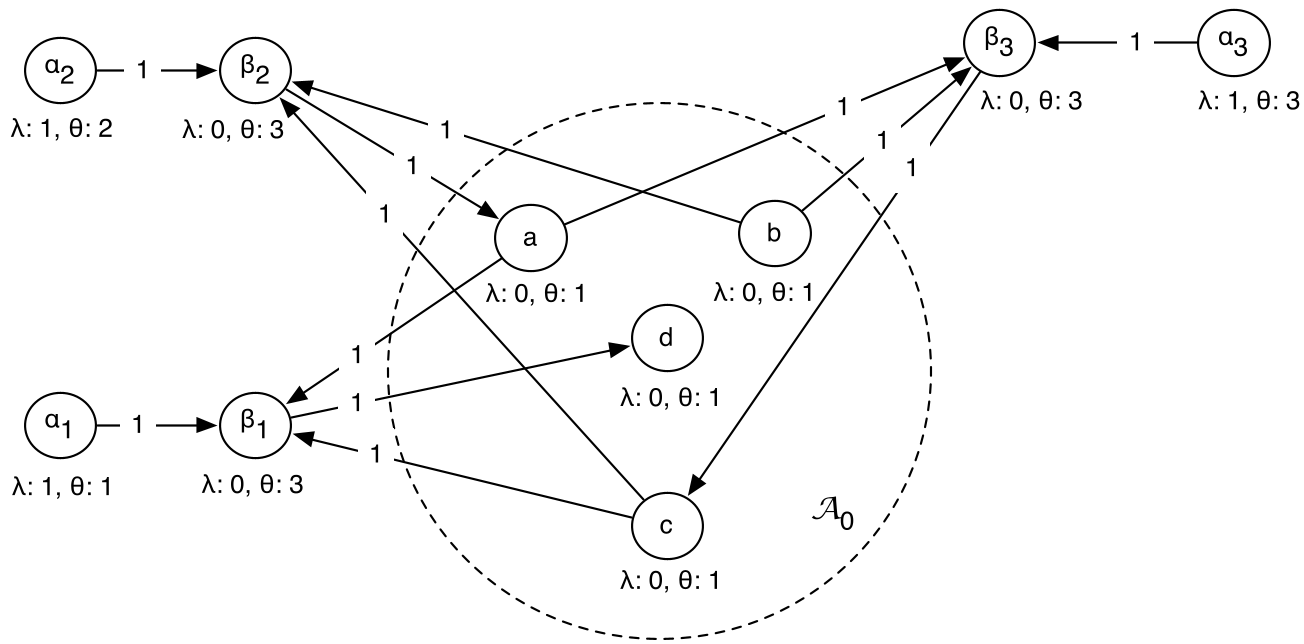 The image above shows the 'Canonical Model' used to prove completeness. It constructs a specific network structure where any formula not derivable from the axioms is shown to be false.
Experiments and Logic Verification
Since this is a theoretical logic paper, the "experiments" are mathematical proofs. However, the authors provide several clear examples of how these relations hold. For instance, in the promotional setting, they prove that the "Budget-Constrained Monotonicity" (if , then ) is a derivable lemma, validating the intuitive sense that "more money is always (at least) as effective."
Critical Insight & Limitations
This work translates the "black box" of social marketing into a transparent, logical system. However, it operates on a deterministic threshold model. Real-world networks often involve stochastic elements (randomness), which this logic doesn't yet cover. Furthermore, the reliance on real numbers for budgets makes computational complexity a future concern—actual implementations might need to restrict inputs to rational numbers for Turing machine compatibility.
Conclusion
By extending Armstrong’s Axioms, Naumov and Tao have provided a rigorous foundation for "Marketing Logic." Whether you are trying to maximize the viral spread of a new app or minimize the spread of misinformation, this framework offers a formal way to calculate how peer impact and external spending interact to reshape the social landscape.