
Beyond Binary Bubbles: Modeling Complex Opinion Dynamics with Markov Random Fields
Modeling opinion dynamics in a social network using Markov random field
This paper proposes a Markov Random Field (MRF) based model to simulate opinion dynamics in social networks, supporting multiple discrete levels of positive, neutral, and negative opinions. It employs Periodic Gibbs Sampling and Fixed Point Iteration to characterize steady-state equilibria across synthetic and real-world topologies.
TL;DR
In the battle for hearts and minds—whether in politics or product marketing—we often oversimplify opinions as "for" or "against." This paper introduces a Markov Random Field (MRF) framework that allows for a spectrum of opinions (positive, neutral, negative) and various intensities. The core finding? Intrinsic quality beats initial hype. Even if you start with a massive initial advantage, the social network's steady state will eventually favor the entity with the strongest "base appeal," specifically in networks with heavy-tailed distributions.
Problem & Motivation: The Limitation of "Either-Or"
Most classical models like the Ising model treat opinions like magnetic spins: you are either +1 or -1. In reality, modern social discourse is defined by the "silent majority" (neutral) and varying degrees of passion. Furthermore, existing "epidemic" models usually look at how one piece of information spreads unilaterally. They ignore the competitive nature of reality where two parties or brands fight for the same crowd.
The author’s intuition is that an individual’s opinion is a cocktail of two ingredients:
- Intrinsic Behavior (Base Probability): Factors external to the network, such as your own research, advertisements, or the actual quality of a product.
- Peer Effect (Social Influence): The pressure or persuasion exerted by your immediate neighbors in the graph.
Methodology: The Mechanics of Influence
The paper models the network as an undirected graph where each node has a local characteristic defined by the probability of holding opinion .
The Local Characteristic Formula
The probability of a node adopting a specific opinion is defined as:
Where:
- is the base probability (the "intrinsic" pull).
- is the fraction of neighbors already holding that opinion.
To find the equilibrium of this complex system, the author uses Periodic Gibbs Sampling (stochastic simulation) and Fixed Point Iteration (numerical convergence).
 Figure 1: The mathematical representation of the local update rule, balancing intrinsic bias and social pressure.
Experiments: Real-World and Synthetic Valdiation
The model was tested across four distinct topologies:
- Synthetic: Erdős-Rényi (ER) and Scale-Free (SF) networks.
- Real-World: Slashdot social network and a Scientific Collaboration network.
Key Finding 1: The Death of Initial Advantage
One of the most striking results (visualized in Figure 4 of the paper) is that even if a party starts with 50% of the network's support vs. 10% for the opponent, if the opponent has a higher "base probability" (), the network will inevitably flip.
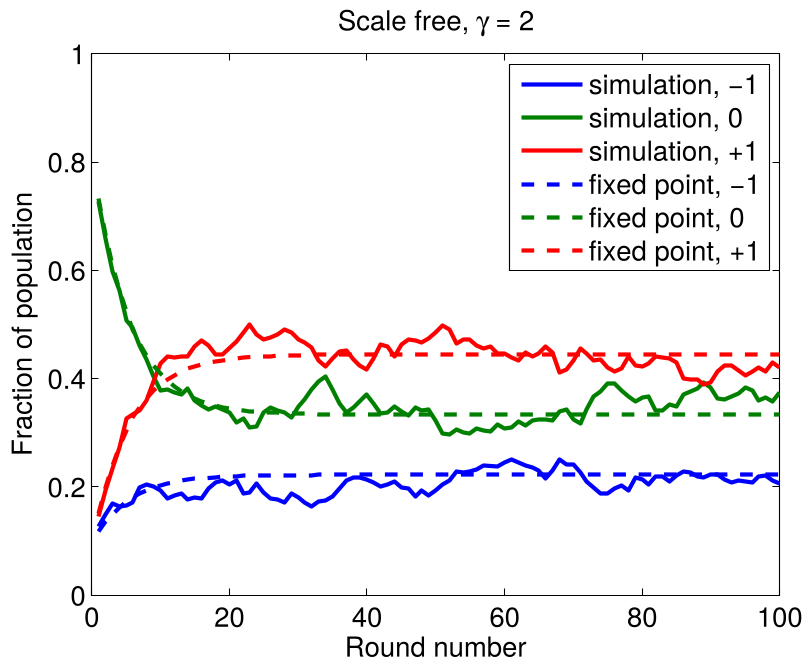 Figure 2: Results on Erdős-Rényi (a) and Scale-Free (b) networks show the system converging to the base-probability-driven steady state regardless of skewed initializations.
Key Finding 2: The Hub Destabilization Effect
The research highlights a critical Inductive Bias of heavy-tailed networks (like Slashdot). In these networks, a few "hubs" (nodes with massive connections) create high variability. These hubs act as swing factors that can cause the steady state to fluctuate more aggressively compared to more uniform networks like the Scientific Collaboration graph.
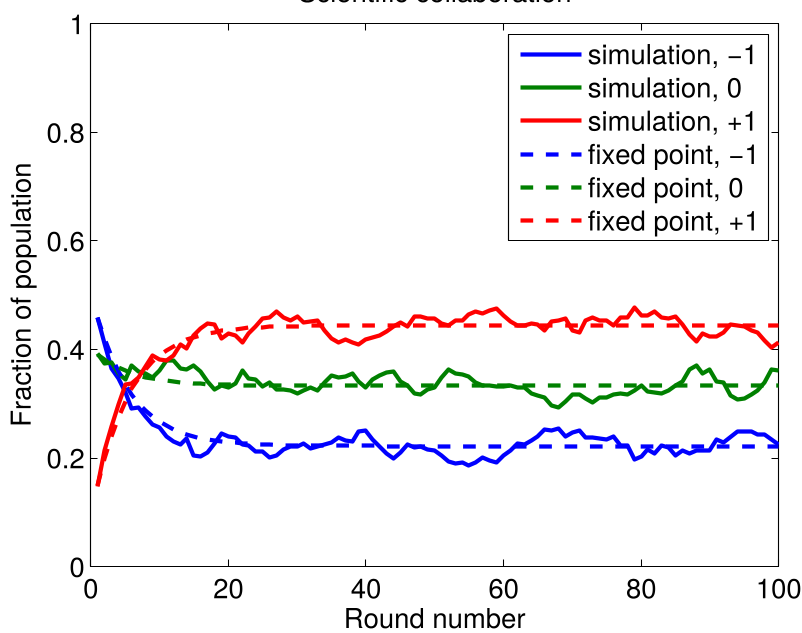 Figure 3: Variability in the Slashdot network illustrates how heavy-tailed distributions impact opinion stability.
Critical Analysis & Conclusion
Takeaways
- Consensus is Fast: Social networks reach a steady state surprisingly quickly.
- Quality is King: In the long run, "marketing stunts" (initial seeding) matter less than the fundamental "base probability" (product quality or reputation).
- Hub Risk: If you are operating in a scale-free environment (like Twitter/X), expect higher volatility.
Limitations
While robust, the model assumes a static graph. In reality, social networks are dynamic—people "unfollow" those they disagree with (homophily), which could lead to echo chambers that this MRF doesn't fully capture yet.
Future Outlook
This work provides a solid mathematical foundation for competitive opinion modeling. Integrating "Stubborn Agents" (nodes that never change their mind) or temporal edge changes could be the next frontier in making these simulations even more reflective of our polarized digital age.