
Measuring Mass Media Influence: Detecting Opinion Segregation via Twitter
Measuring the Influence of Mass Media on Opinion Segregation through Twitter
This paper presents an aspect-based opinion mining framework to quantify mass media's influence on Twitter users' sentiment during the 2012 US presidential elections. By utilizing the Expectation-Maximization (EM) algorithm to cluster sentiment vectors across multiple trending political topics, the authors successfully identified "unidimensional" segregated opinion groups and calculated the probability of media impact within these clusters.
TL;DR
During the high-stakes 2012 US Presidential Election, how much did the media actually pull the strings of public opinion? This paper introduces a framework that uses the Expectation-Maximization (EM) algorithm and Apriori association mining to detect "segregated" opinion groups on Twitter—clusters of users whose views are so polarized they don't overlap with the mainstream. The authors find that media mentions are deeply intertwined with these extreme, unidimensional sentiment groups.
Background & Motivation: The Dissonance of the Feed
In the digital age, users often experience cognitive dissonance when encountering news that contradicts their worldview. To resolve this, they gravitate toward media that aligns with their perspectives, leading to opinion segregation.
The authors' core "Insight" is that these polarized opinions aren't just random; they often converge into a "unidimensional" spectrum (think: staunch Left vs. staunch Right). The goal was to build a framework that doesn't just ask what people feel, but how their feelings are grouped and how likely it is that mainstream news outlets (like CNN, Fox, or Reuters) are driving those specific clusters.
Methodology: The Aspect-Based Mining Framework
The paper proposes a three-step pipeline to transform raw, messy tweets into a quantifiable "Influence Probability."
1. Trending Topic Discovery (Apriori)
Instead of just looking at raw hashtags, the authors used the Apriori algorithm to find frequent itemsets. This ensures that the subjects being analyzed (e.g., "Obama," "Economy," "Romney") are actually related in the discourse, which significantly reduces the "sparsity" of the sentiment matrix.
2. Aspect-Based Sentiment Assignment
Using the AFINN scoring list (a lexicon of ~2,477 words rated -5 to +5) and NLTK for tokenization, the framework assigns sentiment scores to specific topics within a tweet. This "Aspect-Based" approach ensures we know who or what the sentiment is directed at, rather than just getting a general mood for the whole tweet.
3. Clustering via Expectation-Maximization (EM)
This is the "Math Heart" of the paper. The authors treat the influence of news channels and social circles as latent factors (hidden variables).
- Physical Intuition: If we see a cluster of tweets with very similar, extreme sentiment that doesn't "intersect" on the scale with other groups, we have found a segregated opinion.
- The EM algorithm iteratively guesses which "influencer" factor likely produced a tweet's sentiment and then refines the parameters (mean and standard deviation) of those sentiment clusters.
 Figure 1: The proposed framework architecture, from tweet collection to EM clustering.
Experiments and Insights
The researchers analyzed a massive corpus of 10 million tweets. By applying their EM model, they generated 5 distinct clusters and examined the range of sentiment for topics like OWS (Occupy Wall Street), Romney, and Obama.
Key Observations:
- The Obama Polarization: The study found three isolated clusters for "Obama." Clusters 0 and 1 were highly positive (Score > +1.3), while Cluster 4 was severely negative (Score < -2.0).
- The Media Signature: By checking for news channel mentions within these clusters, they calculated specific probabilities. For example, in the highly negative Obama cluster (Cluster 4), media influence was measured at 18.4%.
- Segregation Detection: The "non-intersecting" nature of these clusters (visualized via error bars) proves that Twitter discourse during the election wasn't a single conversation, but several isolated "herds" of opinions.
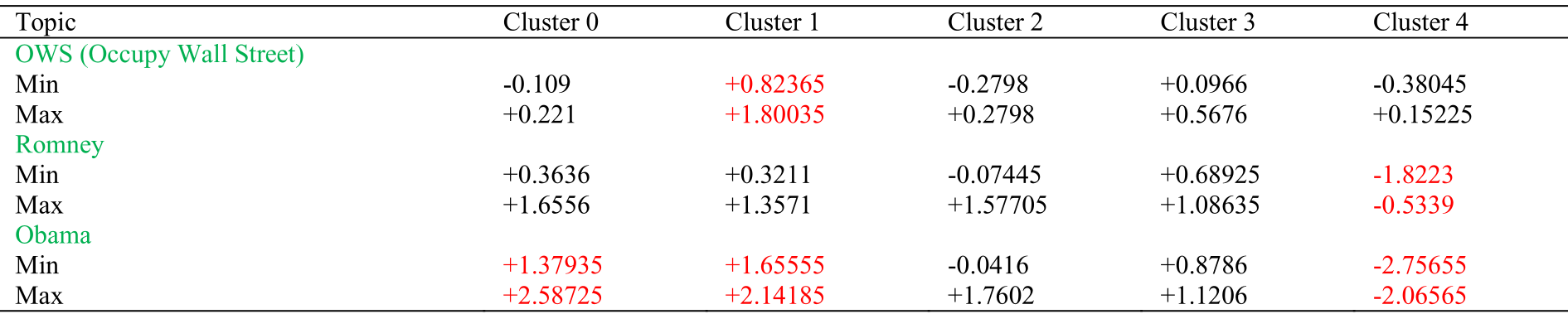 Table 2: Min/Max sentiment scores showing non-overlapping (segregated) clusters.
Critical Analysis & Future Outlook
Takeaway: The study brilliantly uses a probabilistic approach to quantify something as abstract as "media influence." It moves beyond simple word counts to capture the structure of polarization.
Limitations:
- Lexicon Simplicity: The AFINN/NLTK approach is "pre-LLM." It might struggle with sarcasm or complex sentence structures.
- Single-Adjective Filter: To keep the matrix simple, the authors excluded tweets with multiple adjectives, which might filter out more nuanced (and potentially influential) opinions.
Future Directions: The authors suggest moving from "tweet-level" analysis to "user-level" profiles. By tracking a single user's sentiment over time and including Retweets (RTs), researchers could model the viral spread of segregated opinions more accurately.
In the era of modern AI, applying these EM-based segregation models to current political discourse could provide a vital "health check" for our digital democracy.