
Decoding Global Instability: How Fractal Geometry Unmasks Political Change
Massive Media Event Data Analysis to Assess World-Wide Political Conflict and Instability
This paper introduces a large-scale analysis of the Global Database of Events, Language, and Tone (GDELT), utilizing over 178 million political events. By applying the Zipf-Mandelbrot law and Adaptive Fractal Analysis (AFA), the researchers successfully quantify global political stability and identify shifts in long-range temporal correlations (Hurst parameter) corresponding to major historical regime changes.
TL;DR
Researchers leverage the massive GDELT dataset—containing 178 million events—to apply advanced fractal mathematics to geopolitics. By calculating the Hurst parameter, they can distinguish between stable regimes and those undergoing fundamental shifts, accurately tracking historical events like the Arab Spring and China's leadership transitions.
Background: Can Math Predict Revolution?
In the emerging field of "Culturomics," the goal is to treat news media as a sensor for human society. However, political data is notoriously "noisy" and "nonstationary." A single celebrity scandal might generate more news than a minor border skirmish, but the latter has more geopolitical weight. Current methods often rely on sentiment or volume, which often fail to capture the underlying structural shifts in power.
The Mathematical Intuition: Zipf and Fractals
The authors posit that political systems behave like complex physical systems. They discovered two fundamental laws at play:
- Quasi-Universal Scaling: Ranked political events follow the Zipf-Mandelbrot law. Whether in the US or Afghanistan, the frequency of events follows a predictable power-law distribution.
- Interaction Density: Interactions between countries decay exponentially, suggesting that local or prioritized "hubs" dominate a nation's political environment.
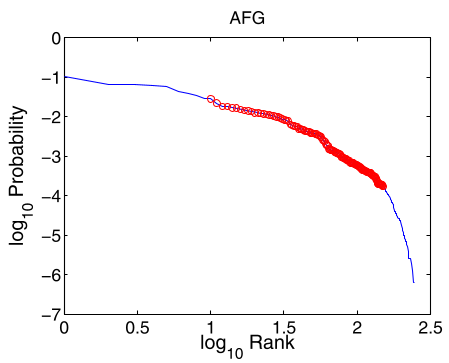 Figure 1: The distribution of ranked events in USA, China, and Afghanistan follows a consistent scaling exponent (α ≈ 2.0).
Methodology: The Power of the Hurst Parameter (H)
The core of this research lies in Adaptive Fractal Analysis (AFA). By examining the Goldstein Scale (a numerical measure of event intensity from conflict to cooperation), the authors calculate the Hurst parameter (H):
- H > 0.5 (Persistence): If high intensity is followed by high intensity, the system has "memory." A rising H suggests a regime is successfully consolidating its policies (status quo enhancement).
- Decreasing H (Breakdown): A sharp drop in H suggests that the "memory" of the previous system is breaking. This is the mathematical signature of a regime change or a fundamental shift in policy.
Experimental Results: Historical Validation
The authors validated their model by mapping H over time against historical records:
- China: Notable dips in H occur precisely during the transitions to Deng Xiaoping (1982) and Hu Jintao (2002), as well as the 1989 Tiananmen Square event. Periods of rising H correspond to the steady persistence of economic reforms.
- The Arab Spring: In Yemen, despite the overthrow of the government, the Hurst parameter showed a generally increasing trend. This suggests that the underlying political "logic" or institutional behavior remained surprisingly consistent despite the change in leadership.
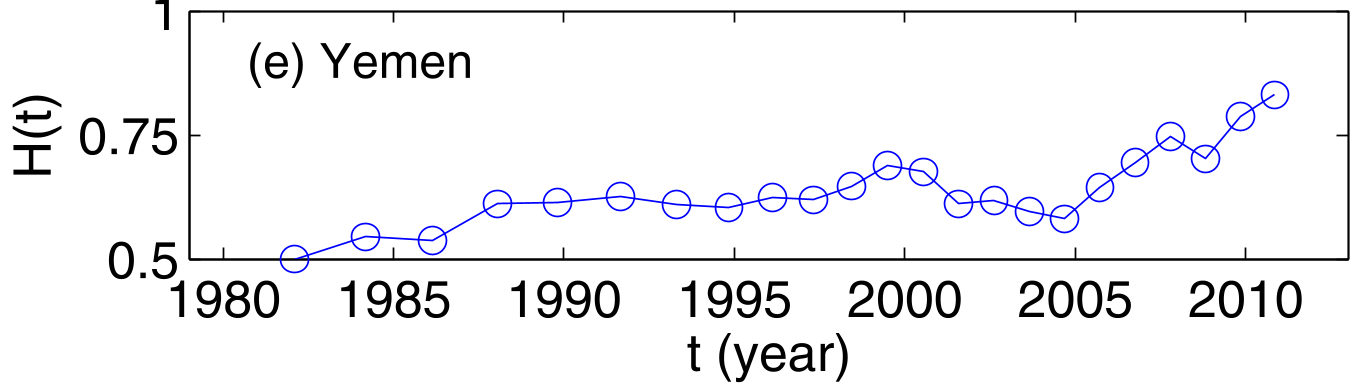 Figure 2: Tracking political "memory" across decades for China, Haiti, Egypt, Tunisia, and Yemen.
Critical Insight & Perspectives
This work demonstrates that political stability is not just about the tone of the news, but the mathematical correlation of events over time.
- Value: It provides a way to filter out the "noise" of media surges and focus on structural shifts.
- Limitation: While AFA identifies when a change occurs, it cannot inherently predict the direction of the change (whether for better or worse) without external qualitative context.
- The Future: As we move toward more real-time GDELT processing, this fractal approach could allow for a "Geopolitical Weather Map," identifying regions where the structural memory of a state is beginning to fracture before the crisis hits the front pages.