
Beyond Machines: The Rise of the Human Cloud and Massive Multiplayer Computation
Massive Multiplayer Human Computation for Fun, Money, and Survival
This paper introduces the "Human Cloud" concept through the CrowdFlower platform, demonstrating how massive-scale crowdsourcing can solve complex human-computation tasks. It highlights the transformation of labor into an on-demand API for diverse applications ranging from business data cleaning to real-time disaster relief.
TL;DR
This foundational work by Lukas Biewald (CEO of CrowdFlower) explores how the "Human Cloud"—a distributed, on-demand workforce—serves as a powerful engine for tasks that baffle traditional AI. By treating human intelligence as a scalable resource, the platform enables everything from high-stakes business data verification to life-saving SMS translation in disaster zones, all while maintaining quality through algorithmic oversight.
Background & Motivation: Breaking the Dataset Bottleneck
For decades, the progress of machine learning was tethered to the availability of static datasets like the Brown Corpus. Researchers often spent years collecting data or, worse, tailored their entire career paths to the constraints of existing, overused information.
The author's core insight was that the Internet creates a massive, untapped reservoir of human cognitive cycles. Similar to how Cloud Computing replaced physical servers with scalable virtual instances, Crowdsourcing replaces fixed labor with "Labor-on-Demand." This shift democratizes research, allowing anyone to generate high-quality datasets overnight for a few dollars.
Methodology: The Architecture of Quality
The paper doesn't just advocate for "hiring people"; it focuses on the routing and quality control of human labor. The methodology relies on three pillars:
- Distributed Routing: Sending micro-tasks to a "crowd of crowds" (including platforms like Amazon Mechanical Turk and Samasource).
- Quality Assurance Algorithms: Since human workers can be "noisy" or "spammy," the system uses gold standard questions and statistical filtering to ensure the resulting data is as accurate as a controlled laboratory environment.
- Task Atomicization: Breaking down complex problems (like translating disaster reports) into small, manageable tasks that take minutes to complete.
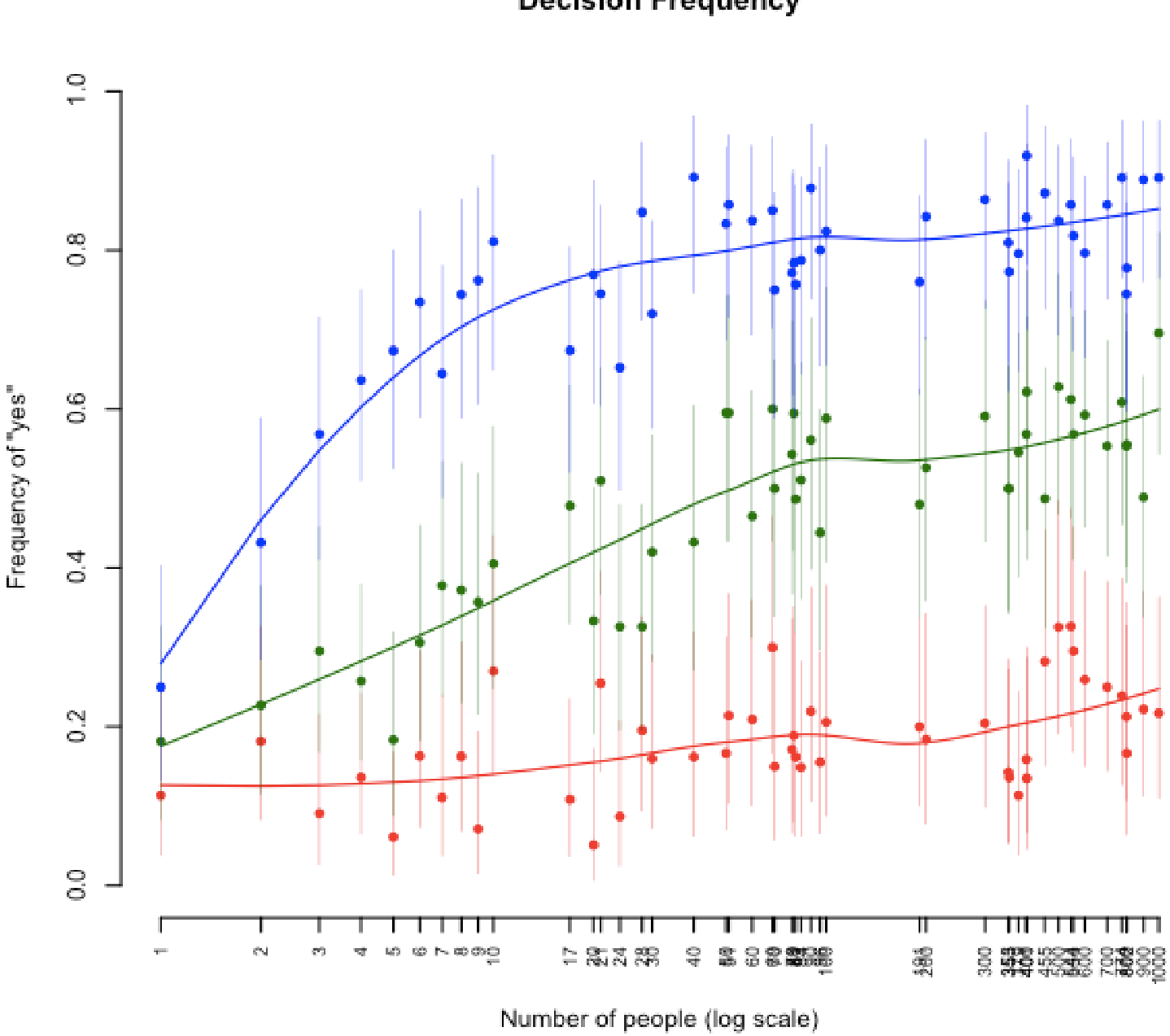 Note: The original paper visualizes the impact of the human cloud on solving ethical dilemmas and business data accuracy.
Real-World Impact: From Business to Survival
1. The Business Edge: Identifying the "McDonald's Problem"
Automated scripts often fail at entity resolution. A computer might think "McDonald’s Manhattan" and "McDonald’s New York City" are two different entities. Humans, however, can perform the nuance of validation instantly.
- Result: CrowdFlower improved business listing accuracy for clients by over 20%.
2. The Ethics Experiment: Sourcing Morality
The author tested the famous "Trolley Problem" at scale. Interestingly, they found a non-linear relationship in human empathy: willingness to sacrifice one life for many increased until the "lives saved" reached 100, dipped between 100-200, and luego rose again. This level of granular sociological data was previously impossible to gather so rapidly.
3. Survival: The Haiti Earthquake Response
In the wake of the 2010 Haiti disaster, communication was crippled by language barriers. By routing Kryol SMS messages to a global crowd of translators, the platform enabled aid agencies to:
- Map medical hotspots in real-time.
- Route potable water to specific thirsty populations.
- Bypass the "two-way audio" bandwidth limitations of the cellular network.
Critical Analysis & Conclusion
This paper serves as a blueprint for the modern AI Data Economy. It correctly predicted that "what you know" would become more important than "where you are," opening up job markets for refugees and people in developing nations through initiatives like Samasource.
Key Takeaways:
- Human-in-the-Loop is essential: AI is not a replacement but a beneficiary of high-quality human computation.
- Scalability is everything: The value of crowdsourcing lies in its ability to handle unpredictable bursts of work (disasters, product launches).
- Quality Control is the differentiator: Without robust algorithmic verification, aggregate human output remains "noise."
In a world currently obsessed with Generative AI, Biewald’s work reminds us that the "Human Cloud" was—and still is—the original foundation upon which all our modern "intelligent" systems are built.