
Matching Influence Maximization: Why "Going Viral" Isn't Enough
Matching influence maximization in social networks
The paper introduces the Matching Influence Maximization (MM) problem, which extends traditional Influence Maximization by requiring influenced users to find "matched partners" (e.g., group-buying or dating). It proposes two diffusion-matching models—Online and Offline—along with efficient algorithms (OPMM and SAMM) that achieve near-optimal approximation guarantees on large-scale social networks.
TL;DR
In modern social marketing, getting someone to "see" an ad is only half the battle. If the goal is a group-buy or a joint activity, they need a partner. This paper moves beyond traditional Influence Maximization (IM) to Matching Influence Maximization (MM), providing algorithmic frameworks to ensure that the people you influence aren't just active, but matched.
Background: The "Lone Wolf" Problem in Viral Marketing
Traditional IM research, pioneered by Kempe et al., treats every activated node as a success. However, consider Example 1.2 from the paper: Social group-buying. If an influencer reaches 100 people across the country, but none of them live near each other to share shipping costs, the "influence" is wasted.
The authors argue that we must prioritize clusters of nodes that have a high probability of matching based on common features (time, location, or interests).
The Core Challenge: Online vs. Offline Matching
The paper bifurcates the matching process into two logical flows:
- Online-Matching: Matching happens "on the fly" between the person sending the influence and the person receiving it.
- Offline-Matching: Anyone influenced can match with anyone else at any time.
The Mathematical Trap
A critical takeaway is the analysis of Submodularity. Traditional IM is submodular, meaning "diminishing returns" apply, and greedy algorithms work well. The authors prove that Online-matching is submodular, but Offline-matching is NOT. This means standard greedy approaches can fail spectacularly in offline scenarios, requiring more sophisticated "Sandwich" approximation techniques.
Methodology: Reimagining Sampling
To handle billion-scale networks, the authors adapt the Reverse Reachable Set (RRS) method. Instead of just looking at who can reach whom, they generate:
- RRSo,M: A set of nodes that could lead to a specific node being matched in an online flow.
- PRRSf,M: A "set pair" that captures the dual requirement of a node being influenced AND finding a compatible partner in the offline pool.
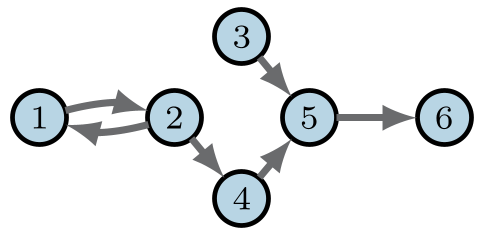 Figure: Difference between Online (simultaneous) and Offline (asynchronous) matching processes.
Experiments: Precision Matters
The researchers tested their algorithms (OPMM and SAMM) against state-of-the-art baselines like OPIM and High-Degree heuristics on Facebook and Twitter datasets.
Key Findings:
- Matching Precision: Our proposed methods consistently achieved higher "matching precision"—the ratio of matched nodes to total influenced nodes.
- Strategic Seeding: Traditional IM (OPIM) often picks "global hubs," whereas MM algorithms prefer "local community leaders" where matching probabilities are denser.
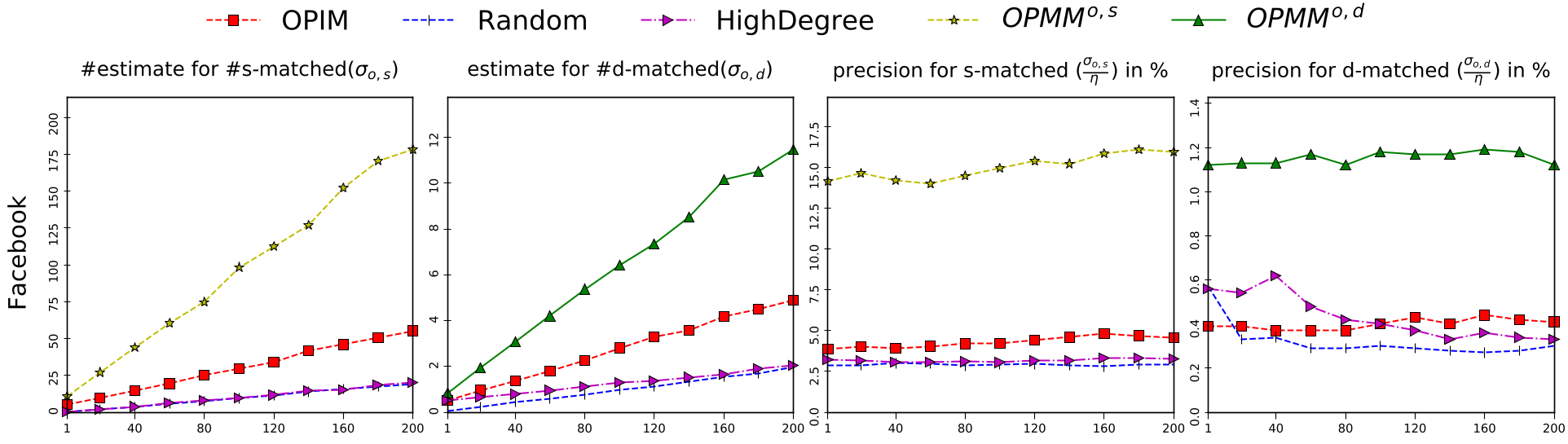 Figure: Performance comparison showing OPMM/SAMM leading in matched node counts across different seed sizes.
Critical Insight: The Future of Social Utility
The value of a social network isn't just connectivity; it’s coordination. By formalizing the MM problem, this paper provides a bridge between pure information diffusion and practical social commerce.
However, a limitation remains: the "matching probability" is currently modeled as static. In reality, matching preferences evolve. Future work exploring Dynamic Matching Influence—where the act of being matched changes your future social weight—would be the next logical frontier.
Summary Table
| Feature | Online-Matching | Offline-Matching |
|---|---|---|
| Submodularity | Yes | No |
| Complexity | NP-Hard / #P-Hard | NP-Hard / #P-Hard |
| Algorithm | OPMM (1-1/e-ε) | SAMM (Sandwich) |
| Best Use Case | Direct Referrals | Group Buying / Dating |