
Decoding the Shadow Hierarchy: Matching Email Networks to Corporate Structure
Matching Organizational Structure and Social Network Extracted from Email Communication
This paper introduces a framework for aligning formal organizational hierarchies with informal social networks extracted from email communication. By applying Social Network Analysis (SNA) metrics to datasets from Enron and a Polish manufacturing firm, the authors identify specific centrality measures that can accurately distinguish management levels from subordinates.
TL;DR
Is your boss actually a leader in the eyes of the company's communication network? This paper investigates the gap between formal hierarchy (the org chart) and the informal network (who actually talks to whom). By analyzing email logs from Enron and a manufacturing company, the researchers found that In-degree centrality—the number of people reaching out to you—is the most reliable indicator of your true managerial status.
Background: The Invisible Organization
In any stable organization, there are two structures: the one printed in the HR handbook and the one that actually moves information. Often, power comes not from a job title, but from being at the center of many relationships. The authors argue that by "matching" these two layers, companies can identify leadership potential, detect communication silos, and even streamline succession planning.
Problem & Motivation: Why Hierarchy Isn't Enough
Current management tools often struggle with "fast-growing" teams where managers are promoted without clear data. Traditional SNA (Social Network Analysis) often looks at individuals in isolation. The authors' insight is to treat the mismatch as the data point. If a manager has a low social rank, they might be a "bottleneck" or a "ghost manager" who is disconnected from their team.
Methodology: From Email Logs to Social Graphs
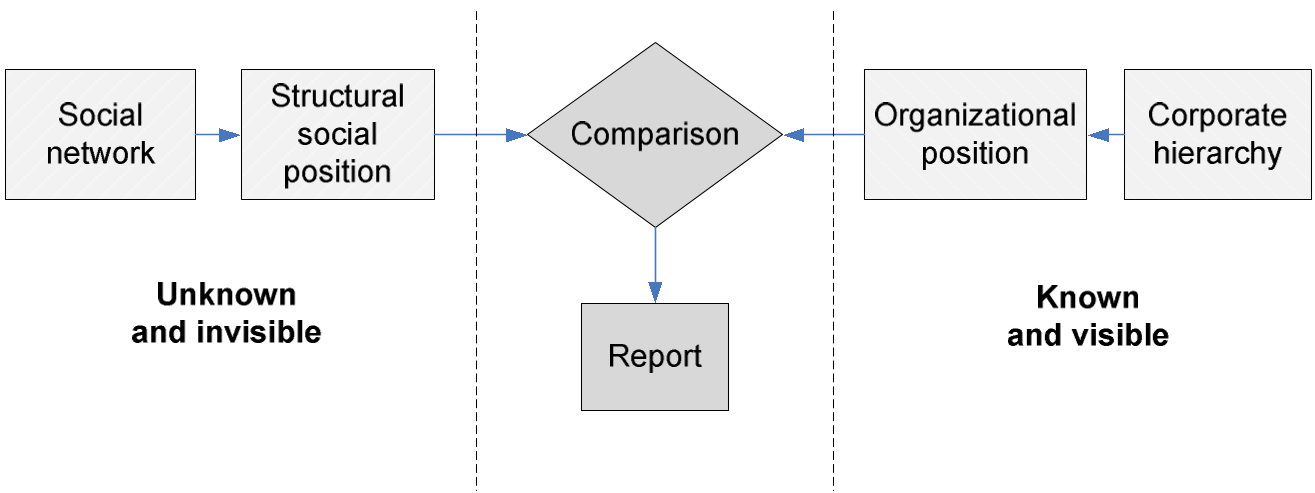
The researchers developed a four-stage workflow:
- Preprocessing: Merging aliases and removing external noise.
- Graph Construction: Building a directed graph where the weight represents the percentage of person 's emails that go to person . This emphasizes local influence over global volume.
- Metric Calculation: Calculating six key metrics: In-degree, Out-degree, Betweenness, Closeness, Watts-Strogatz Clustering, and Eigenvector centrality.
- Comparison: Mapping these social ranks against three levels: Board/CEO, Managers, and Employees.
Experiments & Results: Who are the Real Influencers?
The study utilized two primary datasets: a 300-person Polish manufacturing firm and the infamous Enron email corpus.
Key Findings:
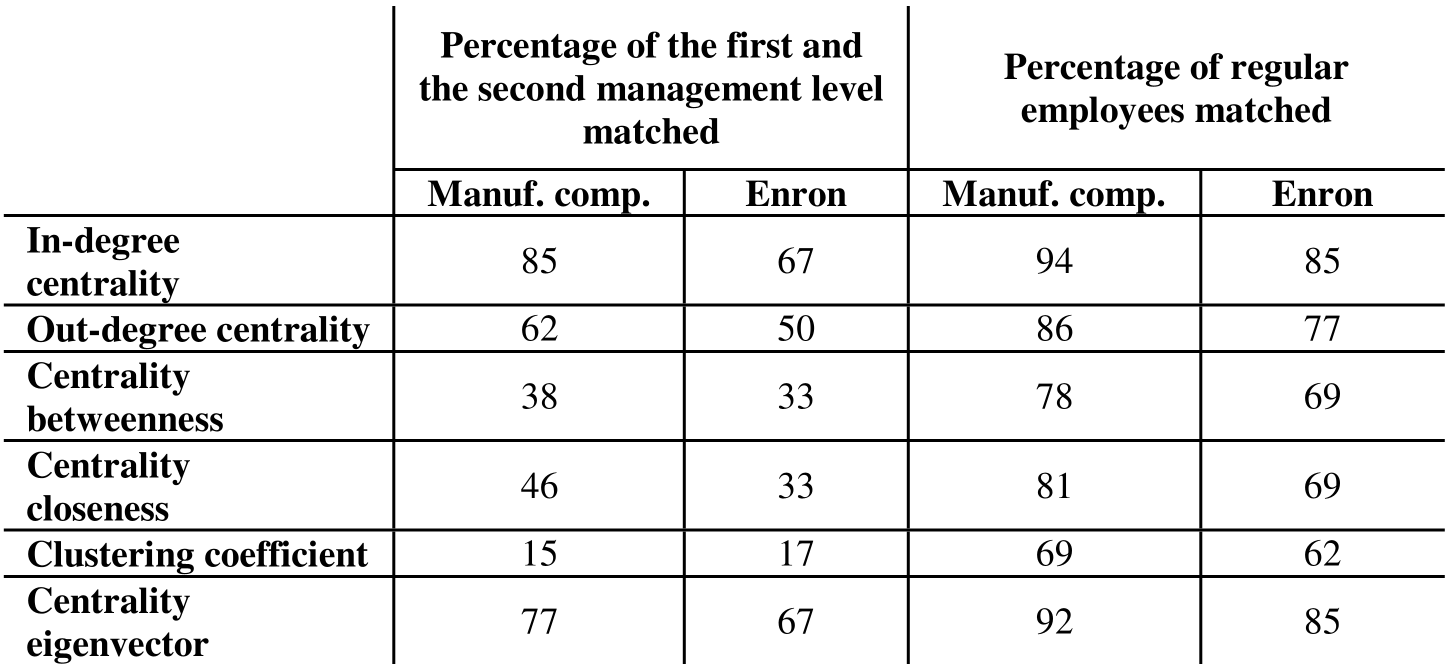
- In-degree is King: In both companies, In-degree centrality showed the highest match (up to 85% for managers). This confirms that "being sought out" is the hallmark of a formal leader.
- Eigenvector Centrality: This performed remarkably well (77-92% match). It suggests that managers are not just connected to many people, but to important people.
- The CEO Paradox: Interestingly, CEOs and Board members often did not rank #1 in the social network. This is likely due to "administrative shielding" (assistants handling their emails) or a preference for face-to-face communication over digital logs.
Critical Analysis & Conclusion
Takeaway
SNA is a powerful "passive" diagnostic tool for HR. Unlike surveys, email logs don't lie about social engagement. If a manager’s In-degree centrality is lower than their subordinates’, it’s a red flag for management misalignment.
Limitations
- Narrow Scope: The method works best for functional/stable hierarchies. It would likely struggle in matrix organizations or decentralized "Holacracies" where roles are fluid.
- Single Channel: By only looking at email, the study misses meetings, Slack/Teams messages, and "watercooler" talk, which explains why top-level executives seem "invisible" in the data.
Future Outlook
As companies move toward hybrid work, the "digital footprint" of leadership becomes even more critical. Future work should integrate multi-layer networks (Email + Calendar + IM) to build a truly holistic "Digital Twin" of the organizational hierarchy.