
Beyond Points and Badges: Psychologically Mapping Motivational Technology to User Goals
Gamification, quantified-self or social networking? Matching users’ goals with motivational technology
This study investigates how users' goal characteristics—focus, orientation, and attributes—influence the perceived importance of three motivational design classes: Gamification, Social Networking, and Quantified-Self. Using survey data (N=167) from the exercise app HeiaHeia, it establishes a predictive framework for tailoring motivational technology to individual goal profiles.
TL;DR
Not all users want to be on a leaderboard. This research demonstrates that the effectiveness of Gamification, Social Networking, and Quantified-Self features depends heavily on a user's internal "Goal Profile." While "proving-oriented" users love social rewards, "avoidance-oriented" users find them threatening, and "mastery-seekers" prefer the cold hard data of self-tracking.
The "One-Size-Fits-All" Fallacy
In the rush to "gamify" everything from fitness to enterprise software, designers often treat motivation as a monolithic entity. They assume that adding a badge or a progress bar will automatically drive engagement. However, as anyone who has ever felt "performance anxiety" from a public leaderboard knows, motivational designs can backfire.
The core insight of this paper by Hamari et al. is that the fit between the technology and the user's goal orientation determines value. If the system forces social comparison on someone trying to avoid failure, it creates an "ego threat" rather than motivation.
Methodology: Decoding the Goal Profile
The researchers broke down goal-setting into three sophisticated dimensions:
- Goal Focus: Do you care about the Outcome (the 10kg lost) or the Process (the daily habit)?
- Goal Orientation: Are you trying to Master a skill, Prove your worth to others, or Avoid looking incompetent?
- Goal Attributes: How Difficult and Specific are your targets?
Using PLS-SEM (Partial Least Squares Structural Equation Modeling), they analyzed how these psychological traits predict which features users actually value in the exercise app HeiaHeia.
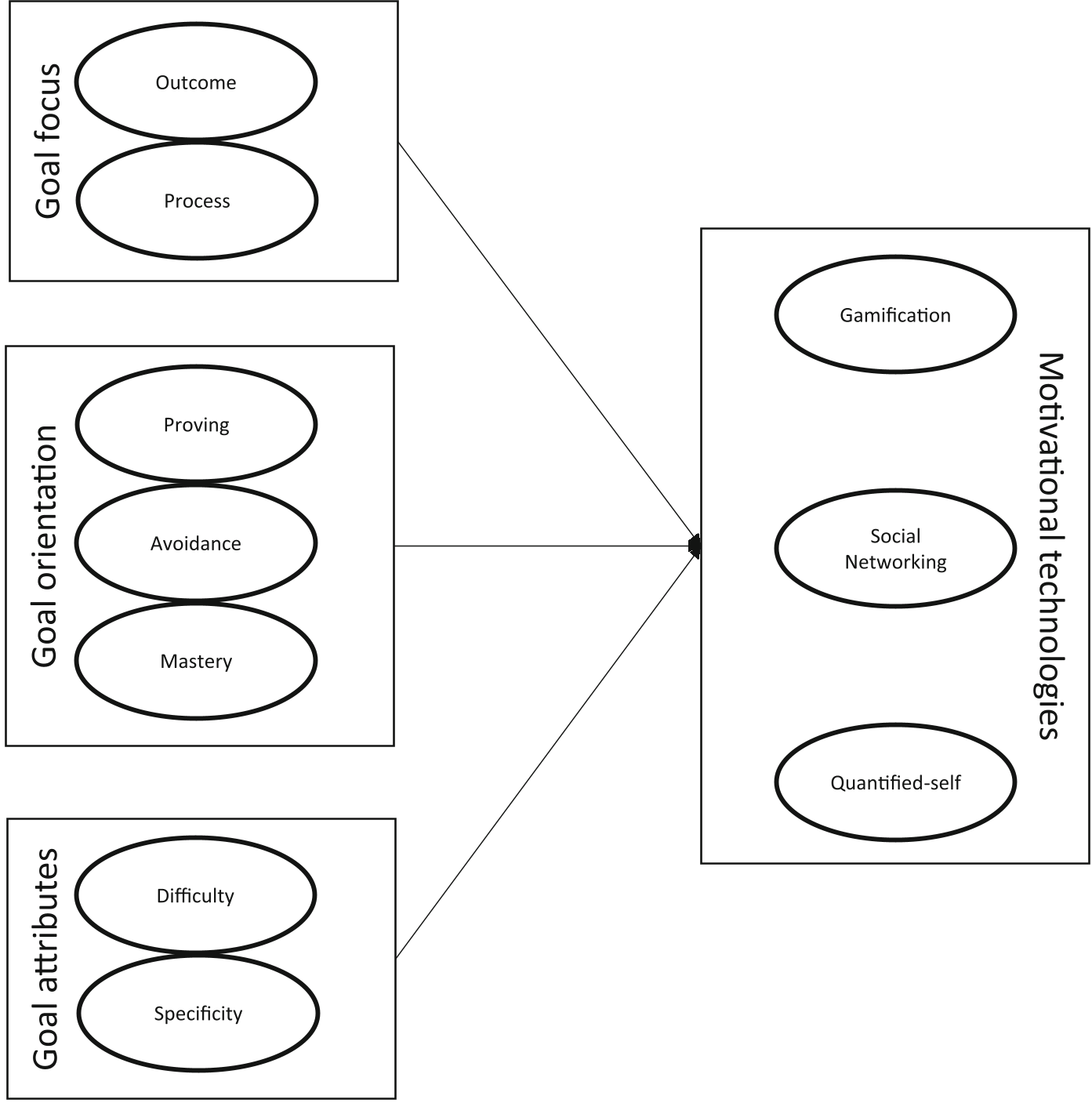 The Research Model: Mapping Goal Settings to Motivational Design Classes.
Key Insights: Who Wants What?
1. Gamification: The Tool of the Outcome-Focused
The study found that Gamification (medals, levels) is primarily valued by users who are outcome-focused and proving-oriented. Interestingly, as goals become more difficult, the perceived importance of gamification actually drops.
- Intuition: When a task is brutally hard, a "gold star" feels trivial or even mocking. Gamification works best as a "status signifier" for attainable wins.
2. Social Networking: The Double-Edged Sword
Social features (cheering, friend feeds) showed the strongest divergence:
- Proving-Oriented (+): These users thrive on social validation.
- Avoidance-Oriented (-): These users actively dislike social features. They fear that their sub-par performance will be exposed to their peers.
3. Quantified-Self: The Domain of Mastery
Users who prioritize Mastery and Goal Specificity gravitate toward Quantified-Self features (logs, advanced tracking).
- Intuition: These users aren't looking for a "high five"; they are looking for accurate feedback loops to help them self-regulate and improve.
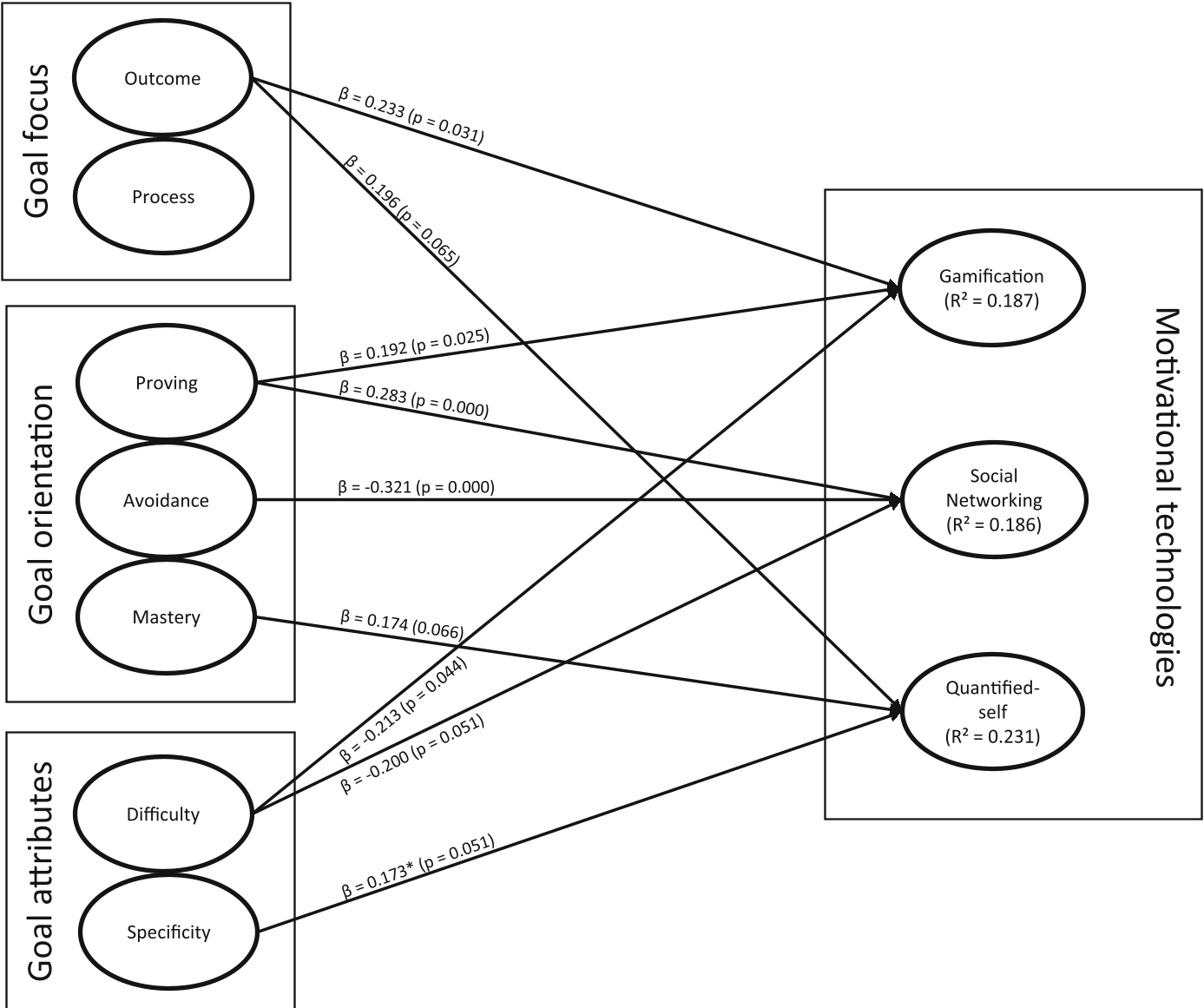 Significant Paths: Note the strong negative correlation between Avoidance orientation and Social Networking.
Critical Analysis: The Strategy for Future Design
The most striking finding is the failure of current designs to support "Process-Focused" users. The study found no significant association between a focus on the enjoyment of the activity and any of the three design classes. This suggests that current motivational technology is "superficial"—it rewards the finish line but fails to make the "run" itself more engaging.
Limitations & Future Work
- The Context Trap: The data comes from a fitness app. Would a mastery-oriented software engineer feel the same about Quantified-Self tools during a sprint?
- Static vs. Dynamic: The study looks at a snapshot. User goals often shift from "Outcome" (I want to lose weight) to "Mastery" (I want to learn proper form) over time.
Conclusion
For product managers and developers, the takeaway is clear: Segment by Psychology, not just Demographics.
- If your user profile suggests high "performance avoidance," disable the leaderboard by default.
- If they are "mastery-focused," give them data visualization, not badges.
True motivational design isn't about adding features; it's about creating a psychological "fit" that respects the user's personal relationship with their goals.