
Matchmaker: Balancing Stability and heterogeneous Quality in Crowdsourcing
Matchmaker: Stable Task Assignment With Bounded Constraints for Crowdsourcing Platforms
The paper introduces "Matchmaker," a stable task assignment framework for crowdsourcing that utilizes many-to-one matching with both quality requirements (lower bounds) and budget constraints (upper bounds). It proposes the Extended Stable Task Assignment (ESTA) algorithm, which achieves a stable matching—ensuring individual rationality, fairness, and nonwastefulness—while handling heterogeneous worker skill levels.
TL;DR
"Matchmaker" addresses a critical gap in crowdsourcing: how to assign heterogeneous workers to tasks in a way that is both stable (no one wants to quit) and reliable (meeting quality and budget limits). By splitting tasks into "Regular" and "Shadow" components, the proposed ESTA algorithm outperforms traditional utility-maximization models, boosting task success rates by up to 18% and worker happiness by over 11%.
Beyond Global Optima: The Need for Stability
In the world of crowdsourcing—think image labeling, traffic monitoring, or distributed sensing—the platform is a marketplace. Traditional algorithms focus on global utility: "How can the platform make the most money or finish the most tasks?"
However, this often ignores Individual Preferences. If a worker is assigned to a task they dislike, or a crowdsourcer is forced to hire a worker they don't trust, they will leave the platform. This makes the assignment unstable.
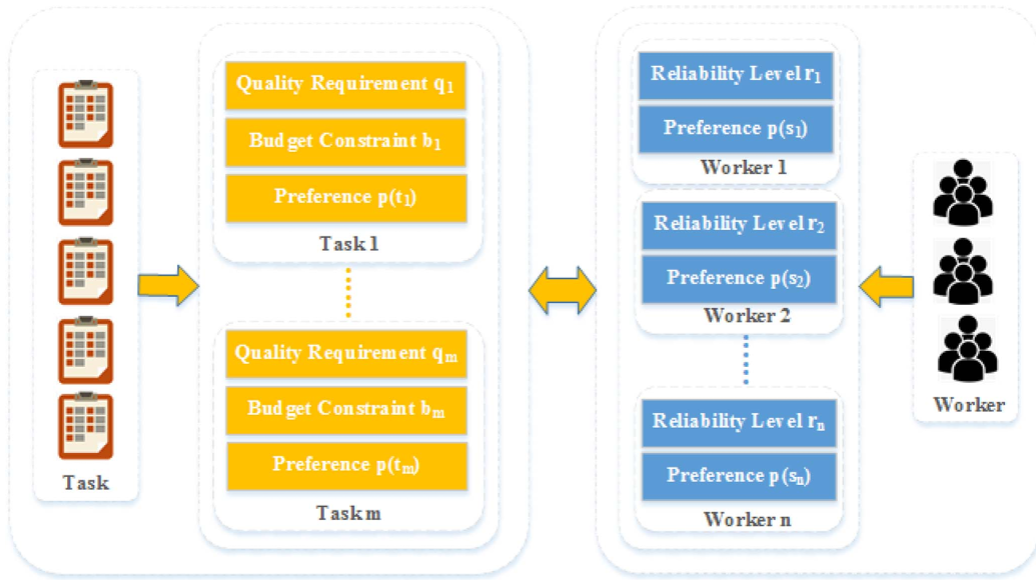
The challenge? Workers have different skill levels (heterogeneity), tasks have minimum quality requirements (lower bounds), and crowdsourcers have limited funds (upper bounds). Balancing these three while ensuring "no one wants to trade" is a complex matching problem that traditional methods like Gale-Shapley cannot solve directly.
Methodology: The Regular-Shadow Split
The core insight of the "Matchmaker" framework is a clever problem transformation. Instead of treating a task as a single entity with complex constraints, the authors split each task into two:
- Regular Task (): Focuses solely on meeting the minimum quality requirement ().
- Shadow Task (): Focuses on using the remaining budget () to maximize extra quality.
The ESTA Algorithm
The Extended Stable Task Assignment (ESTA) algorithm uses a modified Deferred Acceptance (DA) approach. Here is the physical intuition:
- Proposals: Workers propose to their most preferred tasks according to a reconstructed preference list ( then ).
- Prioritization: Regular tasks get first dibs on workers. Shadow tasks can only accept workers if doing so doesn't prevent other tasks in the system from meeting their minimum quality requirements.
- Stability Guaranteed: The authors prove mathematically that this result is Individually Rational, Fair (no "Type I" blocking pairs), and Nonwasteful (no "Type II" blocking pairs).
Experimental Proof: Happiness and Success
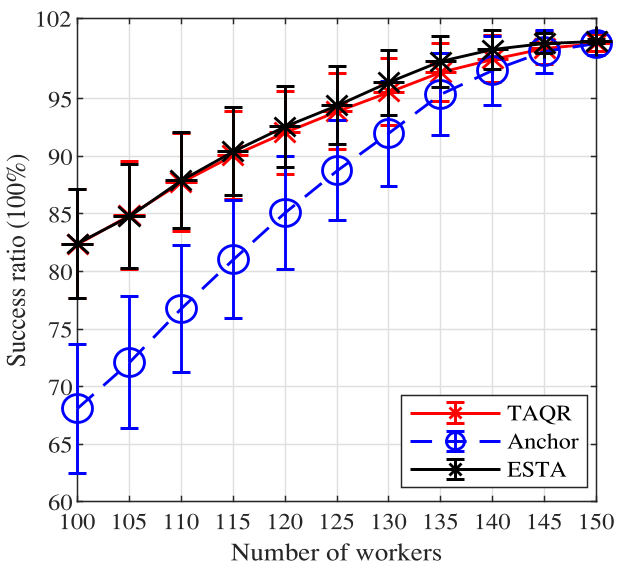
The authors compared ESTA against Anchor, a benchmark for matching with heterogeneous agents that lacks lower-bound (quality) considerations.
1. Higher Success Ratios
As the number of tasks increases, resources become scarce. ESTA maintains a significantly higher success ratio (the percentage of tasks meeting quality requirements) by prioritizing the "Regular" components of tasks.
2. Boosting Worker Happiness
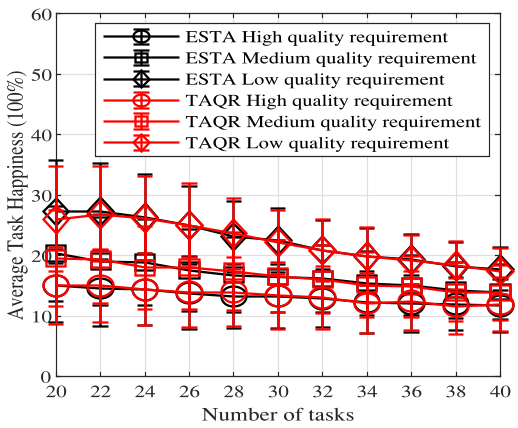
Because ESTA is "nonwasteful," it doesn't leave budgets lying around. It explores task assignments more thoroughly, ensuring workers are more likely to land in their preferred spots compared to the more "aggressive" rejection policy of Anchor.
Deep Insight & Conclusion
The genius of this work lies in the Task Partitioning strategy. It effectively linearizes a complex constraint problem, allowing a version of the Deferred Acceptance algorithm to find a stable settlement.
Key Takeaways:
- Stability > Optimization: In open marketplaces, a "mathematically optimal" solution is useless if participants won't follow it. Stable matching ensures system longevity.
- Heterogeneity is Hard: Simply having enough total "quality" among workers doesn't guarantee task success. The "Matchmaker" framework shows that careful coordination is required when workers aren't interchangeable.
Limitations: The current model assumes a worker's quality is the same across all tasks. In the future, exploring task-specific skill sets (e.g., a worker great at image labeling but poor at audio transcription) will be the next frontier for stable crowdsourcing assignment.