
Matelas: Bringing Mathematical Rigor to the "Wild West" of Social Media Privacy
Matelas: A Predicate Calculus Common Formal Definition for Social Networking
The paper introduces Matelas, a formal specification for social networks using B predicate calculus. It models core social networking entities—users, content, and friendship relations—while formally verifying privacy and access control policies through a layered refinement strategy.
TL;DR
Matelas is a formal specification framework that uses B Method predicate calculus to define social network interactions. By treating privacy policies as mathematical invariants rather than flexible configurations, it ensures that data access logic is bug-free and consistent across different friendship tiers.
Background: The Crisis of Trust
Most social media users have experienced "privacy leakage" by accident—perhaps a friend of a friend saw a photo you intended to keep private due to a "back-door" in the platform's visibility logic. These issues arise because typical web development relies on ad-hoc logic. The authors of Matelas argue that social networks are critical infrastructure that requires Formal Methods to be truly trustworthy.
The Problem: Why P3P and Standard Code Fail
Prior attempts like the Platform for Privacy Preferences (P3P) used XML-based checklists. However:
- Lack of Logic: You cannot mathematically "reason" about an XML tag.
- Ambiguity: Code-level implementations often diverge from high-level policy intent.
- Complexity: As features like "Walls" and "Tagged Photos" are added, the state space explodes, making manual security audits impossible.
Methodology: The "Parachute Strategy" of Refinement
The core of Matelas is built using the B Method, which allows developers to start "high up" with abstract concepts and gradually "parachute" into implementation details through Refinements.
1. The Abstract Layer
At the highest level, the system only knows about Users and RawContent. It defines a critical invariant:
This means a user pe can only see content rc IF they have the explicit view privilege in the system's shared action set.
2. Hierarchical Friendships
One of Matelas's most elegant contributions is the formalization of friendship tiers. It defines a hierarchy: Best Friends > Social Friends > Acquaintances. Through refinement, it proves that a lower-tier friend cannot logically possess a privilege that a higher-tier friend lacks.
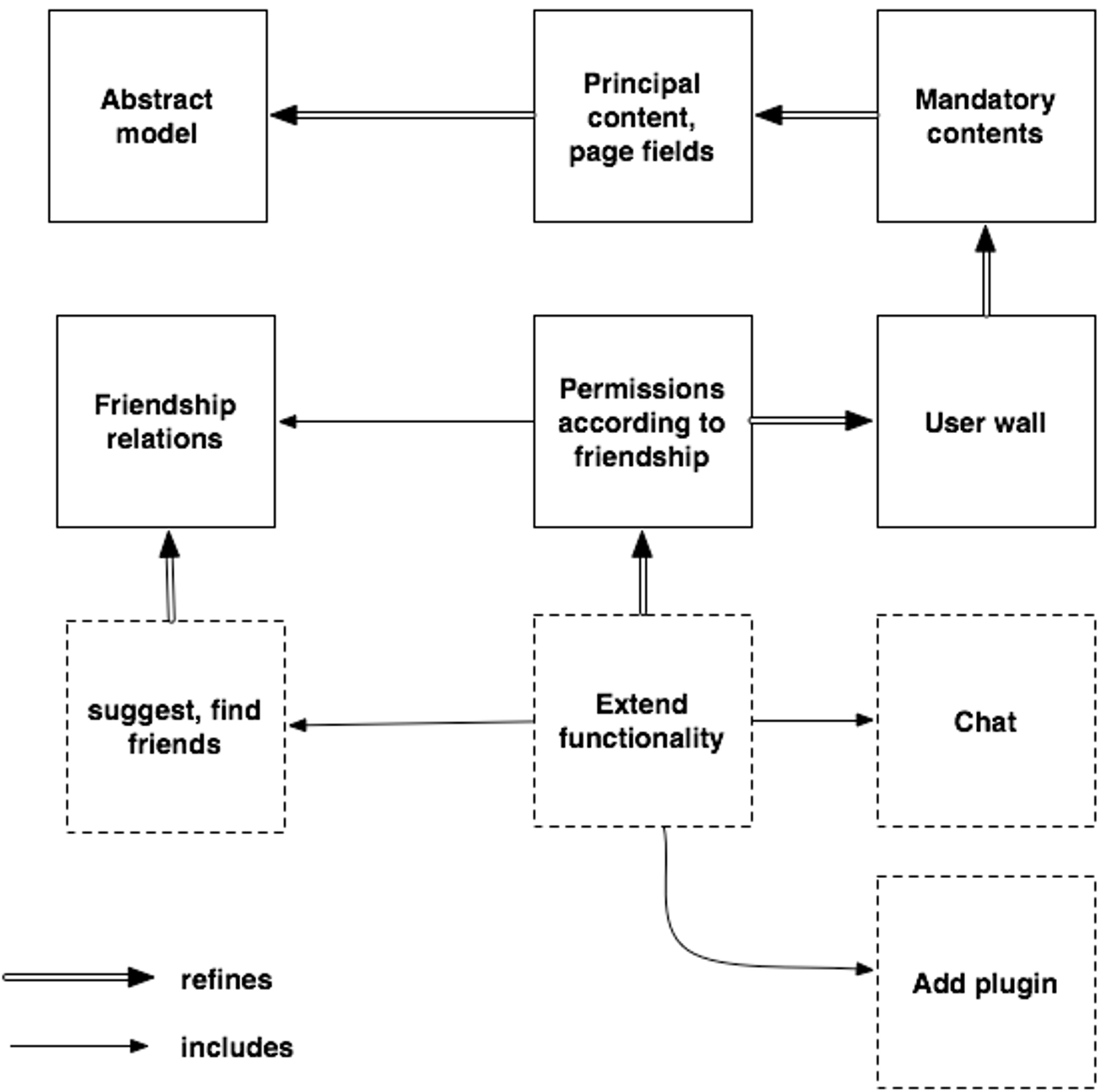 Figure 1: The architecture of the Matelas core system, showcasing the refinement layers from abstraction to specific features like "Social Friends".
Experiments & Results: Proving Safety
The authors used Atelier B to verify their model. Formal verification isn't just about writing code; it's about "discharging" proof obligations—mathematical hurdles that prove the code never violates its own rules.
| Metric | Result |
|---|---|
| Total Proof Obligations | 658 |
| Automatic Discharge | ~60% |
| Manual Discharge | ~30% |
| Core Invariants | Page visibility, Ownership uniqueness, Privilege hierarchy |
By modeling the "Wall" and "Content Transmission" (Sharing), they proved that even when content moves between pages, the original owner's privacy constraints are never violated.
 Example: A formal invariant ensuring that visibility is strictly a subset of authorized access privileges.
Critical Insight & Future Outlook
The brilliance of Matelas lies in its use of Proof Carrying Code (PCC). The authors envision a future where third-party plug-ins (like games or quiz apps) cannot run on a social network unless they provide a mathematical proof that they won't steal user data.
Limitations
- Complexity for Developers: Most social media developers are not trained in B predicate calculus.
- Temporal Logic: The current model lacks a way to express time-based constraints (e.g., "delete this post after 24 hours").
Conclusion
Matelas moves us away from "Privacy by Promise" toward "Privacy by Design." It proves that through rigorous refinement, we can build social platforms where privacy isn't just a setting—it's a mathematical certainty.