
Social Media Vitality: Using Mathematical Epidemiology to Quantify Social Crisis
A Mathematical Epidemiology Approach for Identifying Critical Issues in Social Media
This paper introduces a novel epidemiological framework, the SEI (Susceptible-Exposed-Infected) model, to identify critical social issues using social media dynamics. By deriving the basic reproduction number (R0) for various hashtags, the author quantifies the "virality" of social phenomena, identifying Security, Ebola, and Transport as critical issues in Nigeria.
TL;DR
Can a hashtag be treated like a virus? This research proves it can. By adapting the SEI (Susceptible-Exposed-Infected) compartmental model from infectious disease studies, the author provides a mathematical framework to identify "critical issues." Any social topic with a basic reproduction number R0 > 1 is flagged as a significant social phenomenon. Testing on 4.7 million tweets from Nigeria, the model identified Security and Ebola as the most "infectious" concerns.
Background: Beyond Simple Word Clouds
Most social media monitoring tools rely on frequency—how many times a word is mentioned. However, high frequency doesn't always mean high impact or spread. To understand how an idea takes hold of a population, we need to look at its transmission rate. The author argues that social issues propagate much like biological pathogens: they require a susceptible host (social media user), an exposure event (viewing a tweet), and an infection (the act of tweeting/retweeting).
Methodology: The SEI Framework
The core of this paper is the transition from the complex SEIZ model (which includes skeptics) to a more streamlined SEI model that accounts for "vital dynamics"—the reality that users join and leave social media platforms over time.
The Model Structure
- Susceptible (S): Users who haven't seen the tweet yet.
- Exposed (E): Users who have seen the tweet but haven't shared it.
- Infected (I): Users who have tweeted the message, potentially "infecting" others.
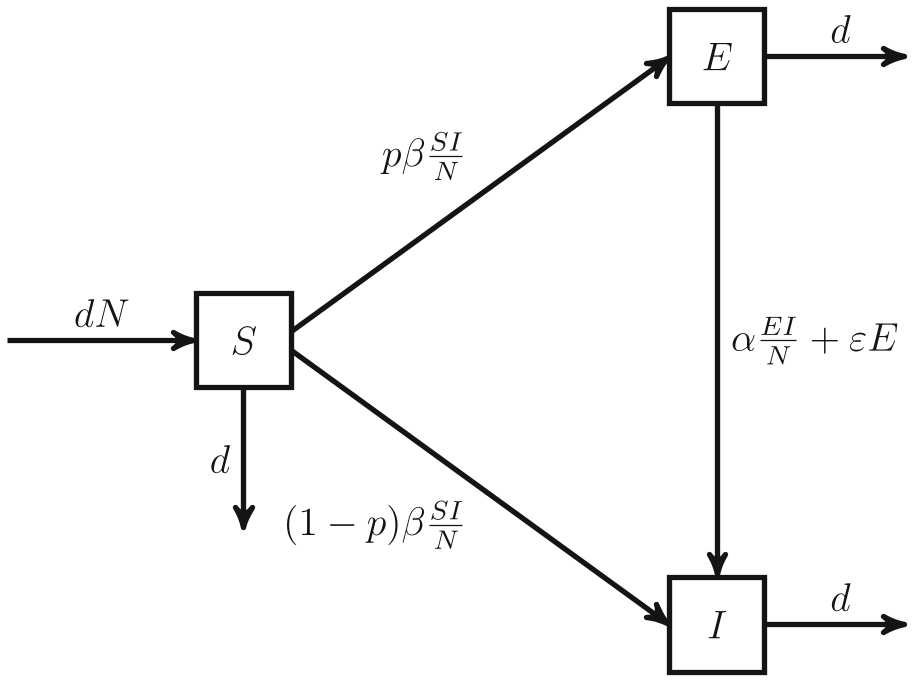
The author defines the Basic Reproduction Number (R0) using the Next Generation Matrix method. In this context, R0 represents the number of secondary "infected" tweets generated by one initial tweet in a susceptible population. If R0 > 1, the issue is considered "critical."
Experiments: Nigeria’s Digital Fever
Using a dataset of 4.7 million tweets from Nigeria (collected in 2014), the author fit the model to the top 20 hashtags using least-squares estimation.
Key Findings:
- #ebola (R0 = 51.949): The highest infectivity rate, reflecting the intense public health anxiety during the 2014 outbreak.
- #bringbackourgirls (R0 = 30.784): This hashtag, related to the kidnapping of the Chibok girls by Boko Haram, showed massive viral spread, marking security as a top-tier national crisis.
- #traffictalk (R0 = 4.166): While lower than Ebola, it still crossed the critical threshold, indicating structural issues in urban infrastructure.
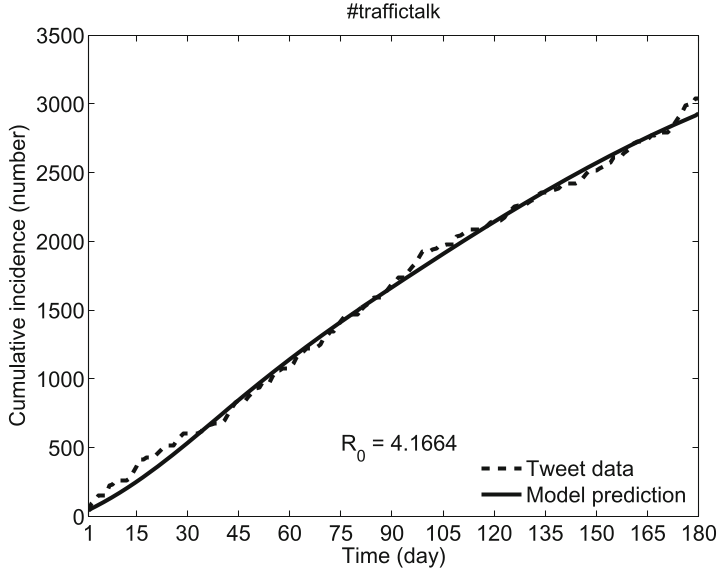 Figure: The model fit for #ebola (c) shows a classic epidemic curve, where the theoretical model (solid line) closely tracks the actual data points.
Critical Insight: Why This Matters
The power of this approach lies in its predictive and classification capabilities. By moving from "how many" to "how fast," government agencies and NGOs can:
- Filter Noise: Ignore high-volume but low-growth topics.
- Early Intervention: Identify when an R0 begins to trend upward, indicating a potentially destabilizing social movement or health crisis.
- Resource Allocation: Quantitatively justify which issues require immediate policy intervention.
Conclusion & Future Outlook
The paper successfully bridges the gap between Mathematical Epidemiology and Computational Social Science. While the model is robust, the author notes a limitation: it doesn't analyze the content or sentiment within the hashtags. Future work could benefit from combining this SEI math with NLP (Natural Language Processing) to understand not just that an issue is spreading, but why it is resonating so deeply with the "susceptible" population.
As social media continues to be the "digital town square," applying the mathematics of biology to the sociology of the internet remains one of the most promising frontiers for maintaining social stability.