
Modeling the Viral: A Sociophysics Approach to Hit Movies
Mathematical Model of Hit Phenomena as a Theory for Human Interaction in the Society
This paper presents a stochastic mathematical model for predicting "hit phenomena" in the entertainment industry, specifically the Japanese motion picture market. By treating human interactions like "many-body" physics, the model integrates advertisement distribution data and social network system (SNS) posts to simulate and predict market revenue and public interest.
TL;DR
Researchers have developed a mathematical framework that treats movie-goers like interacting particles in a physics simulation. By modeling advertisements as an external force and social media chatter as direct (2-body) and indirect (3-body) interactions, the model accurately predicts the rise and fall of "hit" phenomena using only publicly available social media data.
Executive Summary
Why do some movies become cultural juggernauts while others vanish overnight? While marketing experts have long studied "Word-of-Mouth" (WOM), this paper elevates the study to a rigorous level of statistical physics. The authors propose that hit phenomena are not random but follow a predictable stochastic process driven by three specific social "forces": Advertisements, Direct Communication, and Rumors.
The "Many-Body" Problem of Society
Traditional marketing models often treat consumers as isolated units responding to an ad. However, the authors argue that society acts like a Many-Body System.
The fundamental flaw in previous research was the exclusion of "Indirect Communication"—the rumor effect. Think of it this way:
- Direct (2-body): Your friend tells you a movie is great.
- Indirect (3-body): You overhear two strangers at a café discussing a plot twist, or you see a trending discussion on Twitter.
The authors posit that these three-body interactions are often the "tipping point" for a movie to become a massive hit.
Methodology: The Physics of Purchase Intention
The core of the paper is the Purchase Intention Equation. Instead of just looking at sales, the authors model the "potential" to buy as it evolves over time ().
The Formula of Influence
The ensemble-averaged equation is defined as:
- : The natural decay of interest (forgetting).
- : Direct Word-of-Mouth (Two-body interaction).
- : Indirect Rumors (Three-body interaction).
- : The external pressure of advertisements.
 Figure 1: The individual-level equation showing the multi-body interaction terms.
Experimental Results: Theory vs. Reality
The authors tested their model against the Japanese film market. Using blog post counts from platforms like Hottolink as a proxy for public interest, they compared their theoretical "Purchase Intention" curves against real-world data.
Case Study: "Once in a Blue Moon"
The model demonstrated a remarkable fit. Even when using "Exposure Data" (M Data) instead of secret internal "Ad Budget" data, the curves aligned almost perfectly.
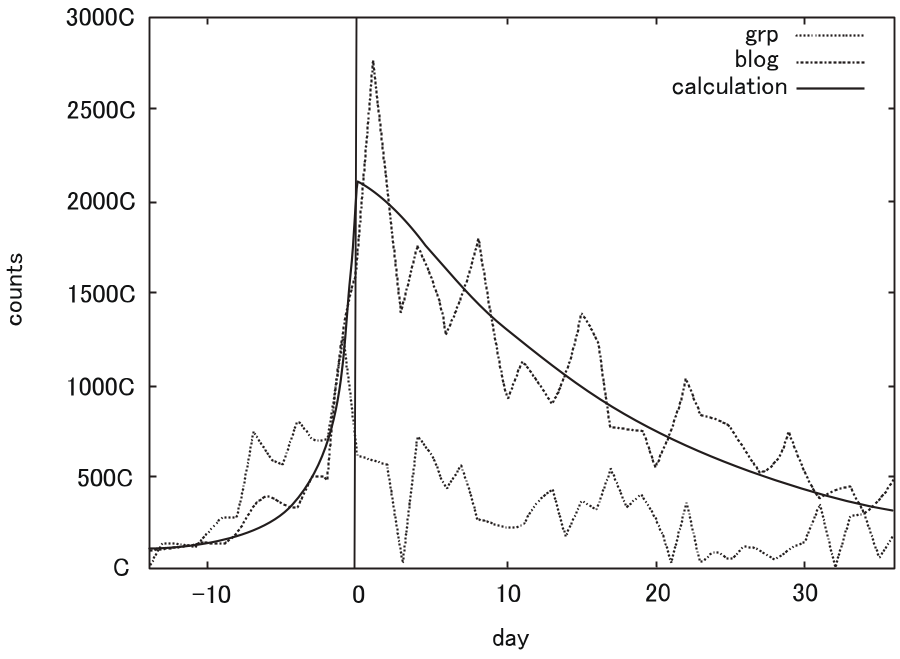 Figure 2: Our calculation vs. blog posting counts. The red curve (calculation) follows the dotted curve (actual posts) with high precision.
The study reveals that once the "Rumor" term () is properly tuned, the model can capture the exponential growth phase of a hit movie that linear models miss.
Critical Analysis & Conclusion
Why this matters
The true innovation here isn't just the math—it's the accessibility. In the past, you needed the studio's internal financial records to model a movie's success. This paper proves that social media listening data is a viable and potentially more accurate signal for human interaction dynamics than budget alone.
Limitations
While the model is powerful, it treats the "Impression Coefficient" () as a somewhat uniform force. It does not yet account for the quality of the interaction (Positive vs. Negative reviews). A movie can be "viral" because it is hated, which would lead to a drop in revenue despite high social media volume.
Future Outlook
This work lays the groundwork for real-time market prediction. By plugging in daily Twitter/X or TikTok trends, studios could theoretically adjust their advertising spend dynamically to "fuel the fire" of the rumor effect just as it begins to peak.
Takeaway: Hits aren't just made; they are calculated interactions.