
One Person, One Vote: Why Social Networks Don't Change the Calculus of Democracy
Mathematical Social Sciences
This paper examines whether knowledge of social network structures should influence voting rules using a Maximum Likelihood (ML) framework. Using a Markov Random Field-style decomposition, the author proves that under specific independence assumptions, the optimal voting rule remains "one person, one vote," effectively ignoring the network structure.
TL;DR
In this technical communication, Vincent Conitzer tackles a provocative question: If we have a perfect map of how voters influence each other (a social network), should we weigh "influencers" or "well-connected" individuals differently in an election? Using a Maximum Likelihood Estimate (MLE) approach, Conitzer proves that as long as a person's individual "insight" is separate from their "desire to agree with neighbors," the optimal rule is to ignore the network entirely.
Contextual Positioning
This work sits at the intersection of Computational Social Choice and Statistical Inference. It serves as a theoretical defense of the "one person, one vote" principle against the argument that modern data (like Facebook's social graph) should be used to "optimize" democratic outcomes by re-weighting votes based on network position.
The Paradox of Connection: Insight vs. Redundancy
The motivation for this research stems from two competing intuitions:
- The Insight Argument: Well-connected voters talk to many people, collect more information, and are therefore more likely to be "right." They should have more weight.
- The Redundancy Argument: Well-connected voters are just echoing their neighbors. Their "independent" thought is low, so they should have less weight.
Conitzer's work aims to resolve this tension by asking what a "Maximum Likelihood" observer would conclude if they wanted to find the "correct" choice (e.g., which policy is objectively better) based on noisy votes.
Methodology: Factoring the Vote
The core of the paper is the transition from a standard independent noise model to a Markov Random Field (MRF) approach.
The Model
The author assumes the probability of a specific set of votes (a profile) given a "correct" outcome can be factored. The critical innovation is Assumption 1, which splits the probability into two parts:
- : The probability that voter identifies the truth .
- : The "social" component—how likely is to vote like their neighbors .
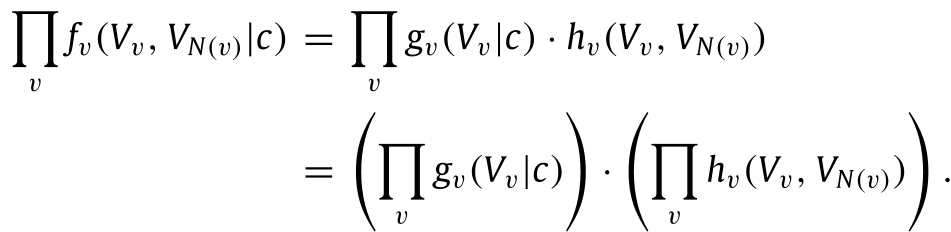
The genius of this assumption is the separation of concerns: the "truth-seeking" ability (g) does not depend on what neighbors think, and the "peer-pressure" (h) does not depend on what the "truth" is.
The "Trivial" but Profound Result
The paper presents a proof that is mathematically simple but philosophically significant. When we try to find the that maximizes the likelihood of the observed votes, the interaction terms (the functions) act as a constant multiplier across all possible outcomes.
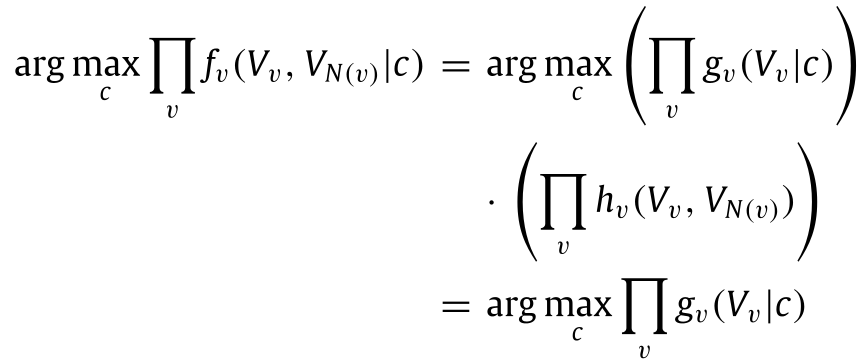
As shown in the derivation, the terms—which contain all the social network structure—cancel out when comparing which outcome is more likely. Thus:
The social network structure should be completely ignored by the voting rule.
Critical Analysis & Conclusion
Why this matters
This result provides a "mathematical shield" for democratic equality. It suggests that even if we know some people are "echo chambers" for others, we shouldn't attempt to de-value their votes, because the "redundancy" effect and the "insight" effect perfectly cancel each other out in a rational statistical model.
Limitations
The primary vulnerability of this conclusion is Assumption 1. If the tendency to agree with neighbors is correlated with the truth (e.g., people are only influenced by neighbors when those neighbors are right), then the network structure does matter. This opens a door for future research into "Social Epistemology" where influence and accuracy are intertwined.
Final Takeaway
In an era of big data and social graphs, Conitzer's proof reaffirms a classical intuition: justice and statistical optimality both point toward treating every voter as an equal unit, regardless of their place in the social web.