
Deciphering Social AI: A Mathematical Value System for OSN Agents
A mathematical value system model for agent in online social network
This paper introduces a formal Mathematical Value System Model for agents in Online Social Networks (OSNs). Based on sociological and psychological theories, it defines a three-dimensional evaluation framework (Social Networking, Self-presentation, Self-development) to quantify agent behavior value and introduces a dynamic weight function mechanism for adaptive agent intelligence in Agent-Based Modeling (ABM).
TL;DR
What motivates a user to share a game recommendation or interact with a stranger online? This paper from Tsinghua University moves beyond simple algorithmic rules by proposing a Mathematical Value System Model. By quantifying human-centric motivations like "self-presentation" and "social networking" into a tri-dimensional mathematical framework, the researchers provide a blueprint for creating more intelligent, human-like agents in social simulations.
Motivation: Why do Agents Need "Values"?
In the realm of Agent-Based Modeling (ABM), we often treat agents as rational actors following rigid "if-then" scripts. However, human behavior in Online Social Networks (OSNs) is driven by an underlying Value System—a set of internal measures that help us decide if an action is "worth it."
Prior work, such as Camarinha-Matos’s conceptual models, laid the groundwork but lacked the mathematical precision needed for computational implementation. These models often used fixed weights for different values, failing to capture the reality that I might value "Self-presentation" more when posting a status update, but value "Social Networking" more when replying to a friend.
The Core Framework: Profile, Impression, and Behavior
The authors define an agent as a four-tuple: . One of the most innovative aspects is the Impression List (). In this model, an agent doesn't just "see" another agent; it maintains a subjective judgment of the other's profile, value system, and the closeness of their relationship.
1. The Three Dimensions of Value
Drawing from Maslow’s hierarchy of human needs, the paper identifies three universal "equivalents" for behavior value:
- : Social Networking (The need to belong and maintain connections).
- : Self-presentation (The need for esteem and expressing personal identity).
- : Self-development (Self-actualization through learning and growth).
2. The Dynamic Weight Function
Unlike previous models that use a static vector, this paper introduces a Weight Function ().
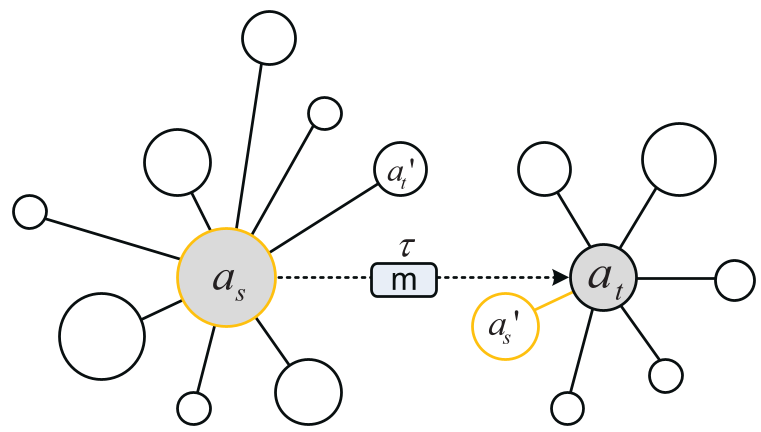 Figure: The interaction between an agent's internal state and the value dimensions.
As shown in the diagram above, every behavior results in a state update. The model maps these updates to the three dimensions:
- If your own profile () is updated (e.g., you learned a new skill), it's a value.
- If your image in someone else's mind () changes, it's a value.
- If the relationship link () strengthens, it's a value.
Methodology: Quantifying the Ineffable
The value of a behavior is a vector . To arrive at a final decision, the agent applies its Weight Function, which is sensitive to the type of behavior.
For example, in a Word-of-Mouth (WoM) scenario:
- Speaking (Recommending): Might have a high weight for (Self-presentation: "Look at this cool game I found").
- Listening (Accepting): Might have a high weight for (Self-development/Personal gain).
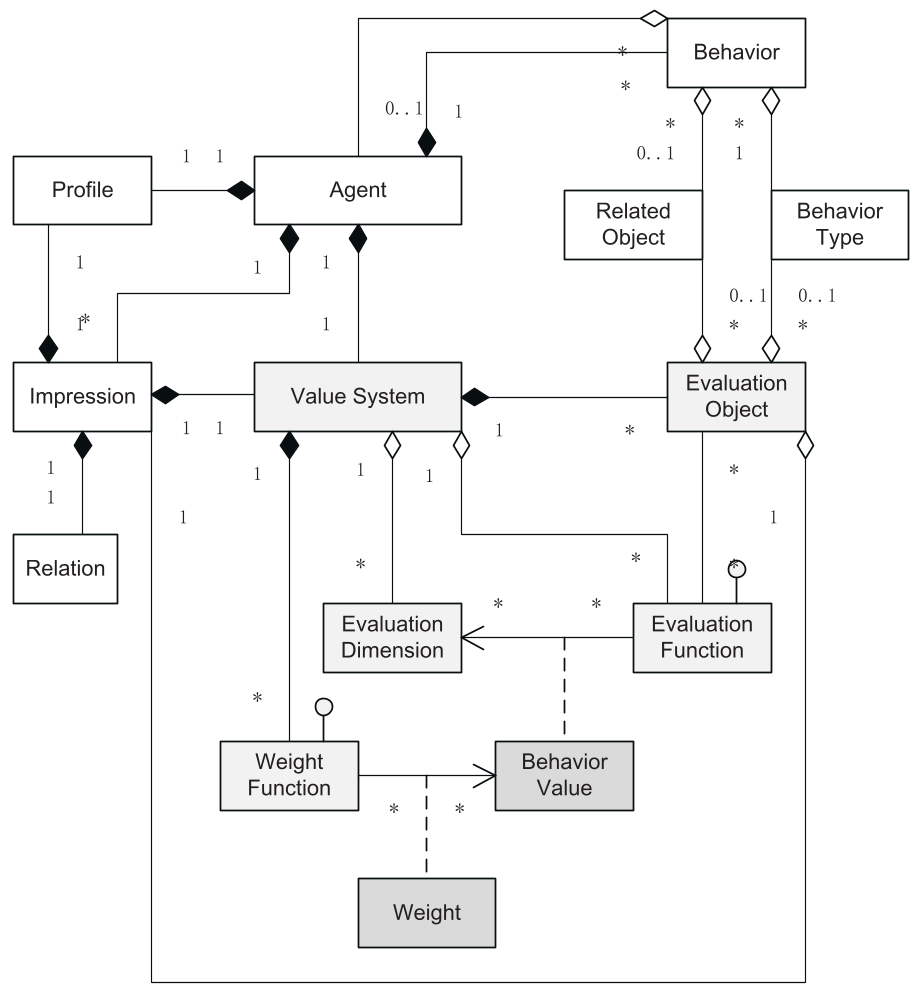 Figure: The UML structure of the Mathematical Value System Model.
The UML diagram highlights that while are unique to an agent, the Evaluation Dimensions () and Functions () can be shared across the system, allowing for a standardized way to compare agent behaviors across a population.
Experimental Case Study: Online Social Games
The authors applied their model to online game recommendations. They categorized users by their "activeness," "interest," and "skill." By simulating behaviors like "Speak" and "Listen," they proved that the model could effectively estimate the "utility" of interactions based on how much they improved the agent's standing or knowledge.
Key Results Summary:
| Dimension | Trigger Event | Metric Impact |
|---|---|---|
| Social Networking () | Interaction frequency | Link closeness increases |
| Self-presentation () | Successful recommendation | Impression in target improves |
| Self-development () | Adopting recommendation | Personal interest/skill profile updates |
Critical Analysis & Future Outlook
Strengths
- Theoretical Grounding: Unlike many "black-box" social simulations, this model is rooted in verified sociological research (Maslow, Dichter, Boyd).
- Flexibility: The shift from fixed weights to weight functions allows agents to exhibit different "personalities" for different tasks.
Limitations & Future Work
The authors acknowledge that they have only revealed "a tip of the iceberg."
- Learning Mechanism: Currently, the evaluation functions () and weight functions () are defined as interfaces. The authors suggest using SVMs or Social Exchange Theory to allow agents to "learn" these values from history, but the current paper focuses on the architecture rather than the learning algorithm.
- Granularity: Three dimensions are a start, but human value systems are far more complex (e.g., ethics, altruism).
Conclusion
This paper provides a rigorous mathematical foundation for the "subjective" side of AI. As we move towards more autonomous AI agents living in our social networks, models like this will be essential to ensure they act with a "value system" that we can understand, measure, and potentially align with human goals.