
MATRICS: Harmonizing Human Intuition and Machine Scale for Geopolitical Forecasting
MATRICS: A System for Human-Machine Hybrid Forecasting of Geopolitical Events
MATRICS is a human-machine hybrid system designed for geopolitical forecasting that integrates crowdsourced human intelligence with ensemble machine learning on big data. It achieves a mean Brier score of 0.27, matching or exceeding human-only SOTA, by employing parallel pipelines for machine-aided human forecasting (MAHF) and human-aided machine forecasting (HAMF).
TL;DR
Predicting global events—from election outcomes to disease outbreaks—is traditionally a battle between the tireless but rigid machine and the clever but easily fatigued human. MATRICS (Machine-Aided Training for Real-time Interactive Crowdsourced Systems) bridges this gap. By creating a symbiotic loop where machines handle the "big data" heavy lifting and humans provide contextual "sanity checks," the system achieved a competitive Brier score of 0.27 across 187 complex geopolitical questions.
Context: Beyond the "Cold Start"
The primary motivation for MATRICS stems from the limitations of prior SOTA systems like PULSE. While automated systems are excellent at processing social media or economic indices, they often fail the "Cold Start" test: when a new, unprecedented topic emerges, the machine has no historical context to learn from.
Humans, however, excel at transferring knowledge. We can see a hurricane's impact on gold prices as a one-time outlier rather than a permanent trend change. The authors recognized that the most robust forecasting system wouldn't be "Human vs. Machine," but a "Centaur" system that exploits the Inductive Bias of humans to steer the statistical power of machines.
Methodology: The Parallel Pipeline
The architecture of MATRICS is built on two interconnected processing loops that redefine the human-in-the-loop (HITL) paradigm.
1. Machine-Aided Human Forecasting (MAHF)
Instead of asking humans to browse the internet aimlessly, the machine acts as a research assistant. It scrapes news, Twitter, and Google Trends, distilling them into interactive dashboards. This reduces human fatigue and mitigates cognitive biases by presenting objective data visualizations.
2. Human-Aided Machine Forecasting (HAMF)
This is the core innovation. Humans don't just provide forecasts; they tune the algorithm. Users can:
- Flag and remove outliers (e.g., ignoring price spikes during a specific conflict).
- Select relevant historical scales for the Bayesian Structural Time Series (BSTS) models.
- Input domain-specific keywords for the machine to track.
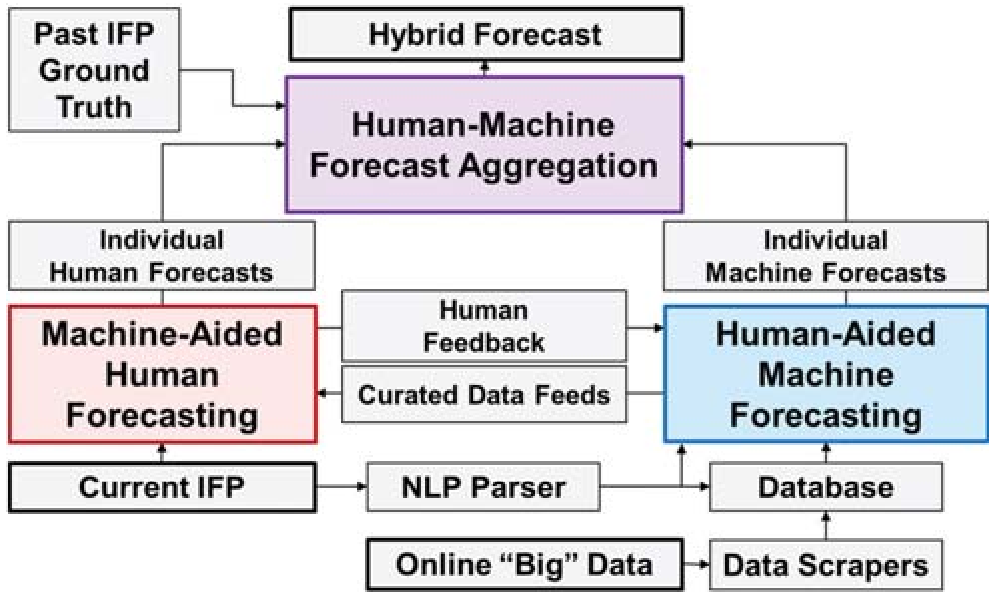 The MATRICS pipeline: Parallel flows of MAHF and HAMF culminate in a unified aggregation module.
The "Secret Sauce": Adaptive Aggregation
How do you combine a machine's probability with a human's "gut feeling"? MATRICS employs Multiplicative Weights. Rather than a simple average, the system tracks the historical accuracy of every individual "forecaster" (human or algorithm). If a specific human has been consistently right about West African politics, the system dynamically increases their weight for similar future questions.
Results: Matching the Gold Standard
The system was battle-tested during the IARPA Hybrid Forecasting Competition (HFC). Over 18 months, it tackled 187 Individual Forecasting Problems (IFPs).
- Performance: The "Multiplicative Weights: Median" method achieved a Brier score of 0.27. (In Brier scores, 0 is perfect and 2.0 is total failure).
- Comparison: These results proved that hybrid systems can match the accuracy of professional high-level human forecasting groups while being significantly more scalable.
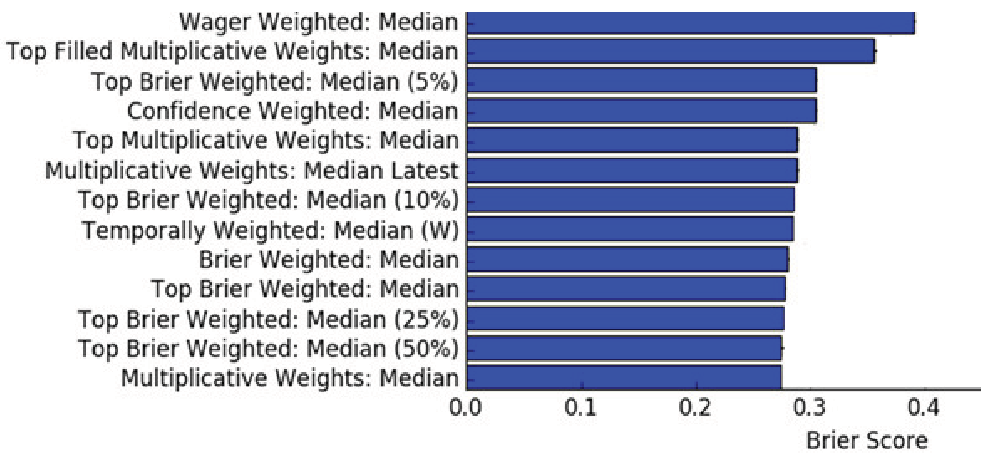 Comparative performance of various aggregation methods. Adaptive learning methods (Multiplicative Weights) significantly outperformed baseline averages.
Critical Insight & Future Outlook
The true value of MATRICS isn't just in its Brier score, but in its ability to handle diverse categories. By leveraging human "common sense," the system successfully navigated over 50 different geopolitical categories—ranging from sea ice levels to acts of war—without needing a ground-up redesign for each topic.
Limitations: The system still relies on a constant stream of human labor (from Amazon Mechanical Turk). A potential future direction would be replacing the "Human Crowd" with Large Language Model (LLM) agents that simulate human reasoning, potentially offering the same "contextual sanity checks" at 1/100th of the cost.
Conclusion: MATRICS proves that in the high-stakes world of geopolitical risk, the most powerful tool isn't the most complex algorithm, but the most effective collaboration between carbon and silicon.