
MATRICS: Bridging Human Intuition and Machine Scale for Geopolitical Forecasting
MATRICS: A System for Human-Machine Hybrid Forecasting of Geopolitical Events
2019-12-01
Summary
Problem
Method
Results
Takeaways
Abstract
MATRICS is a human-machine hybrid system for geopolitical forecasting that integrates crowdsourcing with ensemble machine learning. By utilizing parallel pipelines for "Machine-Aided Human Forecasting" (MAHF) and "Human-Aided Machine Forecasting" (HAMF), the system achieved a competitive mean Brier score of 0.27 across 187 complex forecasting questions.
## TL;DR
Geopolitical forecasting is traditionally a battle between rigid "Big Data" algorithms and clever but easily fatigued human crowds. **MATRICS** (Machine-Aided Human Forecasting / Human-Aided Machine Forecasting) bridges this gap. By creating a symbiotic pipeline where humans filter machine noise and machines automate human research, the system achieves a state-of-the-art Brier score of **0.27**, effectively solving the "cold-start" problem for new, unpredictable global events.
## The Wall: Big Data’s Rigidity vs. Human Fatigue
Prior automated systems like *PULSE* were remarkable at predicting specific events (e.g., civil unrest) but failed a critical test: **adaptability**. If a topic shifted or a new one emerged, these systems hit a "cold-start" wall—they simply didn't have the specialized data extraction rules to cope.
On the flip side, human groups (as seen in the IARPA ACE program) are brilliant at connecting disparate dots but suffer from:
* **Research Fatigue**: Sifting through thousands of news clips is exhausting.
* **Cognitive Bias**: Humans often weigh recent or sensational events too heavily.
* **Inefficiency**: Reaching a consensus takes time that fast-moving crises don't allow.
## Methodology: The Dual-Pipeline Architecture
The core "Smarter-than-the-sum-of-its-parts" logic in MATRICS lies in its bidirectional design.
### 1. Machine-Aided Human Forecasting (MAHF)
The machine acts as a high-speed research assistant. It scrapes social media, Google Trends, and economic indices, then presents them to users via an interactive dashboard. Instead of reading 100 articles, a human forecaster sees distilled time-series data and key-phrase trends.
### 2. Human-Aided Machine Forecasting (HAMF)
This is the most innovative "Why." Humans aren't just consumers of data; they are supervisors.
* **Outlier Detection**: A machine sees a price spike as a trend; a human knows it was a one-time hurricane and tells the machine to ignore it.
* **Contextual Tuning**: Humans provide "context vectors" by identifying relevant keywords that the machine should track, allowing the system to adapt to new topics instantly.
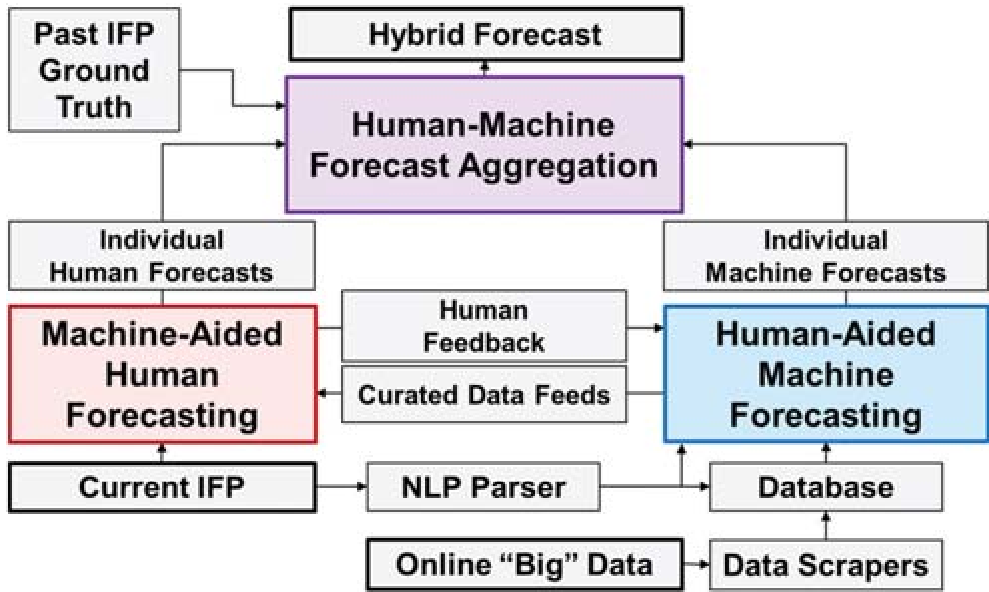
*Fig 1: The recursive relationship between MAHF and HAMF pipelines.*
## Evaluating Success: The IARPA Hybrid Forecasting Competition
The system was tested against 187 different "Individual Forecasting Problems" (IFPs), ranging from gold prices to election outcomes.
### The "Multiplicative Weights" Advantage
How do you combine a "Turker's" guess with a Bayesian model's output? MATRICS experimented with several aggregation methods. The winner was the **Multiplicative Weights** algorithm. This method assigns a "trust score" based on historical accuracy. If a specific machine model or a specific human forecaster has been consistently right, their "weight" in the final probability increases.
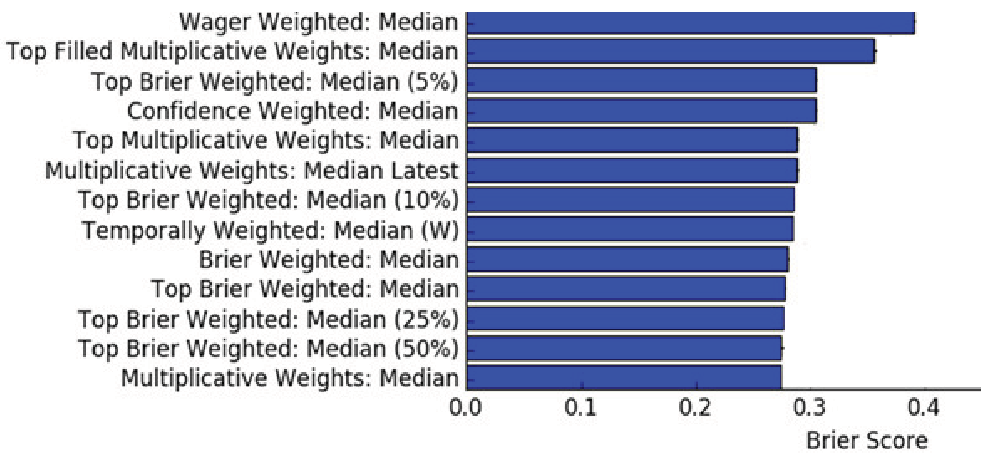
*Fig 2: Comparison of different aggregation strategies. Adaptive methods (Multiplicative Weights, Brier-weighted) significantly outperformed simple averages.*
## Critical Analysis & Future Outlook
**Insight**: The true value of MATRICS isn't just the Brier score; it’s the **reduction of the cold-start penalty**. By allowing humans to "hand-hold" the algorithm through the first few days of a new event, the system reaches high accuracy much faster than a purely data-driven model.
**Limitations**:
* The system still relies heavily on the quality of the crowd (Amazon Mechanical Turk).
* The User Interface (UI) remains a bottleneck; if the interface is clunky, the human "context" input becomes lower quality.
**The Takeaway**: The future of geopolitical intelligence isn't about replacing analysts with AI, but about building "Centaur" systems where the machine handles the volume and the human handles the nuance. MATRICS proves this hybrid approach is not just a theory, but a scalable reality.