
Tracking the Social Pulse: Matrix-Based Community Evolution Detection
Matrix Based Community Evolution Events Detection in Online Social Networks
The paper introduces a matrix-based algorithm for detecting six types of community evolution events (growth, contraction, merging, splitting, birth, death) in dynamic social networks. By utilizing the Louvain algorithm for initial detection and a lightweight correlation matrix approach for tracking, it achieves scalable analysis of large-scale datasets like DBLP and Facebook.
TL;DR
Understanding how groups form, merge, and dissolve in social networks is a monumental data challenge. This paper presents a scalable, matrix-driven framework that tracks community life cycles across snapshots. By introducing a noise-tolerant threshold, the authors successfully mapped the stable academic collaborations of DBLP against the volatile, "leisurely" friendship shifts on Facebook.
Background: Beyond the Static Graph
Traditionally, we view social networks as static "snapshots." However, a static view is like a single frame of a movie; it tells you who is standing next to whom, but not whether they are coming together or drifting apart. Tracking Community Evolution allows us to see the "life cycle" of social groups—essential for predicting user churn, viral trends, or shifts in academic interests.
The Core Problem: The Rigid Definition Trap
Previous research defined community events (like "Merging" or "Splitting") using strict set theory. For instance, a "Growth" event was defined as .
In the messy reality of large-scale data:
- Strictness kills detection: A community might grow but lose one random member; strict set theory would fail to classify this as "Growth."
- Scalability: Comparing every node across every community pair in massive snapshots is computationally expensive.
Methodology: The Correlation Matrix Insight
The authors bypass complex graph matching by converting communities into Community Vectors and then into Correlation Matrices.
1. The Matrix Framework
They define two key matrices:
- : Describes how much of a community at time persists into time .
- : Describes how much of a community at time originated from time .
2. The Procedure
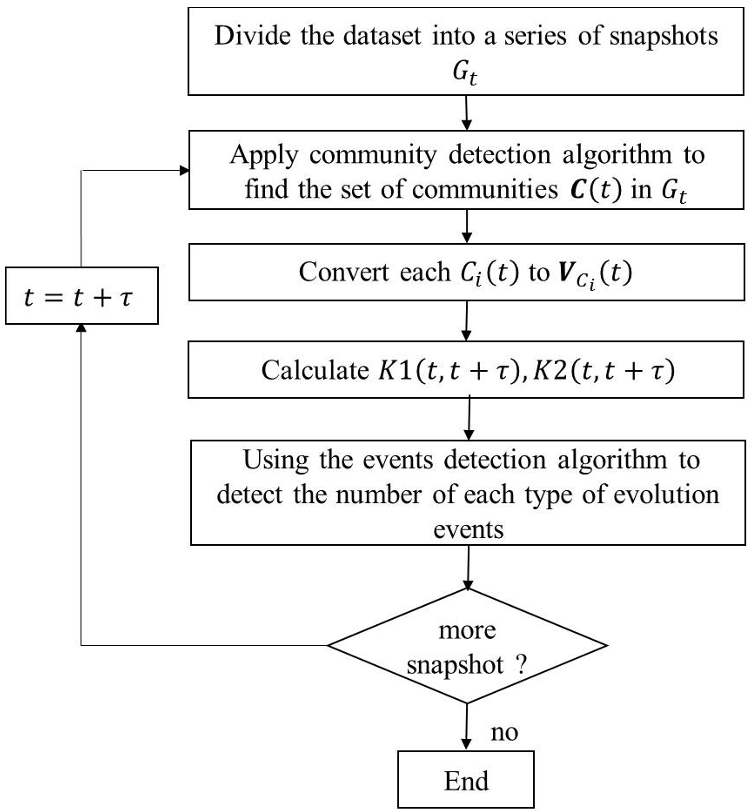
The workflow follows a clean pipeline:
3. Noise Tolerance ()
This is the paper's secret sauce. By setting a threshold (e.g., 0.3), they ignore minor membership jitters. This allows the algorithm to focus on the "signal" of the evolution rather than the "noise" of a few users joining or leaving.
Experimental Results: Stability vs. Volatility
The authors tested their method on DBLP (Academic) and Facebook (Social) datasets. The contrast was striking.
- DBLP (Stability): Dominated by "Growth" and "Contraction." This reflects the physical reality of academia where research groups are long-term and stable.
- Facebook (Dynamics): Showed high "Birth" and "Death" rates. A notable spike in 2008 coincided with Facebook's website interface upgrade, which saw a massive influx of over 100 million users.
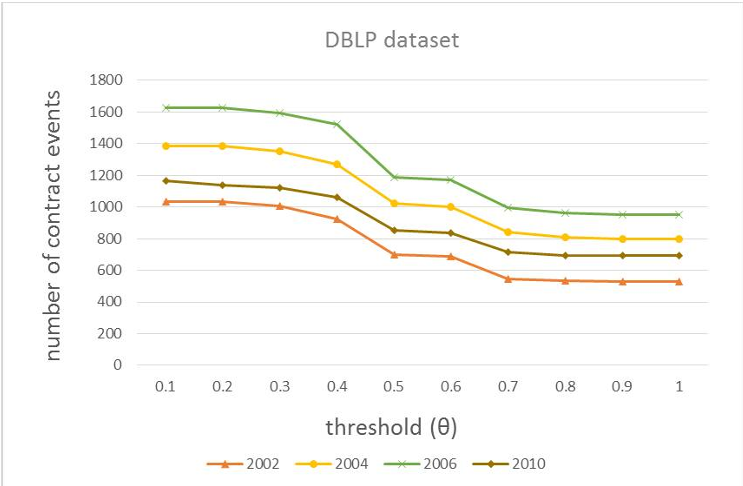 Figure: In DBLP, communities evolve slowly, reflecting consistent professional ties.
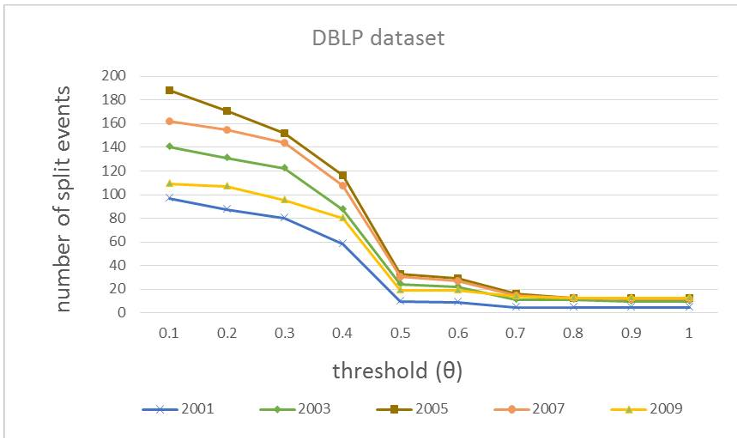
The impact of the threshold is also quantified. As shown below, if we demand perfection (), we find almost no events. Real-world evolution is "fuzzy."
Critical Insight & Conclusion
The strength of this work lies in its simplicity. By reducing community tracking to matrix operations, it achieves the scalability required for modern web-scale social networks.
Limitations: The method is a "downstream" consumer of community detection. If the initial Louvain algorithm produces unstable communities (e.g., due to its stochastic nature), the event detection will inherit that instability. Future work could benefit from "online" detection that identifies events as they happen, rather than relying on discrete snapshots.
Takeaway: To understand a network's future, you must look at how its groups breathe—it is the movement between the snapshots, governed by parameters of noise and correlation, that reveals the true social pulse.