
Bridging the Gap: Fusing Physical and Social Sensors via Unified Matrix Factorization
A Matrix Factorization Based Framework for Fusion of Physical and Social Sensors
The paper proposes a unified matrix factorization (MF) framework to fuse heterogeneous data from multimodal physical sensors (e.g., CCTV, PSI stations) and social sensors (e.g., Twitter). By integrating Latent Dirichlet Allocation (LDA) for semantic modeling, the system achieves SOTA performance in spatio-temporal situation awareness and noise filtering.
TL;DR
Researchers have developed a unified framework that treats human social media activity and physical sensor readings as two sides of the same coin. By adapting Matrix Factorization (MF)—a technique popularized by Netflix-style recommendation engines—to spatio-temporal data, they've created a system that can "see" through sensor noise and even predict environmental conditions (like pollution levels) in areas where no physical sensors exist.
Background: The Heterogeneity Paradox
Our cities are blanketed with sensors: CCTV cameras for traffic, PSI stations for air quality, and GPS for mobility. Yet, these sensors are "dumb"—they provide numbers without context. Conversely, social media (the "social sensor") provides rich semantic context (the "why") but is erratic and subjective.
The technical challenge lies in heterogeneity. How do you mathematically combine a floating-point temperature reading with a "tweet" expressing frustration about the heat? Previous works treated these as separate streams; this paper proposes a unified latent space.
Methodology: MF Meets Topic Modeling
The core innovation lies in the transformation of the fusion problem into a collaborative filtering task.
1. The Situation Matrix
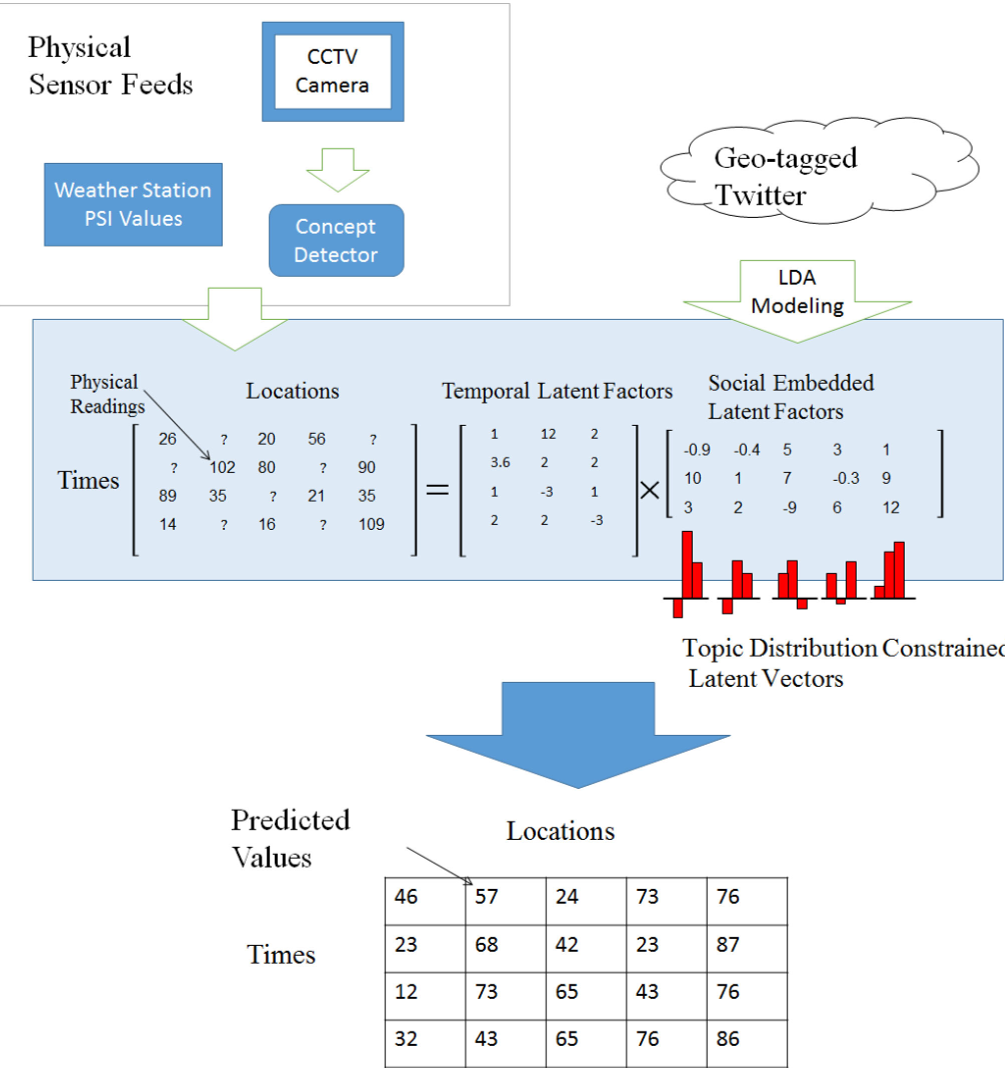
The authors build a matrix where rows are time stamps and columns are physical locations. Cells contain sensor readings.
2. Latent Feature Mapping
By factorizing into (Time latent vectors) and (Location latent vectors), the model captures the "hidden" characteristics of urban events.
3. The Social Anchor
This is the "secret sauce": the spatial latent vectors are not learned in isolation. Instead, they are regularized by Latent Dirichlet Allocation (LDA) topic distributions. If people at a specific location are tweeting about "smoke" and "haze," the latent vector for that location is pushed to align with the "Haze" topic, which in turn helps reconstruct the physical PSI readings.
Experiments & Results: Seeing the Unseen
The framework was tested on two high-stakes scenarios:
Case Study A: Singapore Haze Prediction
Can social media predict air quality? The authors zeroed out readings for several stations and used the model to "fill in" the gaps.
- Result: The inclusion of social data significantly outperformed the physical baseline. While a standard MF could only use time-biases (averages) to guess, the social-fused model used the semantic "haze" signal to accurately predict spikes in specific neighborhoods.
- Accuracy: RMSE dropped from 40.84 to 25.87.
Case Study B: NYC Event Noise Filtering
CCTV cameras are prone to false positives (e.g., raindrops on a lens being flagged as a crowd).
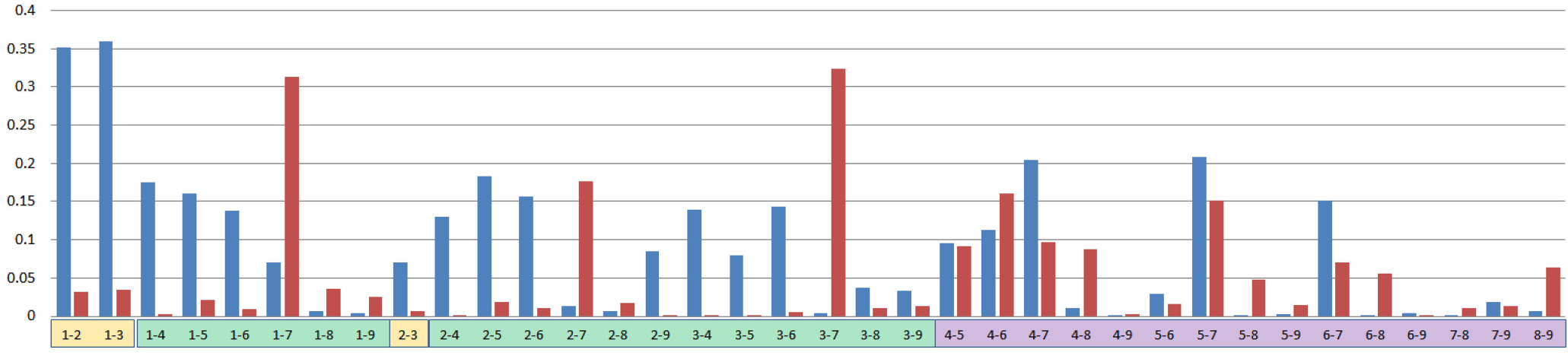
- Result: By using social impulse patterns (spikes in tweet volume) to weight physical signals, the system successfully filtered out camera noise.
- Metric: Achieved an F1-score of 0.76, a notable improvement over previous semantic-only or physical-only approaches.
Critical Insight: Why This Works
The brilliance of this approach is its treatment of Social Sensors as a Regularizer. Physical sensors give the "ground truth" but are noisy; social sensors are noisy but give the "intent." By coupling them through a joint optimization loss function, the model ensures that the latent space is "explained" by human context, making it far more robust than purely data-driven numeric models.
Future Outlook
While powerful, the model currently assumes a static correlation. The authors suggest that moving toward Factorization Machines or incorporating temporal evolving factors (to handle how events change over minutes) would be the next logical step. As we move toward "Smart Cities," frameworks like this will be essential for creating a truly comprehensive "Situation Awareness."
Takeaway for Researchers
If your sensor data is sparse or noisy, look for a "semantic anchor" (like text or tags) and use Matrix Factorization to bridge the gap. It's not just for movies; it's for the physical world.