
MERP: Bridging Social Network Embeddings and Matrix Factorization for Next-Gen Recommendations
Matrix Factorization Meets Social Network Embedding for Rating Prediction
The paper introduces MERP (Matrix factorization meets social network Embedding for Rating Prediction), a novel recommendation framework that integrates Social Network Embedding (SNE) techniques—such as DeepWalk and Node2vec—with Probabilistic Matrix Factorization (PMF). It effectively bridges representational learning on graphs with collaborative filtering to alleviate data sparsity in social recommendation tasks.
Executive Summary
TL;DR: The paper presents MERP, a hybrid framework that fuses Social Network Embedding (SNE) with Probabilistic Matrix Factorization (PMF). By learning a projection kernel from social graph features to a latent "social rating" space, the model overcomes the limitations of simplistic social regularization. It achieves state-of-the-art accuracy across major datasets, particularly excelling in cold-start and data-sparse environments.
Field Positioning: This work represents a significant evolutionary step from "Social Regularization" (fixing constraints on user similarity) to "Feature Synthesis" (learning how social structure directly contributes to the interaction representation).
The Core Motivation: Moving Beyond Simple Similarity
In the real world, our preferences are shaped by our social circles. While traditional social recommendation systems (like SoMF) recognize this, they usually treat social influence as a regularization penalty—forcing friends to have similar latent vectors.
The authors argue this is too restrictive. Social networks contain rich, multi-dimensional structures that a simple similarity score cannot capture. The challenge lies in:
- Complexity: How to process massive social graphs efficiently?
- Dimensionality: How to map high-dimensional graph features into a rating space without overfitting?
- Synergy: How to make matrix factorization "aware" of social characteristics during the learning process?
Methodology: The MERP Framework
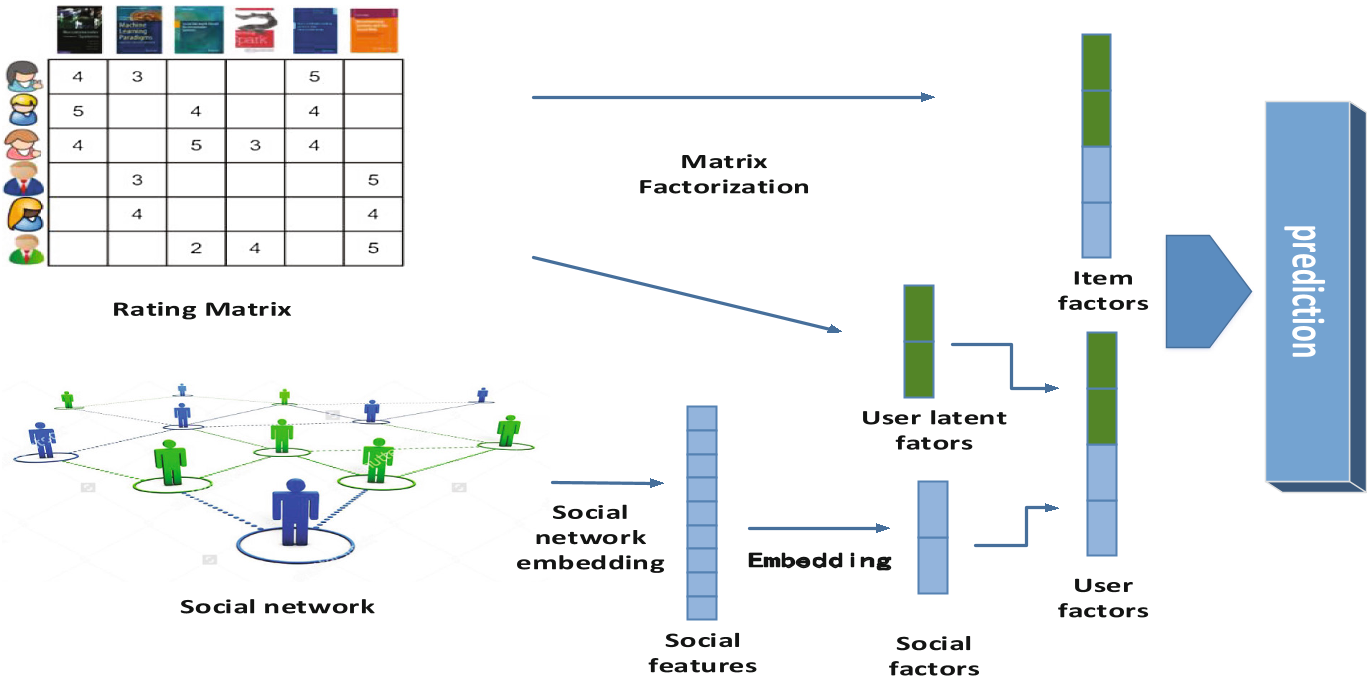
The genius of MERP lies in its two-stage feature fusion. Instead of using raw network features, it learns a transformation.
1. Social Feature Extraction
The model employs methodologies like DeepWalk and Node2vec to vectorize the social graph. These methods treat random walks as "sentences" and use Skip-gram to learn user embeddings () that preserve network topology.
2. The Integrated Predictor
The standard PMF equation is augmented. The final prediction is defined as:
- : Standard user/item latent factors.
- : The Embedding Kernel. This matrix transforms the high-dimensional social vector into a dense "social rating" factor.
- : A social-specific item factor, representing how an item appeals to different social dimensions.
- : A visual/social bias term accounting for global item popularity within specific social subgroups.
Experimental Analysis
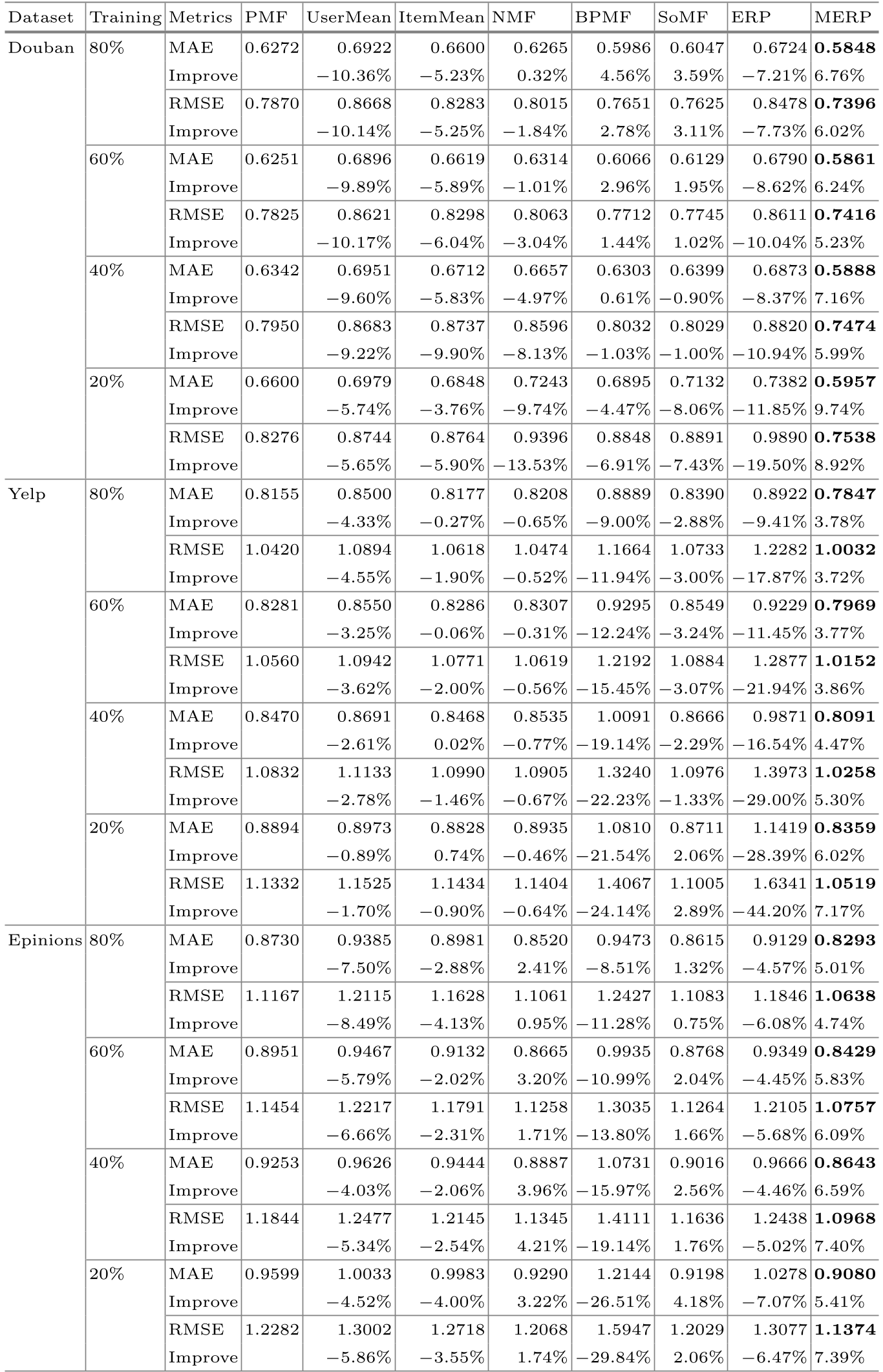
The authors tested MERP against a battery of baselines including PMF, NMF, BPMF, and SoMF across three datasets: Douban, Yelp, and Epinions.
Key Findings:
- Data Sparsity Resilience: In the Douban dataset, as the training data ratio dropped to 20%, MERP’s performance gain actually increased (reaching ~9.74% MAE improvement over PMF), suggesting that social information becomes more valuable when interaction data is scarce.
- BFS vs. DFS: Interestingly, in Node2vec testing, the BFS (Breadth-First Search) strategy outperformed DFS. This indicates that in social recommendation, capturing "community" properties (homophily) is more critical than capturing structural roles.
Critical Insights & Conclusion
Why MERP Works
By utilizing a shared embedding kernel , the model significantly reduces the number of learnable parameters compared to deep neural networks, maintaining the efficiency of Matrix Factorization while gaining the expressive power of Network Embeddings. It creates a "socially-aware" latent space where user interactions are filtered through their social context.
Limitations & Future Work
While MERP is efficient, the SNE features are pre-computed (offline). A jointly optimized end-to-end framework where the graph embedding is learned simultaneously with the rating prediction could potentially unlock even higher performance, though it would likely increase computational overhead.
Final Takeaway: For practitioners dealing with sparse interaction matrices, integrating social graph embeddings via a projection kernel is a highly efficient way to boost recall and accuracy without the massive overhead of Graph Neural Networks.