
Matrix Profile V: Bridging the Gap Between Math and Meaning in Motif Discovery
Matrix Profile V: A Generic Technique to Incorporate Domain Knowledge into Motif Discovery
This paper introduces "Guided Motif Search" via Matrix Profile V, a framework that incorporates domain knowledge into time series motif discovery. By utilizing an Annotation Vector (AV) to bias the Matrix Profile, the method successfully filters out "stop-word" motifs, simplicity-biased patterns, and sensor artifacts, achieving SOTA relevance in specialized domains like seismology and medicine.
Executive Summary
TL;DR: While we can now search through millions of data points in seconds, the "best" mathematical match in time series data is often the "worst" match for a human expert. This paper introduces a breakthrough framework that uses Annotation Vectors (AV) to inject domain knowledge into the Matrix Profile, effectively filtering out noise, artifacts, and "simple" patterns that typically swamp motif discovery.
Background: This work sits at the intersection of high-performance data mining and interactive human-computer interaction. It acknowledges that algorithms like STOMP and STAMP have solved the speed of motif search, but the definition of a motif remained biologically/physically naive until now.
The "Blind Spot" of Classic Motif Search
Why does a state-of-the-art algorithm frequently return "boring" results? The authors identify three critical biases:
- Stop-Word Bias: Like the word "the" in text, calibration signals or sensor flatlines are highly repetitive but carry zero information.
- Simplicity Bias: Euclidean distance inherently favors "simple" shapes (e.g., a straight line) over complex ones. Two flat lines are always "closer" than two complex heartbeats, even if the latter are identical.
- Actionability Bias: Users often need patterns that happen at specific times (e.g., weekends) or under specific conditions, which standard search ignores.
Methodology: The Corrected Matrix Profile (CMP)
The core innovation is the Annotation Vector (AV). Think of it as a transparent layer placed over your data that tells the algorithm where to "look harder."
The Formula
The algorithm modifies the original Matrix Profile () to create a Corrected Matrix Profile (CMP): Where is a value between 0 and 1. If (the region is interesting), the distance remains low. If (the region is junk), the distance is "pushed" to the maximum, effectively disqualifying it from being a top motif.
Architecture & Logic
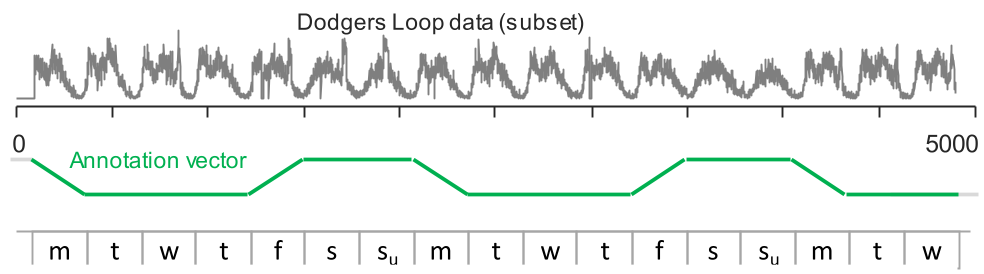 In the traffic data example above, the AV (bottom) is manually set to favor weekends, allowing the system to ignore repetitive weekday commutes in favor of rare weekend patterns.
Real-World Case Studies
1. Eliminating Motion Artifacts
In medical fNIRS (brain imaging) data, head movement creates spikes that the math thinks are "motifs." By using an accelerometer as a secondary data source, the authors generated an AV that zeroed out any period of high physical motion.
 Figure: The red line (acceleration) identifies junk data, allowing the algorithm to find the true biological motif in the blue signal.
2. Solving Simplicity Bias with Complexity Estimation
By using a "Complexity Estimator" (measuring how much a signal "stretches"), the authors created an AV that penalizes simple ramps. This allowed for the discovery of complex finger flexion patterns in ECoG data that were previously hidden by signal drift.
Performance Benchmarks
Does this add a heavy computational burden? No.
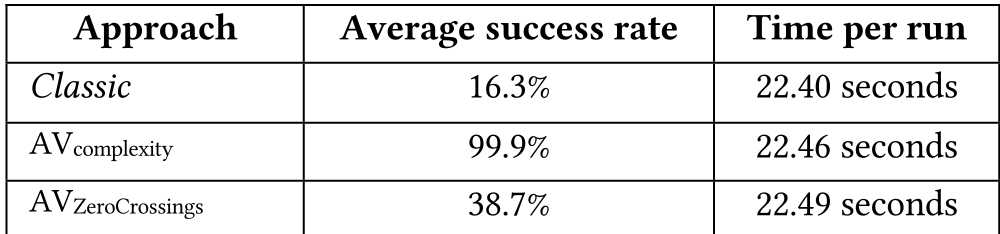
- Success Rate: In synthetic tests against random walk noise, the success rate jumped from 16.3% (Classic) to 99.9% (Guided).
- Overhead: For a dataset of 20,000 points, the additional computation took a mere 0.06 seconds.
Critical Insight & Conclusion
The Takeaway: The genius of the Matrix Profile V is its orthogonality. It doesn't require rewriting the underlying search algorithm. It separates the "heavy lifting" (calculating distances) from the "domain thinking" (defining what matters).
Limitations: The system still requires a human to "understand" the bias first. Future work aims to automate this by observing how users interact with data—essentially "learning" the Annotation Vector through feedback. This work marks a shift from pure algorithmic scaling to Semantic Signal Processing.