
MaxEnt: Tackling the Scarcity of Cyberbullying Data via Maximum Entropy
Adopting MaxEnt to Identification of Bullying Incidents in Social Networks
This paper introduces the Maximum Entropy (MaxEnt) method to identify cyberbullying users on YouTube. By framing cyberbullying detection as an "incident-only" modeling task, it achieves superior discrimination performance (AUC 0.75) compared to traditional supervised classifiers like SVM and Random Forests.
TL;DR
Detecting cyberbullies is a "needle in a haystack" problem. This paper proposes a paradigm shift: treating cyberbullying identification not as a standard binary classification, but as an incident-only modeling task using Maximum Entropy (MaxEnt). Applied to YouTube data, MaxEnt achieved an AUC of 0.75, proving significantly more robust to low prevalence and imbalanced datasets than Support Vector Machines (SVM) or Random Forests.
The "Prevalence" Problem in Cyberbullying
In the real world, bullying is a rare event compared to the vast sea of benign social interactions. In the YouTube dataset used in this study, only 12% of users were identified as bullies. This creates two major hurdles for AI:
- Labeling Costs: It is extremely laborious to manually label enough "bully" instances to satisfy data-hungry models.
- Model Bias: Standard classifiers like SVM are "prevalence-dependent." When the positive class is rare, these models struggle to find the decision boundary, often leading to high false-negative rates or statistical artifacts.
The authors' core insight is that we need a model that doesn't just look for a boundary between "Good" and "Bad," but instead characterizes the "profile" of bullying incidents itself—a technique borrowed from biology known as Species Distribution Modeling.
Methodology: The Logic of Maximum Entropy
MaxEnt is a general-purpose machine learning method with a precise mathematical foundation. Its guiding principle is simple: The best approximation of an unknown distribution is the one that is most spread out (maximum entropy) while still satisfying the constraints of what we actually know.
Feature Engineering
The authors utilized 14 features across three categories:
- Activity Features: Frequency of uploads, comments, and subscriptions.
- User Features: Age and membership duration.
- Content Features: Use of profane words, pronouns (1st/2nd person), and non-standard spelling.
Model Architecture
While GLM, RF, and SVM require both positive (bully) and negative (non-bully) examples for training, MaxEnt is optimized to work with incident-only data. It uses an exponential model for probabilities, making it exceptionally robust to limited training data.
Experimental Results: Why MaxEnt Wins
The study compared MaxEnt against three heavyweights: Generalized Linear Models (GLM), Random Forests (RF), and Support Vector Machines (SVM).
1. Superior Discrimination (AUC)
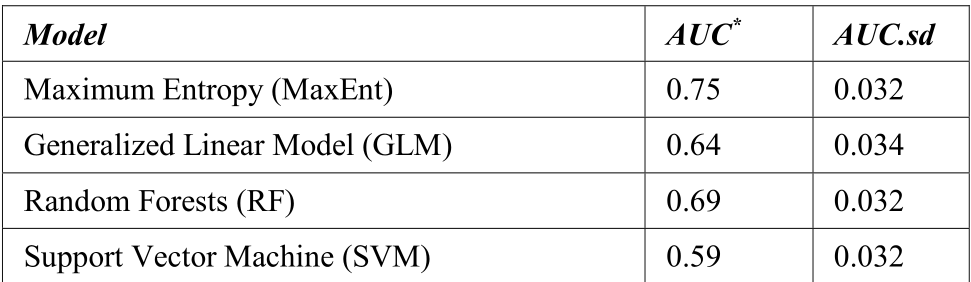
The Area Under the Curve (AUC) is a threshold-independent metric. MaxEnt reached 0.75, whereas SVM lagged behind at 0.59. This indicates that MaxEnt is far more effective at ranking potential bullies higher than non-bullies, even when the data is sparse.
2. Robust Calibration
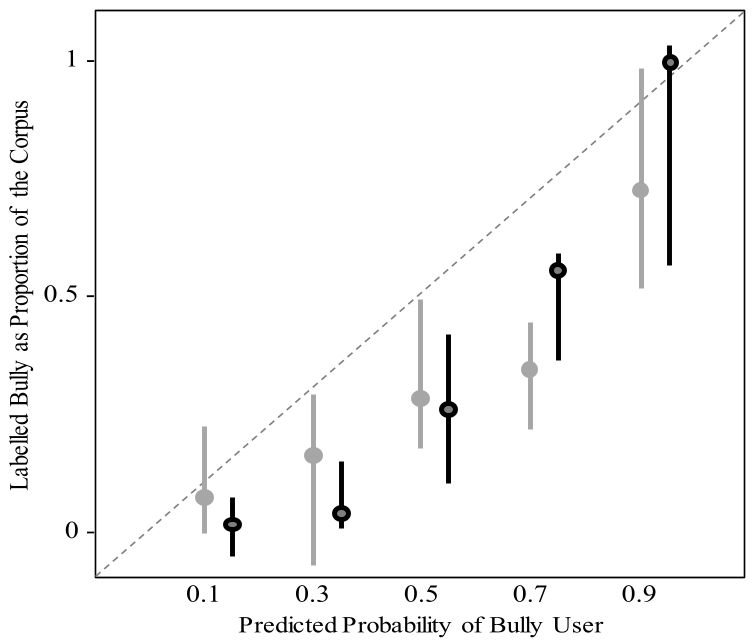
A "well-calibrated" model means the predicted probability (e.g., 0.8) actually reflects the real-world frequency of the event. MaxEnt and Random Forest demonstrated superior calibration curves, suggesting they are safer to deploy in real-world environments where decision-making depends on probability thresholds.
3. Feature Importance
Analysis of the MaxEnt model showed that the number of profane words was the strongest predictor (33% contribution), followed by the total frequency of comments. Interestingly, the number of subscriptions had almost no impact on identifying bullies.
Critical Insight & Future Outlook
This paper proves that "Domain Adaptation" works both ways—taking a model designed to predict where rare animals live and applying it to how rare "digital predators" (bullies) behave.
Takeaway for the Industry: If your target event (fraud, bullying, system failure) accounts for less than 15% of your data, stop using standard SVMs. Exploring incident-only or anomaly-detection frameworks like MaxEnt can provide higher reliability and better calibration.
Limitations: MaxEnt use an exponential model, meaning it can produce extreme values for data points outside the training range (extrapolation risk). Future work should integrate temporal features (the timing of attacks) to further sharpen detection.