
Scaling the Ripple Effect: Parallel Influence Maximization via MapReduce
Maximal Influence Spread for Social Network Based on MapReduce
This paper introduces Parallel DAGIS and Parallel Sampling, two MapReduce-based algorithms designed to maximize influence spread in large-scale social networks. By leveraging the Hadoop framework, the authors achieve significant scalability, transforming sequential graph traversal into parallelized tasks that handle billions of nodes.
TL;DR
To tackle the computational bottleneck of identifying influential nodes in massive social networks, this paper proposes Parallel DAGIS and Parallel Sampling. By utilizing Hadoop's MapReduce framework and a novel bidirectional BFS strategy, the authors achieve over 5x speedup on million-edge networks while improving the accuracy of influence estimation.
Problem & Motivation
In the world of viral marketing, finding the "seed set"—a small group of individuals who can trigger the largest cascade of information—is an NP-hard problem. While algorithms like CELF and IC-based greedy models exist, they are notoriously slow for "Big Data" scenarios.
The authors identify three core limitations in prior work:
- Serial Execution: Most algorithms calculate influence spread node-by-node, failing to utilize cluster resources.
- Information Loss: Heuristics like DAGIS simplify the graph into a Directed Acyclic Graph, which ignores potential influence paths.
- Search Inefficiency: Unidirectional Depth-First Search (DFS) in sampling often explores unnecessary regions of the network.
Methodology: High-Throughput Influence Calculation
1. Parallel DAGIS via MapReduce
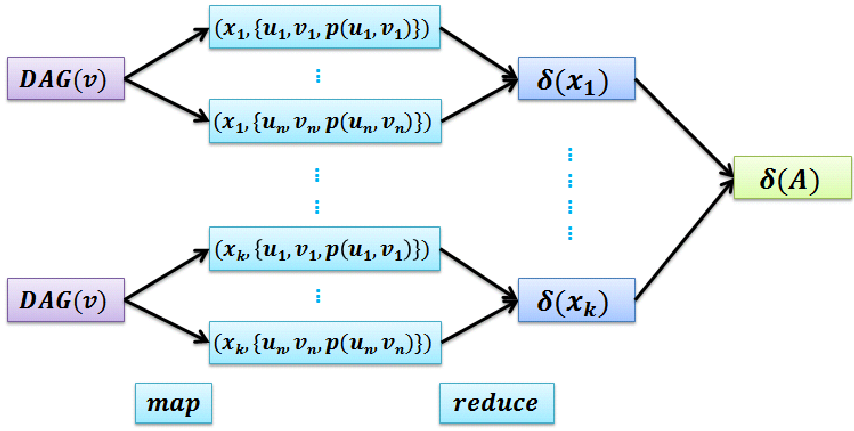
The core insight is that the influence spread of a set can be decomposed: This property allows the authors to distribute the calculation of across different Hadoop Task Trackers. The Map function emits node-edge relationships, while the Reduce function aggregates the expected influence.
2. Parallel Sampling & Bidirectional BFS
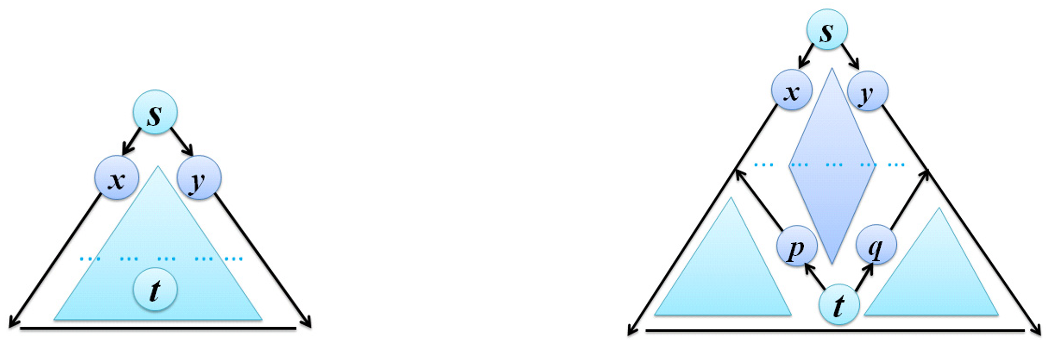
To solve the "Information Loss" problem, the authors moved from DAG spanning to a sampling-based approach on the original graph. To optimize this, they introduced Bidirectional BFS. Instead of searching outward from the seed indefinitely, they search both forward and backward, focusing on the "Diamond Region" intersection. This significantly reduces the queue space and accelerates pruning.
Experiments & Results
The authors tested their framework using the Amazon product co-purchasing network (262k nodes, 1.2M edges).
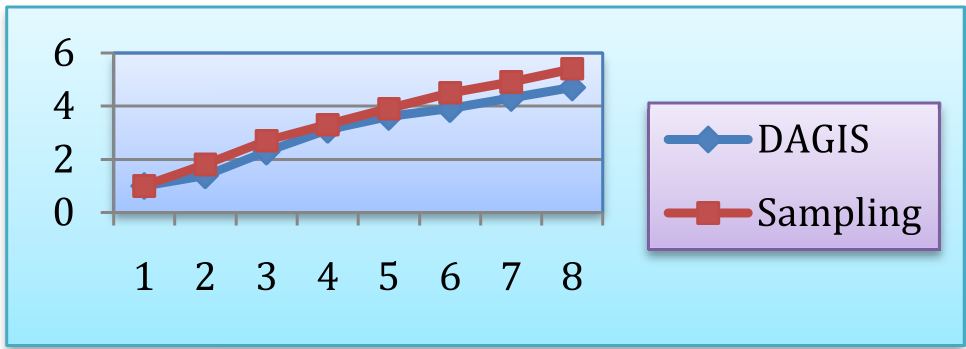
- Efficiency: The algorithms scale remarkably well. As the number of cluster PCs increases, the speedup ratio follows a nearly linear trend.
- Sampling vs. DAGIS: Parallel Sampling proved more efficient (5.4x speedup) than Parallel DAGIS (4.7x speedup) because the bidirectional BFS optimization drastically lowered the per-node processing time.
Critical Analysis & Conclusion
Takeaway
The shift from single-threaded heuristics to a distributed MapReduce paradigm is essential for modern social media analytics. By combining global variable management (to avoid redundant calculations) and bidirectional search, this work bridges the gap between theoretical influence maximization and practical retail/marketing applications.
Limitations & Future Work
While Hadoop provides stability, its disk-based I/O can be a bottleneck compared to in-memory frameworks like Apache Spark. Additionally, the current model assumes a static graph. In real-world social networks (like Twitter or Weibo), edges appear and disappear dynamically. Extending these parallel samplers to streaming graph data would be the logical next step for this research.
Disclaimer: This post is a technical breakdown of "Maximal Influence Spread for Social Network Based on MapReduce" by Shi et al.