
Beyond Blind Assignment: Maximizing Acceptance in Rejection-Aware Crowdsourcing
Maximizing Acceptance in Rejection-aware Spatial Crowdsourcing
This paper introduces the Maximizing Acceptance in Spatial Crowdsourcing (MA-SC) problem, which incorporates worker rejection behavior into task assignment. The authors propose the Greedy algorithm and several other approximation methods to maximize the expected acceptance rate of tasks by workers.
TL;DR
Most spatial crowdsourcing systems assume workers are passive agents who accept whatever task is pushed to them. This paper challenges that "perfect obedience" assumption by introducing the MA-SC (Maximizing Acceptance in Spatial Crowdsourcing) problem. By modeling the probability that a worker will actually interest themselves in a task, the authors provide a suite of algorithms—led by a highly efficient Greedy approach—that maximizes system throughput even when workers have the power to say "no."
Background: The Price of Rejection
In platforms like Uber or DoorDash, rejections are not just an anomaly; they are a standard part of the workflow. Drivers reject rides because of distance, poor pay, or inconvenient destinations. When a server ignores these preferences, it results in wasted time and a "cold" system where tasks remain unvisited.
The core challenge lies in the Inductive Bias of previous models: they optimized for distance or coverage but ignored the human element. This paper treats acceptance as a probabilistic event, turning task assignment into a complex combinatorial optimization problem.
Methodology: The Math of "Interest"
The authors define as the probability that worker is interested in task . The expected acceptance for a single worker receiving a set of tasks () is calculated as:
The goal is to partition the task set such that the sum of these expectations across all workers is maximized. Because this is proven to be NP-hard, the paper explores a hierarchy of solutions:
- Exact Solutions: Dynamic Programming (DP) and Depth-First Search (DFS) with pruning for small-scale scenarios.
- Guided Random Sampling (GRS): Using weighted sampling to find promising regions of the solution space.
- Local Search (LS): Iteratively swapping tasks between workers to climb towards a local optimum.
- Greedy Algorithm: Picking the best task-worker pair in each step—a method that surprisingly outperforms more complex heuristics.

Experiments & Results
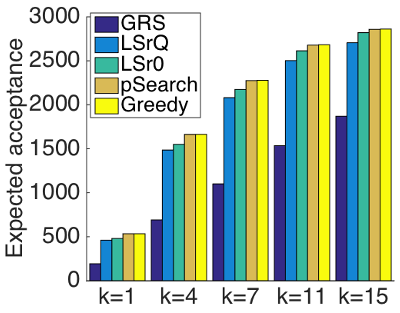
The evaluation focused on two dimensions: Expected Acceptance (how many tasks actually get done) and Efficiency (how fast the server can decide).
Small-Scale Performance
With , DFS proved significantly faster than DP because its pruning strategies could eliminate sub-optimal assignment branches early. Most approximation methods kept pace with the optimal solution, proving their reliability.
Large-Scale Scalability
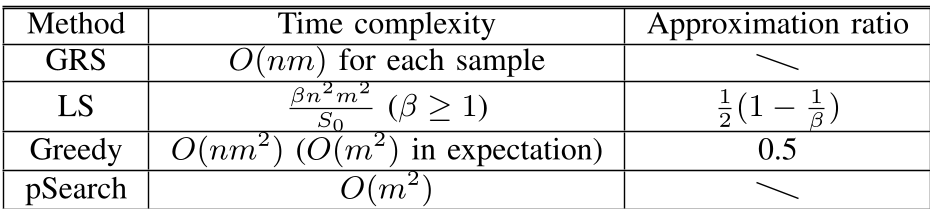
When scaled to 3,000 workers, the Greedy algorithm became the "SOTA" choice. It maintained a high acceptance rate (approx. 0.5 ratio) while keeping computation costs low. Interestingly, Parallel Search (pSearch) offered competitive speed but struggled slightly more with task collisions.
Critical Insights & Conclusion
This work marks a shift from Server-Centric to Worker-Centric crowdsourcing. By acknowledging that workers are autonomous agents with preferences, the system becomes more resilient.
Key Takeaways:
- Simplicity Wins: The Greedy algorithm's performance suggests that in high-dimensional task spaces, making locally optimal choices regarding worker interest is a robust strategy.
- The Scalability Gap: While exact solutions are mathematically elegant, they are practically useless for real-time city-scale applications, highlighting the need for the or better approximations explored here.
Limitations: The model assumes is known or easily mineable from historical data. In highly dynamic or "cold-start" scenarios where worker behavior is unknown, the model would need to be coupled with a Multi-Armed Bandit (MAB) framework to learn preferences on the fly.