
Maximizing Acceptance: Making Spatial Crowdsourcing Rejection-Aware
Maximizing Acceptance in Rejection-aware Spatial Crowdsourcing
This paper introduces a Rejection-Aware Spatial Crowdsourcing framework and defines the MA-SC (Maximizing Acceptance in Spatial Crowdsourcing) problem. It aims to maximize the expected number of tasks performed by accounting for worker interest probabilities, proposing a suite of solutions including a highly efficient Greedy algorithm with a 0.5 approximation ratio.
TL;DR
Current spatial crowdsourcing systems (like Uber or gMission) often fail because they assume workers will always accept assigned tasks. This paper formally defines the Maximizing Acceptance in Spatial Crowdsourcing (MA-SC) problem, proves it is NP-hard, and provides a Greedy algorithm that is both theoretically grounded (0.5 approximation ratio) and practically efficient for massive real-world datasets.
The Reality Check: Workers Can Say "No"
In the typical Server Assigned Tasks (SAT) mode, a central server matches moving workers to location-specific tasks. Traditional models optimize for total tasks assigned or minimum travel distance, but they ignore the "Rejection" factor. If a worker finds the pay too low or the distance slightly too far, they reject the task, and that task remains unserved, wasting a matching cycle.
The Research Intuition: If we can model the probability of interest () for every worker-task pair, we can optimize for the Expected Acceptance (EA). By maximizing the sum of probabilities that workers will say "yes," we naturally increase the system's total throughput.
Methodology: Mining Submodular Gold
The authors prove that the objective function—the total expected acceptance—is monotone and submodular.
1. The Exact Solutions
For small-scale problems, the authors propose:
- Dynamic Programming (DP): A bottom-up approach that is exhaustive but has a staggering complexity of .
- Depth-First Search (DFS) with Pruning: By calculating a lower bound for rejections, the algorithm can "cut" branches of the search tree that cannot possibly beat the current best solution.
2. The Practical Winner: Greedy Algorithm
Since the objective is submodular, a Greedy approach is highly effective. In each step, the algorithm selects the worker-task pair that provides the maximum marginal increase in expected acceptance.
 The objective function: Minimizing the product of "non-interest" probabilities to maximize total acceptance.
To make this scale to thousands of workers, the authors optimized the Greedy implementation to (and in expectation) by maintaining a vector of maximum marginal gains for each row, avoiding redundant re-calculations.
Experimental Evidence
The authors validated their model using real-world data from Gowalla (check-ins) and Uber (NYC trip data).
- Correlation: They first proved on the gMission platform that "Expected Acceptance" is highly correlated with "Practical Acceptance," justifying their mathematical model.
- Scalability: While DFS dies out when the number of tasks per worker exceeds 2 or 3, the Greedy algorithm handles workers with ease.
- Acceptance Quality: Greedy and a heuristic called "Parallel Search" consistently outperformed sampling methods (GRS), capturing nearly the same value as the optimal brute-force solutions in small-scale tests.
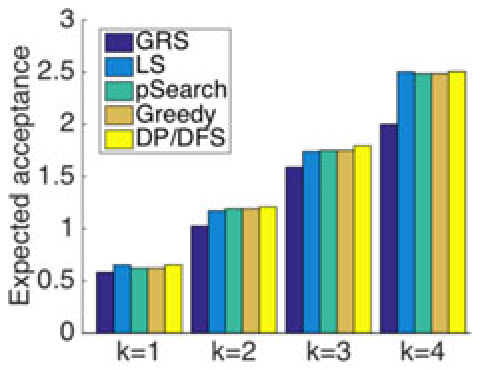 Figure: In small-scale tests (n=4), the Greedy algorithm (Green) is virtually indistinguishable from the Optimal solution (Red).
Critical Insights & Future Outlook
This work fills a critical gap in crowdsourcing literature by moving away from "perfect worker" assumptions.
Key Takeaways:
- Submodularity is Key: Many assignment problems in crowdsourcing can be reduced to submodular maximization, allowing us to use Greedy handles on NP-hard problems.
- Estimation Matters: The system relies on a good matrix. The authors suggest using Maximum Likelihood Estimation (MLE) based on historical worker behavior to "learn" what tasks a worker is likely to accept.
Limitations: The current model is "timestamp-based," meaning it processes batches of tasks. The next frontier is Online Rejection-Aware Assignment, where the server must decide instantly when a single worker appears, without waiting for a batch.
Senior Editor's Note: This paper is a foundational read for anyone building dispatching systems for gig-economy platforms where worker autonomy is a first-class citizen.