
ELTM: Winning the Viral Marketing War in Competitive Social Networks
Maximizing the Spread of Competitive Influence in a Social Network Oriented to Viral Marketing
The paper introduces the Extended Linear Threshold Model (ELTM) to address competitive influence maximization in viral marketing. It focuses on selecting an optimal seed set for a specific product (Product A) to maximize its spread in a social network where a competitor (Product B) is already active, achieving a (1 - 1/e) approximation ratio using a greedy algorithm.
TL;DR
In the digital marketplace, products don't exist in a vacuum; they compete. This paper introduces the Extended Linear Threshold Model (ELTM), a framework designed to maximize a brand's reach when a competitor is already present. By proving the objective function is submodular, the authors show that a simple greedy algorithm can capture at least 63% of the optimal influence spread, offering a robust strategy for "underdog" brands to challenge market leaders.
Problem & Motivation: Beyond Single-Product Influence
Most classical research on influence maximization (pioneered by Kempe et al.) assumes a "monopoly" where only one piece of information spreads. In reality, marketing is a battleground.
Current competitive models—mostly based on Independent Cascade (IC) logic—often treat influence as a binary "hit or miss." They ignore the cumulative effect of social pressure. For instance, you might not buy a product after one friend mentions it, but you might after five friends do. The authors identified that existing models lacked:
- Influence Accumulation: The power of multiple neighbors.
- Product Strength (Influence Degree): The reality that some brands (like Nike or Apple) have inherently higher persuasion power than others.
Methodology: The Extended Linear Threshold Model (ELTM)
The core innovation is the ELTM, which builds on the classic LT model but adds a competitive layer.
The Mechanics of Persuasion
Each node in the network has two hidden thresholds (). A node becomes activated by Product A if the weighted sum of its A-activated neighbors, multiplied by A's "influence degree" (), exceeds the threshold.
The authors define four decision cases for a node:
- A-only activation: Only Product A's influence exceeds the threshold.
- B-only activation: Only Product B's influence wins.
- Strategic Conflict: If both exceed thresholds, the "bigger weight" or a dominant product (assigned as A in this study) takes the node.
- Inactivity: Neither is strong enough.
The Mathematical Edge: Submodularity
The brilliance of ELTM lies in proving that the influence function is monotone and submodular. In layman's terms, this means "diminishing returns": adding a seed to a small set helps more than adding it to a large set. This property allows the use of a Greedy Algorithm to find the near-optimal seed set with a guaranteed performance bound of .
 Figure 1: The objective function used to solve the NP-hard problem of seed selection.
Experiments & Results
The researchers tested their model on the Cit-HepTh dataset (Arxiv citation network).
1. Greedy vs. The World
As shown in the performance charts, the Greedy algorithm significantly outperformed common heuristics like "Max-Degree" (picking the most connected people) and "Random" selection. This proves that structural influence is more complex than just having many followers; it's about where those followers are positioned relative to the competitor.
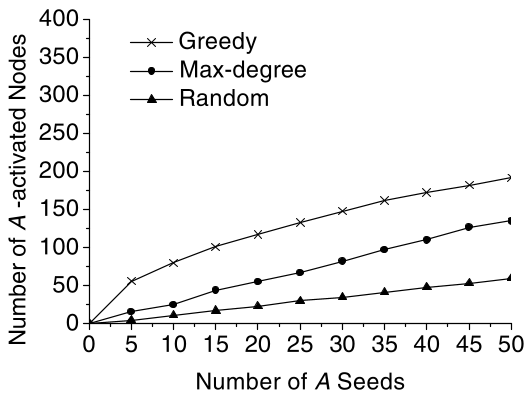 Figure 2: Spread of A-activated nodes. The Greedy approach (top line) shows superior growth as more seeds are added.
2. The Power of "Influence Degree"
The study also varied and . When Product A had a higher influence degree (), its spread grew exponentially faster. This quantifies a vital marketing truth: a better product (higher ) requires fewer resources to achieve the same reach.
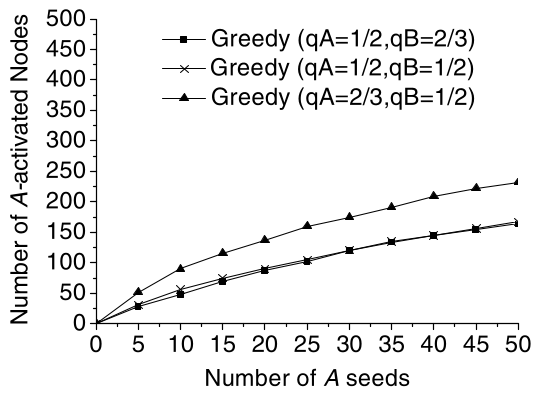 Figure 3: Impact of relative product strength on total market penetration.
Critical Analysis & Future Outlook
Takeaway: ELTM provides a mathematically sound bridge between social network theory and real-world competitive marketing.
Limitations:
- The model assumes and are static. In reality, a brand's influence degree changes over time due to ad campaigns or scandals.
- The current experiment assumes Product A always wins ties, which is a simplification of market dynamics.
Future Work: The next frontier for this research is Dynamic ELTM, where the competition happens in real-time, and companies can reactively change their seed sets as the "battlefield" shifts.