
Beyond Competition: Maximizing Cooperative Influence Spread in Viral Marketing
Maximizing the Cooperative Influence Spread in a Social Network Oriented to Viral Marketing
The paper introduces a novel framework for maximizing "Cooperative Influence Spread" in social networks, focusing on associated products (e.g., phones and cases). It proposes the Similarity Model (SM) for edge weight generation and the Independent Cascade Model with Accepted Probability (ICMAP) to simulate joint product adoption, achieving near-optimal influence maximization via an improved greedy algorithm.
Executive Summary
In the realm of social network analysis, the "Influence Maximization" (IM) problem has historically focused on picking the right "seeds" to spread a single idea or product. However, real-world commerce is rarely solo. Products like beds and mattresses or smartphones and power banks exist in a cooperative ecosystem.
This paper breaks away from the "winner-takes-all" competitive model to explore Cooperative Influence Spread. By introducing the ICMAP (Independent Cascade Model with Accepted Probability), the authors provide a mathematically grounded approach to selecting seeds that maximize the profit of product bundles, proving that cooperative dynamics significantly alter the landscape of viral marketing.
The Missing Link: Why Product Association Matters
Most prior works treat products as independent entities or fierce rivals. The authors identify a glaring gap: Functional Dependency. If a consumer buys Product A, their probability of buying Product B increases significantly.
The bottleneck in existing literature is twofold:
- Topology vs. Content: Models often ignore the strength of the relationship between specific products.
- Binary Fallacy: Traditional IC models assume that if a neighbor "activates" you, you are 100% influenced. In reality, consumers have an Accepted Probability ()—a personal preference barrier.
Methodology: The ICMAP Framework
1. Generating the Cooperative Graph
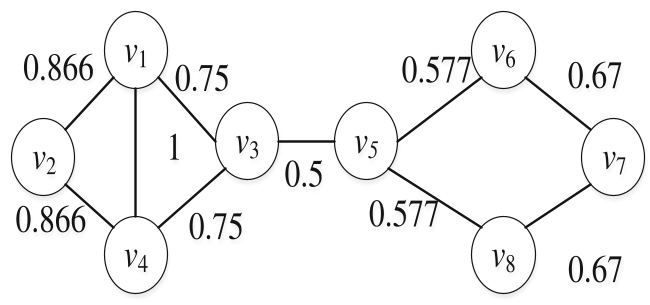
The authors first define edge weights using a Similarity Model (SM), which calculates the cosine similarity of mutual friends between two nodes. They then integrate "Association Rules" (Support and Confidence) to derive the cooperative spread probability ():
This ensures that the spread of Product A and B together is grounded in historical consumer behavior data.
2. The ICMAP Model
The core innovation is the Independent Cascade Model with Accepted Probability. Unlike standard models, even if an edge successfully "carries" the influence, the target node only adopts the products with probability . This adds a layer of realism relevant to high-stakes purchasing decisions.
3. Optimization and Submodularity
The researchers prove that their profit-based objective function is monotone and submodular. This is a crucial finding because it guarantees that a simple Greedy Algorithm can achieve an approximation ratio of , roughly 63% of the optimal solution (which is otherwise NP-hard to find).
Experiments and Insights
The team tested their approach on several arXiv collaboration networks and P2P topologies.
Key Findings:
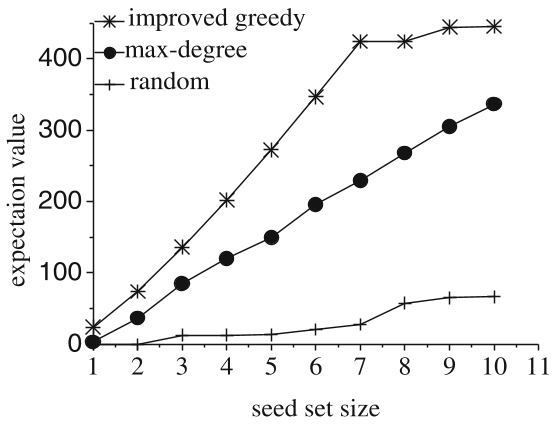
- Superiority of Heuristics: The improved greedy algorithm consistently outperformed "Max-Degree" (picking the most popular people) because popular people tend to be in the same "cluster," leading to redundant influence overlapping.
- The Power of Confidence: As the conditional probability increases, the total reach grows non-linearly, suggesting that marketing "bundles" becomes exponentially more effective as product affinity strengthens.
Critical Analysis & Conclusion
Takeaway
The shift from "node centrality" to "pair-wise product affinity" is a major step toward practical viral marketing. By considering the Accepted Probability, the model moves closer to capturing human psychology in digital networks.
Limitations & Future Work
While the "Improved Greedy" algorithm avoids expensive Monte-Carlo simulations by limiting the time-horizon (promotion days), it is still computationally intensive for billion-node scales. The authors suggest that moving to distributed computing frameworks like Apache Spark is the next logical step. Furthermore, future iterations could benefit from dynamic values that change based on the number of friends who have already adopted the product.
In conclusion, this paper provides a robust blueprint for brands looking to leverage the "Beer and Nappy" effect in the social media age.