
Maximizing Cooperative Influence: The Next Frontier in Viral Marketing
Maximizing the Cooperative Influence Spread in a Social Network Oriented to Viral Marketing
The paper introduces a framework for maximizing the Cooperative Influence Spread of associated products (e.g., beer and nappies) in social networks. It proposes the Independent Cascade Model with Accepted Probability (ICMAP) and an improved greedy algorithm to optimize the selection of seed users for viral marketing.
TL;DR
In the world of e-commerce, products rarely exist in a vacuum. If you buy a phone, you likely need a case. This paper moves beyond traditional single-product influence maximization by proposing a model for cooperative influence spread. By introducing the ICMAP model, which accounts for both product associations and user "acceptance" likelihood, the authors provide a mathematical framework to pick the perfect "seed" influencers to maximize the sales of paired products.
Background: Beyond the Single-Product Silo
Most research in Social Network Analysis (SNA) treats influence like a virus: if I "catch" an idea, I pass it to my friends. However, in viral marketing, we care about conversion. Previous SOTA models like the Independent Cascade (IC) or Linear Threshold (LT) models often ignore the fact that:
- Product Associations: Some products are naturally bought together (Association Rules).
- User Resistance: Just because I see an ad doesn't mean I will buy it (Accepted Probability).
Methodology: The ICMAP Framework
1. Constructing the Cooperative Graph
The authors first use a Similarity Model (SM) to define the strength of relationships based on mutual friends: They then apply Rule 1, which uses "Confidence" (conditional probability ) and "Support" from historical data to merge individual product influence graphs into a single Cooperative Influence Spread Graph ().
2. The ICMAP Model
The Independent Cascade Model with Accepted Probability (ICMAP) is the core innovation. In this model:
- A node attempts to activate neighbor with probability .
- Crucially, even if the "information" reaches node , the node only becomes an active purchaser with its own Accepted Probability .
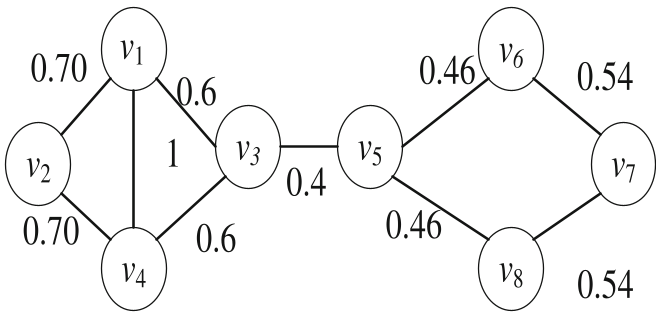 Fig 1: Example of ICMAP where seed attempts to activate neighbors with varying success rates.
Mathematical Elegance: Submodularity
The beauty of this work lies in the proof that the objective function (Total Profit - Cost) satisfies Monotonicity and Submodularity.
- Why does this matter? It means that while the problem is NP-hard, a simple Greedy Algorithm can achieve an approximation of , roughly 63% of the optimal solution. The authors further improved this by estimating influence over a fixed time horizon () to bypass expensive Monte-Carlo simulations.
Experimental Results
The authors tested their approach on real-world datasets like ca-HepTh and ca-GrQc.
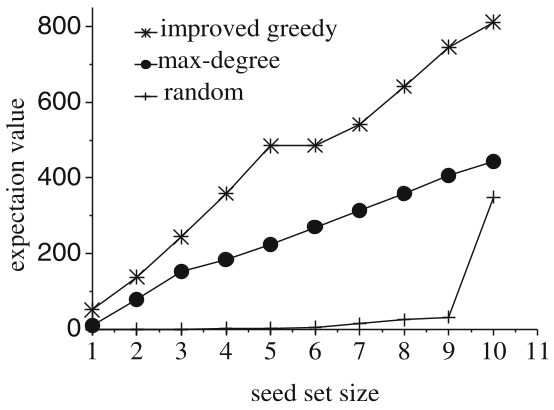 Fig 2: Comparative analysis showing the Improved Greedy Algorithm (Red) consistently outperforming Max-Degree and Random seeds.
Key Findings:
- Effectiveness: The greedy approach scales better because it avoids "clustering" seeds, unlike the Max-Degree heuristic which often picks highly-connected nodes that are too close to each other.
- Profit Correlation: As the association strength () between products increases, the total influence spread grows non-linearly, proving that cooperative marketing is more efficient than separate campaigns.
Critical Analysis & Conclusion
Takeaway
This paper bridges the gap between Data Mining (Association Rules) and Network Science (Influence Maximization). For marketers, it suggests that "influencer" selection should change depending on the product mix being promoted.
Limitations
- Computational Complexity: Even with the improved greedy algorithm, large-scale networks with millions of nodes remain a challenge.
- Static Probabilities: The model assumes (acceptance probability) is static, whereas in reality, it might change based on how many friends have already bought the product (Social Proof).
Future Work
The authors point toward Distributed Computing (Spark) as the next step to handle massive datasets. Integrating temporal dynamics—how influence decays over time—would also be a significant step forward in making this model "production-ready" for platforms like WeChat or Twitter.