
Beyond One-Off Clicks: Maximizing Cumulative Influence in the Era of Repeated Consumption
Maximizing the Cumulative Influence through a Social Network when Repeat Activation Exists
This paper introduces the Cumulative Influence Maximization (CIM) problem, a novel task that accounts for repeated user activations (e.g., recurring purchases) in social networks. Leveraging the Voter Model framework, the authors propose the ExactSolution algorithm, which achieves optimal influence selection with tractable computational complexity.
TL;DR
Classic Influence Maximization (IM) assumes a user is a "one-and-done" target. Once they buy a product, they are "active" and the job is finished. This paper by Zhou et al. challenges this by introducing Cumulative Influence Maximization (CIM). Using the Voter Model, they provide a mathematical bridge to model repeated activations (like daily coffee runs or monthly subscriptions) and offer an "ExactSolution" that identifies the best seeds for maximum long-term profit.
Academic Positioning: This work moves away from the NP-hard complexity of Independent Cascade (IC) models toward a more tractable, matrix-based approach for recurring viral marketing.
The Problem: The "Once-Active" Fallacy
In the literature of viral marketing, we usually assume that if a friend influences you to buy a phone, you've been "captured." But what about products like toothpaste, cigarettes, or video game microtransactions?
Existing models (IC and LT) are limited because:
- State Persistence: They assume once you are active, you stay active forever.
- No Re-activation: They cannot quantify the value of a user who "buys again and again."
- Complexity: They are often NP-hard, requiring greedy approximations that are computationally expensive for large graphs.
The authors argue that the total volume of activations is a better metric for real-world ROI than simple reach.
Methodology: The Power of the Voter Model
To handle the "back-and-forth" nature of human behavior, the authors utilize the Voter Model. Unlike IC models where edges "fire" once, the Voter Model allows a node to be activated at step based on its neighbors' states at step .
1. The Mathematical Intuition
The core insight is that cumulative influence—the expected total number of activations over steps—can be expressed as a summation of state probabilities. By representing the network as a weight matrix , the authors prove that:
This means the influence is not just a random simulation; it is a convergent series. If the time horizon is infinite, this simplifies beautifully into a matrix inversion: .
2. The ExactSolution Algorithm
Because the cumulative influence of a seed set is simply the sum of the influences of individual nodes (a property derived from the linear nature of the Voter Model), we don't need a greedy search. We simply compute a "Score" for every node and pick the Top-K.
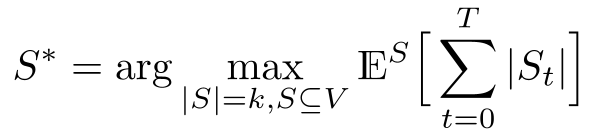 Figure 1: The Objective Function for Cumulative Influence.
Experiments: Superior Quality at a Reasonable Cost
The authors tested their approach on datasets ranging from Facebook (4k nodes) to Epinions (51k nodes).
Key Findings:
- Performance: ExactSolution consistently beat PhaseRank and Degree-based methods. While PageRank is a decent approximation, it misses the nuances of repeated propagation over specific time horizons.
- Convergence: The cumulative influence stabilizes quickly. The difference between a limited time and is mathematically bounded, making the model robust for "short-term campaigns" (e.g., marketing ice cream in summer).
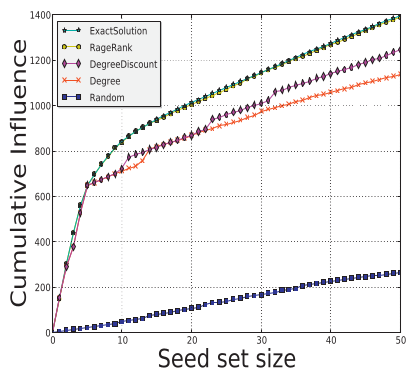 Figure 2: Performance on Facebook and Digger datasets showing ExactSolution leading the pack.
Efficiency:
While heuristic methods like "Degree" take sub-second time, they produce sub-optimal seeds. ExactSolution takes about a minute for a 50k-node graph—a very acceptable trade-off for the leap in accuracy.
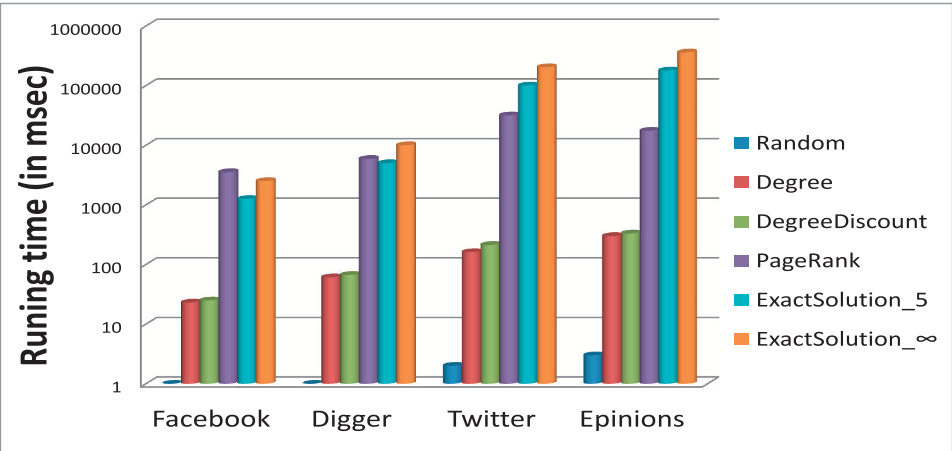 Figure 3: Runtime across different datasets. ExactSolution spans the 10-100s range, making it highly practical.
Critical Insight & Conclusion
This paper is a vital reminder that the model chosen for the social dynamics dictates the complexity of the optimization. By switching to a Voter Model, the authors turned a notoriously "hard" problem (IM) into a "tractable" one (CIM), while arguably making it more realistic for the consumer goods industry.
Limitations: The model assumes we know the edge weights perfectly. In reality, edge weights are latent and must be inferred from historical data, which remains a massive challenge.
Final Takeaway: If your business model relies on retention and repeat purchases rather than a one-time acquisition, stop using standard IM algorithms. Focus on Cumulative Influence via the Voter Model.