
Maximizing Innovation Diffusion: Why Strategic Seeding Beats Pure Influence
On Maximizing Diffusion Speed Over Social Networks With Strategic Users
This paper investigates how to maximize the diffusion speed of innovations in social networks where users make strategic, rational choices under a game-based model (logit dynamics). The authors propose the PrPaS (Practical Partitioning and Seeding) algorithm, achieving near-optimal performance across Erdős-Rényi, planted partition, and geometric graphs, significantly reducing convergence time compared to traditional influence maximization methods.
In the realm of social networks, understanding how a new technology or behavior spreads is more than just a marketing challenge—it is a complex mathematical puzzle. While most literature focuses on "Epidemic Models" (where nodes infect each other like a virus), this paper explores the Game-Based Model. Here, users are rational actors: they only adopt an innovation if it provides more utility than the status quo, typically depending on how many of their neighbors have already made the switch.
TL;DR
The study shifts the focus from how many people adopt an innovation to how fast they do it. By utilizing the theory of meta-stability in Markov chains, the authors developed PrPaS (Practical Partitioning and Seeding). This algorithm outperforms traditional degree-based strategies by identifying and "fixing" the architectural bottlenecks (clusters) that slow down the coordination game.
The Core Conflict: Epidemic vs. Strategic Diffusion
In an epidemic model (Independent Cascade), the primary goal is reaching a critical mass. In a strategic coordination game, the system will eventually reach equilibrium where everyone adopts, but the hitting time (the time it takes to reach that state) can be exponentially long.
The authors identify a critical insight: The diffusion speed is governed by "Energy Barriers." High-degree nodes (the usual targets for influencers) aren't always the best seeds. In strategic games, these nodes might be deeply embedded in clusters that are resistant to change due to internal coordination.
Methodology: Breaking the Energy Barrier
The authors tackle three distinct graph topologies, proving that "optimal" seeding changes fundamentally with network structure:
- Erdős-Rényi (Globally Connected): If the network is dense and symmetric, specialized seeding is unnecessary. Any random set of seeds works almost as well as the optimum.
- Planted Partition (Large Communities): Diffusion is dominated by intra-cluster inertia. The strategy here is proportional allocation—distributing seeds based on the size of the communities.
- Geometrically Structured (Small, Local Clusters): Diffusion is slowed by "inter-cluster correlation." The strategy shifts to seeding the boundary nodes to decouple the clusters.
The PaS Framework
The proposed Partitioning and Seeding (PaS) algorithm follows a two-step logic:
- Phase 1 (Partitioning): Divide the graph into a separator set (inter-cluster nodes) and individual clusters.
- Phase 2 (Seeding): Iteratively add seeds to the "slowest" cluster until the budget is spent.
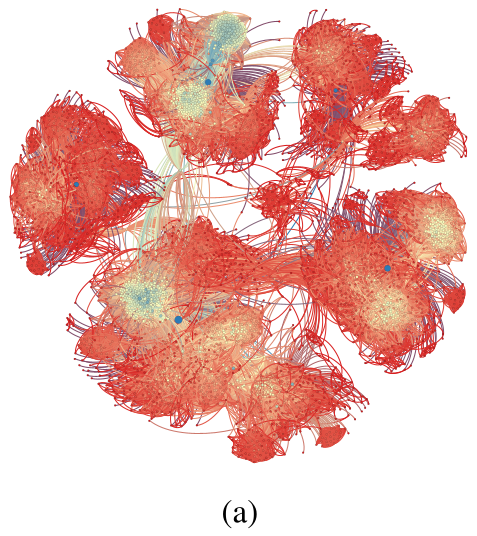 Figure 1: Comparison of network structures and the visual bottleneck that partitioning aims to resolve.
Experimental Results: The Failure of Degree-Based Seeding
One of the most provocative findings is that Degree-based seeding often performs the worst in real-world networks (like Facebook ego-networks).
While a high-degree node has many neighbors, in a coordination game, those neighbors are also influencing the node to stay with the "old" technology. By contrast, PrPaS achieves a "Phase Transition"—a point where adding just a few more seeds causes the diffusion time to collapse from nearly infinite to practically instant.
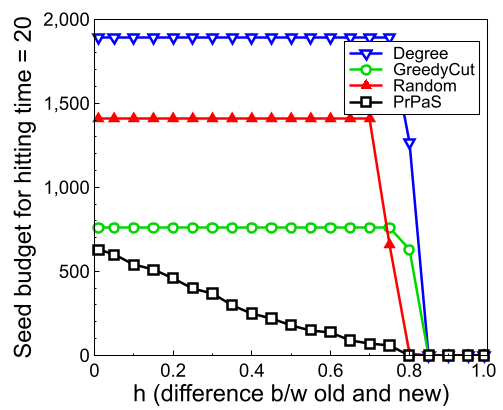 Figure 2: Performance comparison on Facebook networks. Note how PrPaS (orange line) maintains the lowest seed budget threshold as the technology gap (h) increases.
Critical Insights & Conclusion
The value of this research lies in its move away from submodular optimization (typical of influence maximization) towards a structural bottleneck analysis.
Takeaways for Strategy:
- Don't just hunt for "Influencers": Look for community boundaries. Seeding nodes that bridge different groups is often more effective than seeding the "hub" of a single group.
- Topology Matters: High connectivity can actually slow down diffusion in a strategic game because it increases the "coordination cost" of switching.
- Scalability: The PrPaS algorithm uses random-walk-based partitioning, making it computationally feasible for massive social graphs.
Limitations: The model assumes users have "bounded rationality" (logit dynamics). In scenarios where users are either perfectly rational or completely irrational, the phase transition thresholds might fluctuate more unpredictably than the theory suggests.