
ComPBRA: Optimizing ROI in Incentivized Social Networks through Community Intelligence
Maximizing the earned benefit in an incentivized social networking environment: a community-based approach
This paper introduces the Earned Benefit Maximization (EBM) problem, a variant of Social Influence Maximization (SIM) that incorporates non-uniform node selection costs, targeted users, and varying benefit values under a fixed budget. The authors propose PBRA (Priority-Based Ranking Algorithm) and its enhanced version, ComPBRA, which leverages network community structures to achieve superior benefit outcomes across real-world social datasets.
TL;DR
Social Influence Maximization (SIM) has evolved from simple "node counting" to a complex financial optimization problem. This paper tackles the Earned Benefit Maximization (EBM) problem, where every seed node costs money, and only specific "target nodes" generate revenue. The authors introduce ComPBRA, a community-aware ranking algorithm that intelligently distributes a marketing budget across social clusters, outperforming traditional scripts by up to 28% in earned benefit with minimal computational cost.
Problem & Motivation: Beyond "Influence for Influence's Sake"
Most classical influence maximization research operates under a flawed assumption: that all users are free to activate and all influenced nodes are equally valuable. In reality:
- Incentive Demands: Influential users (seeds) often require incentives/payments that vary based on their status.
- Targeted Marketing: Companies don't want to influence everyone; they want to influence potential customers (target nodes) who provide actual "benefit" or revenue.
- Budget Constraints: Marketing budgets are finite.
Prior work like Budgeted Influence Maximization (BIM) addressed costs but ignored the non-uniform value of target users. The authors bridge this gap by treating social networks as incentivized environments where the goal is to maximize the "Earned Benefit" rather than just the number of active nodes.
Methodology: The Power of Priority and Communities
1. The Priority-Based Ranking (PBRA)
The core of the approach is a unique Priority Function designed to rank potential seed nodes. It moves beyond simple "degree centrality" by incorporating:
- Expected Earned Benefit (): Recursive calculation of the benefit a node can reach within hops (the "influence zone").
- Cost-Effectiveness: Dividing the potential benefit by the selection cost ().
- In-Degree Dampening: High in-degree nodes are likely to be influenced by others for free; therefore, they receive lower priority as paid seeds.
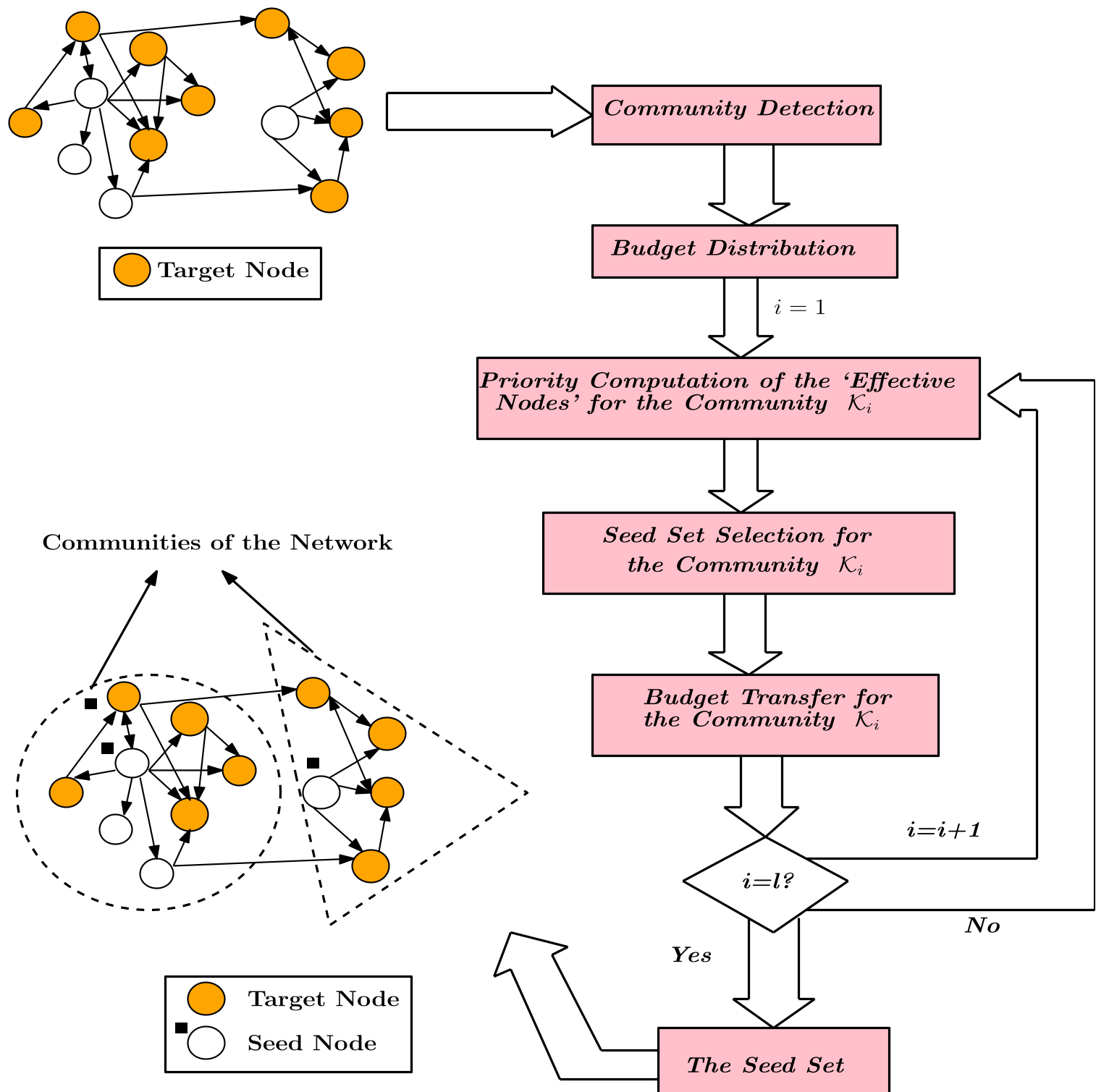
2. Leveraging Community Structure (ComPBRA)
The breakthrough comes from the observation that social networks are not homogeneous. The authors transform the global problem into a multi-community optimization task:
- Budget Distribution: The total budget is split using a "blending factor" () that weights a community's cost versus its potential benefit.
- Budget Transfer: If a community has leftover budget (e.g., no more effective nodes to buy), the surplus is transferred to the most connected neighboring community to maximize spillover effects.
Experimental Results: High Efficiency, Higher Returns
The authors tested their methodology on three iconic datasets: Facebook (social), HEP (collaboration), and Epinions (trust).
Key Findings:
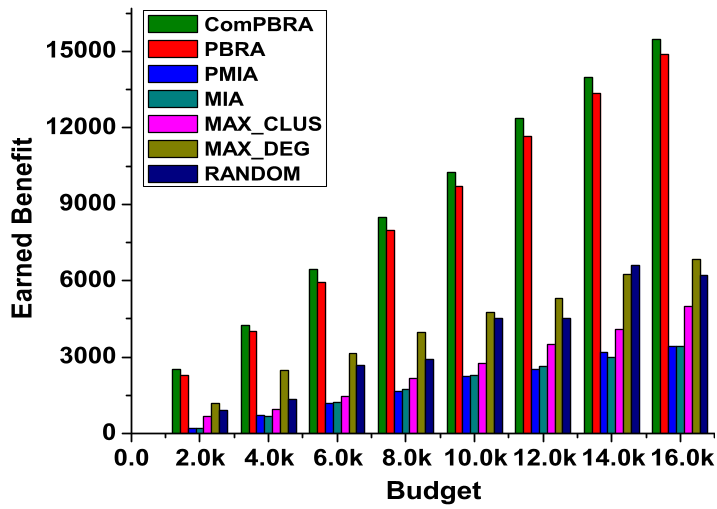
- Substantial Benefit Gains: On the HEP dataset, ComPBRA achieved ~28% more benefit than PMIA (a high-performance heuristic). In tri-valency settings, the gap widened further, showing the robustness of the community-based approach in uncertain environments.
- Scalable Execution: Despite the complexity of the e-commerce dataset (Epinions), ComPBRA completed its seed selection in under 5 seconds, proving it is ready for real-world, large-scale applications.
- Ablation Proof: The results clearly show that
ComPBRA > PBRA > Baseline, validating that leveraging community structures is the key to breaking the scalability bottleneck of greedy algorithms.
Critical Analysis & Conclusion
The EBM problem is a vital step toward making Social Influence Maximization practically useful for CMOS and marketing agencies. By treating the network as a set of interacting communities rather than a monolithic graph, ComPBRA manages to balance local influence with global budget management.
Limitations:
- The model assumes a static network. In reality, edge weights (influence probabilities) and user costs fluctuate over time.
- The "Budget Transfer" logic, while clever, is currently one-directional based on initial community detection results.
Future Outlook: The marriage of Game Theory and EBM could be the next frontier—modeling how users might artificially inflate their costs or how competitor brands might bid for the same influential seeds in a multi-campaign environment.
Takeaway: If you are allocating a budget for viral marketing, stop looking at global top-rankers. Start looking at the cost-benefit ratio of hubs within specific community clusters.