
OASNET: Leveraging Network Modularity for Optimal Influence Maximization
Maximizing influence spread in modular social networks by optimal resource allocation q
This paper introduces OASNET (Optimal Allocation in a Social NETwork), a framework that reformulates the Influence Maximization (IM) problem as an optimal resource allocation task across modular communities. By leveraging the topological property of network modularity, the authors use dynamic programming to distribute seed nodes among sub-communities, achieving superior spread performance in Independent Cascade models.
Executive Summary
Influence Maximization (IM)—the art of selecting seed nodes to trigger the largest possible "viral" spread—is a cornerstone of viral marketing and epidemic control. However, the classic greedy approach is often too slow for massive networks, and simple heuristics like "pick the most popular people" often backfire due to overlap.
In this paper, the authors present OASNET (Optimal Allocation in a Social NETwork). Instead of treating the network as a single giant entity, they view it as a collection of modules (communities). By transforming the problem into an Optimal Resource Allocation task, they use dynamic programming to decide exactly how many seeds each community deserves. This approach achieves state-of-the-art (SOTA) results, particularly when the diffusion probability is high enough to trigger "phase transitions" within communities.
The Problem: The High Cost of Greed and Hub Blindness
The gold standard for IM has long been the Greedy Hill Climbing algorithm. While it guarantees a approximation, its complexity——is a dealbreaker for modern social networks with millions of edges.
More importantly, existing heuristics often ignore Modularity. Real social networks aren't random; they are composed of dense clusters with sparse connections between them. If you blindly pick the top-10 high-degree nodes, you might end up picking 10 people who are all in the same "friend group," wasting your seeds on redundant influence.
Methodology: From Influence to Resource Allocation
The core insight of the paper is a shift in perspective: Influence Maximization is actually a Knapsack-style optimization problem.
1. The Strategy
The authors assume the network is composed of communities . If these were disconnected, the total spread would simply be the sum of local spreads: where is the number of seeds allocated to community .
2. The Algorithm (OASNET)
To solve this, they use Dynamic Programming (DP). The recursive relationship is defined as: This allows the algorithm to decide, for example, that giving 3 seeds to a small but "efficient" community is better than giving 10 seeds to a large community that has already reached its saturation point.
Experiments and Insights
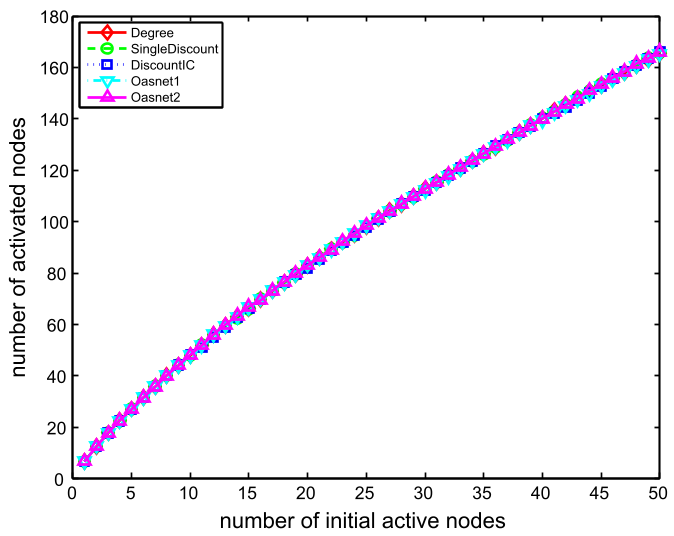
The authors tested OASNET on three major co-authorship datasets. They compared it against High Degree and Degree Discount heuristics.
The "Percolation" Threshold
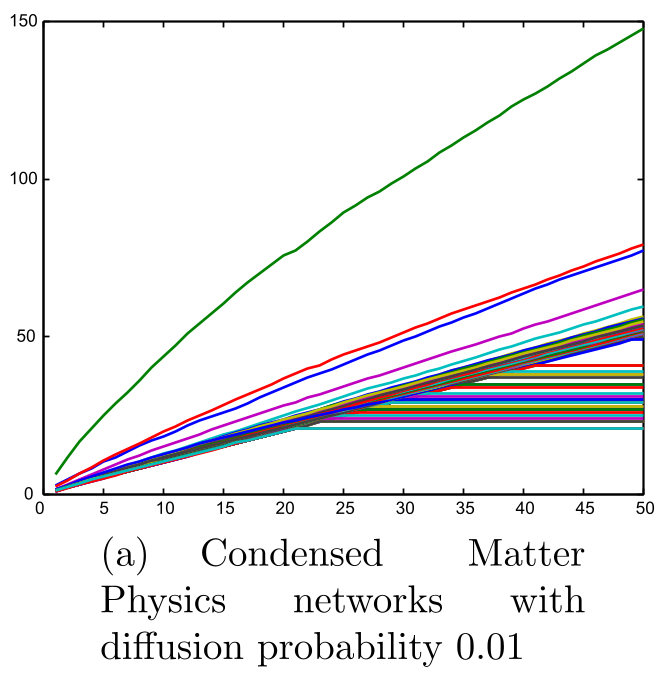
A fascinating discovery was that OASNET's advantage is most pronounced when the diffusion probability () is high (e.g., ).
- At low : Spread is localized. The growth function is smooth, and simple heuristics perform similarly to DP.
- At high : Communities reach a Percolation Stage. One seed might activate almost the entire community. In this scenario, adding a second seed to the same community is a waste. OASNET detects this "saturation" via the growth function and shifts the remaining seeds to other communities.
Critical Analysis & Conclusion
Takeaway
OASNET proves that global optimality can be built upon local sub-optimality. By understanding how a single community "grows" in response to seeds, we can allocate resources across a massive network far more effectively than any global heuristic.
Limitations
- Disconnectivity Assumption: The model assumes communities are disconnected or weakly connected. In highly dense or "flat" networks without clear modularity, the benefits of OASNET diminish.
- Community Detection Dependency: The performance is tied to the quality of the underlying community detection algorithm (e.g., Clauset-Newman-Moore).
Future Work
The authors suggest extending this to Temporal Networks, acknowledging that social ties are not static. In the age of real-time social media, adapting seed allocation as communities form and dissolve is the next frontier for viral marketing.